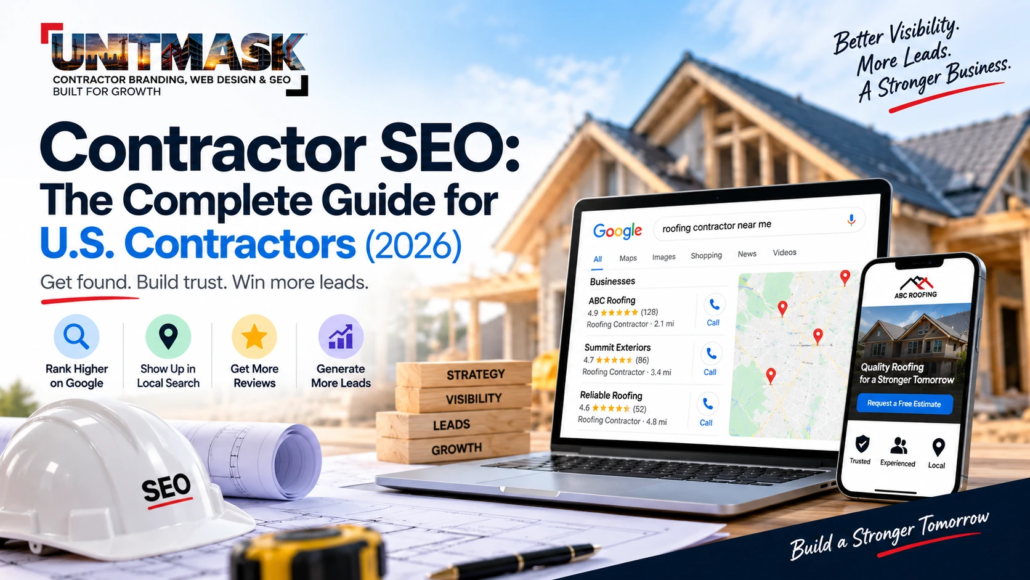
Contractor SEO: The Complete Guide for U.S. Contractors in 2026
Contractor SEO guide for U.S. contractors in 2026. Learn how to rank higher on Google, improve local SEO, and generate more qualified leads.
A homeowner needs a roofer.
A property manager needs an HVAC contractor.
A developer needs a concrete company.
A homeowner wants to remodel a kitchen.
What do many of them do first?
They search Google.
Queries like:
“roofing contractor near me”
“kitchen remodeling contractor in Dallas”
“HVAC company near me”
“concrete contractor in Phoenix”
“best general contractor in Austin”
If your construction company doesn’t appear when potential customers make searches like these, those leads are going somewhere else.
That’s why contractor SEO matters.
Search engine optimization can help your construction business appear in Google Search and local results when homeowners, property managers, developers, and other potential customers are actively looking for the services you provide.
This guide explains how contractor SEO works in 2026, what you should optimize, what mistakes to avoid, and how to build an SEO strategy designed to generate qualified local leads.
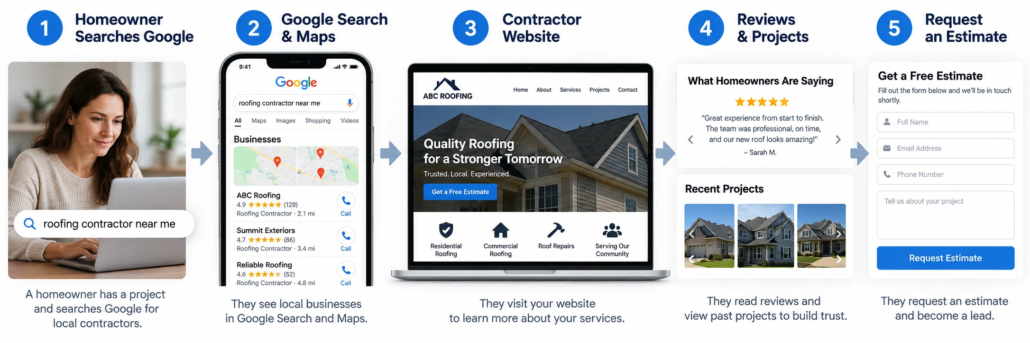
What Is Contractor SEO?
Contractor SEO is the process of improving a contractor’s website and online presence so the business can appear more prominently when potential customers search for relevant construction services.
For example, a roofing company in Dallas may want to appear for searches such as:
- roofing contractor Dallas
- roof repair Dallas
- commercial roofing Dallas
- roofing company near me
A remodeling contractor may target:
- kitchen remodeling contractor
- bathroom remodeling company
- home remodeling contractor
- home renovation company near me
The objective isn’t simply to generate more website traffic.
The real goal is to attract people who are already searching for the services your company provides.
For most contractors, that means focusing on three major areas:
Google Search + Google Maps/local visibility + a website built to convert visitors into estimate requests.
Why SEO Matters for Contractors in 2026
Contractor marketing is highly local.
A contractor doesn’t necessarily need thousands of visitors from across the country.
You need the right potential customer in the right service area searching for the right service.
Someone searching:
“bathroom remodeling contractor in Tampa”
is significantly more valuable to a Tampa remodeling company than someone casually browsing home improvement content.
SEO allows contractors to build visibility around these high-intent searches.
A strong SEO strategy can help your company:
- appear when customers search for your services;
- increase visibility across your service areas;
- generate qualified website visitors;
- strengthen your credibility before a homeowner contacts you;
- reduce dependence on shared-lead platforms;
- build a long-term source of inbound opportunities.
Unlike a lead marketplace where several contractors may receive the same inquiry, organic search can send a potential customer directly to your business.
How Contractor SEO Works
Contractor SEO is not one optimization.
Think of it as a system.
A strong contractor SEO strategy typically combines:
Keyword Research → Website Structure → On-Page SEO → Local SEO → Google Business Profile → Service Area Pages → Content → Reviews → Authority → Conversion Optimization
If one part is weak, the entire system may produce weaker results.
Let’s break it down.
1. Start With Contractor Keyword Research
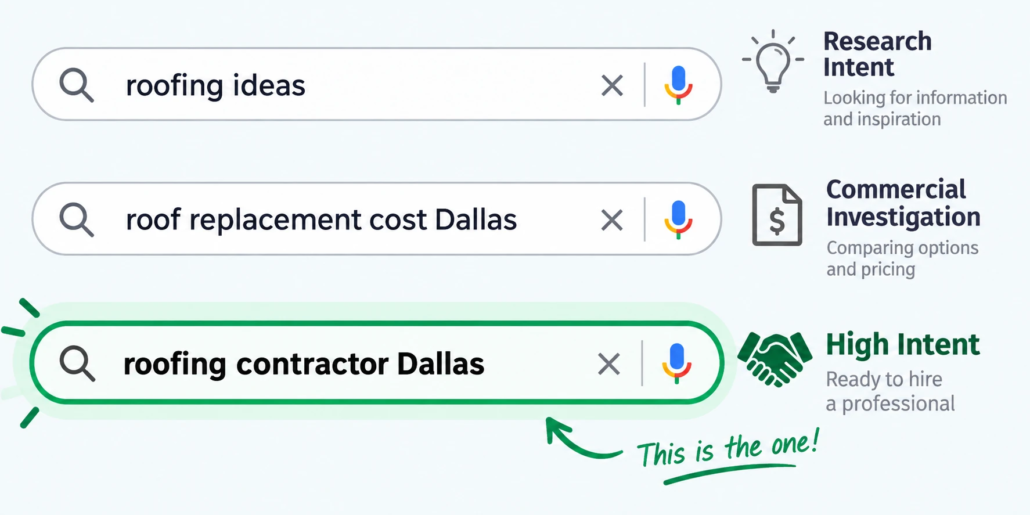
Search intent becomes stronger as homeowners move from researching roofing ideas to searching for a local roofing contractor in Dallas.
SEO starts by understanding what your potential customers actually search for.
Contractors sometimes target broad terms such as:
construction company
But broad keywords don’t always reveal enough intent.
Compare that with:
commercial roofing contractor Dallas
or:
bathroom remodeling contractor Austin TX
These searches tell you much more about:
Service + Location + Intent.
For contractors, some of the most valuable keyword patterns are:
Service Keywords
Examples:
- roofing contractor
- kitchen remodeling contractor
- HVAC contractor
- concrete contractor
- excavation contractor
- plumbing company
- electrical contractor
- general contractor
Service + Location Keywords
Examples:
- roofing contractor Dallas TX
- remodeling contractor Tampa FL
- concrete contractor Phoenix AZ
- HVAC contractor Denver CO
Problem-Based Keywords
Examples:
- leaking roof repair
- foundation crack repair
- AC not cooling
- water heater replacement
- sewer line repair
Commercial-Intent Keywords
Examples:
- commercial roofing contractor
- commercial HVAC contractor
- commercial concrete company
- construction company for retail buildout
The closer a keyword is to a real service you provide and a location you actually serve, the more useful that keyword may be to your business.
2. Build the Right Contractor Website Structure
One of the biggest SEO problems we see with contractor websites is trying to rank one page for everything.
For example, a contractor may have one Services page containing:
Roofing
Siding
Gutters
Windows
Storm Damage
That’s convenient for building a small website.
It isn’t necessarily the strongest structure for organic search.
Instead, important services should usually have dedicated pages when there is enough unique information to justify them.
For example:
Homepage
→ Roofing
→ Roof Repair
→ Roof Replacement
→ Commercial Roofing
→ Storm Damage Repair
→ Service Areas
This gives each important service a dedicated page that can address the customer’s specific problem, questions, projects, trust signals and next step.
Your site architecture should also make important pages easy for users and search engines to discover.
3. Optimize Every Contractor Service Page
Creating a page called “Roofing Services” isn’t enough.
Each important service page should clearly answer:
What do you do?
Who do you help?
Where do you provide the service?
Why should someone choose your company?
What should the visitor do next?
A strong contractor service page can include:
Clear H1
Example:
Residential Roof Replacement in Dallas, TX
Strong Opening Section
Explain the service, target customer and area served.
Relevant Service Details
Explain what the service includes rather than filling the page with generic SEO copy.
Project Photos
Show real work whenever possible.
Trust Signals
Consider adding:
- years of experience;
- licenses where applicable;
- insurance information;
- certifications;
- warranties;
- customer reviews;
- completed projects;
- industry associations.
FAQs
Answer questions prospects commonly ask before requesting an estimate.
Clear CTA
Examples:
Request a Free Estimate
Schedule a Consultation
Get a Roofing Estimate
Your page should satisfy the searcher’s question while making the next step obvious.
4. Optimize Your Google Business Profile
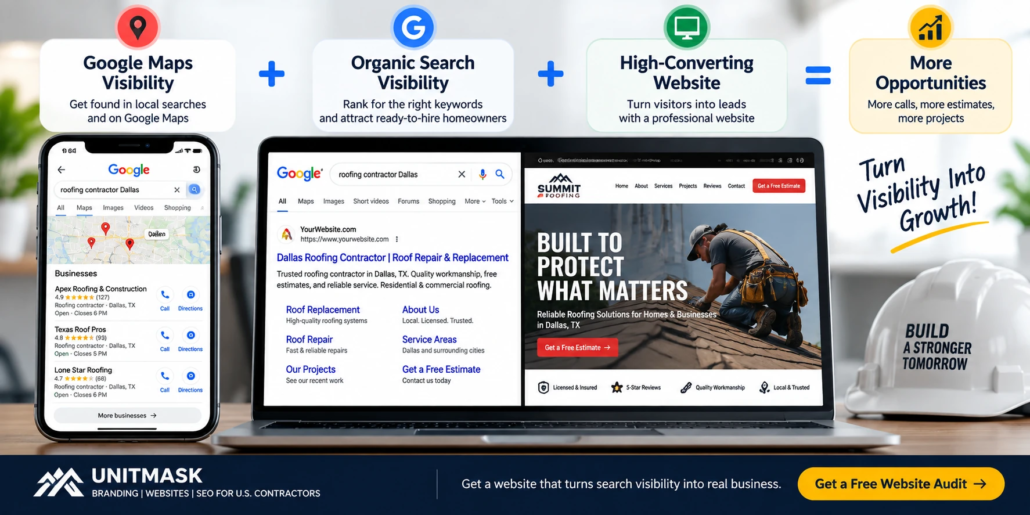
Strong contractor SEO connects Google Maps visibility and organic search rankings with a professional website that converts homeowners into leads.
For local contractors, your Google Business Profile can be an important part of your search presence.
A homeowner searching for a contractor may encounter local businesses before traditional organic results.
Make sure your profile contains complete and accurate information, including the appropriate business category, contact details, hours and other applicable information.
You should also develop a consistent process for earning genuine customer reviews and adding useful photos that demonstrate your work.
Your website and Google Business Profile should reinforce each other.
5. Build Service Area Pages the Right Way
If you serve multiple cities, service area pages can help explain where your company operates.
For example, a Dallas-area contractor might genuinely serve:
Dallas
Plano
Frisco
McKinney
Arlington
You may create useful pages for important service areas when you have enough relevant, location-specific information to make each page valuable.
But avoid creating dozens of pages where only the city name changes.
A useful location page can contain:
- services available in that location;
- relevant projects;
- neighborhoods or areas served;
- testimonials from customers in that market;
- locally relevant project information;
- photos;
- FAQs;
- contact or estimate CTA.
Each page should exist because it helps a potential customer—not simply because you want another keyword indexed.
How to Create Contractor Service Area Pages That Rank on Google — Without Duplicate Content
6. Optimize for “Near Me” Searches
Searches like:
roofer near me
HVAC contractor near me
general contractor near me
plumber near me
can represent valuable local intent.
But adding “near me” dozens of times to your website isn’t the strategy.
Local visibility depends on Google’s ability to understand your business, services, location/service area and prominence.
Your broader local SEO strategy should therefore include:
- a properly maintained Google Business Profile;
- accurate business information;
- relevant service pages;
- clear geographic information;
- genuine customer reviews;
- useful local content;
- strong website architecture;
- local authority and mentions where appropriate.
7. Create Content Around Real Customer Questions
A contractor blog shouldn’t exist just because someone said publishing every week improves SEO.
Create content that supports your potential customer’s buying journey.
A roofing contractor might publish:
- How Much Does Roof Replacement Cost?
- Repair vs. Replace: Which Does Your Roof Need?
- How Long Does Roof Replacement Take?
- Signs Your Roof Needs Replacement
- What Happens During a Roof Inspection?
An HVAC contractor could publish:
- How Much Does HVAC Replacement Cost?
- Repair or Replace Your AC?
- Why Is My AC Running But Not Cooling?
- How Long Does an HVAC System Last?
These articles can capture earlier-stage searches and guide users toward your commercial service pages.
Think of your website as a topic cluster:
Contractor SEO Pillar
↓
Local SEO
↓
Google Business Profile
↓
Service Area Pages
↓
Google Reviews
↓
Near Me Rankings
↓
Lead Generation
Each supporting article should help users move naturally to the next relevant resource.
8. Build a Contractor Review Strategy
Reviews serve two important purposes.
First, they help prospective customers evaluate your company.
Second, Google states that review count and positive ratings can contribute to local prominence.
Don’t wait until you suddenly need more reviews.
Build review requests into your normal project workflow.
For example:
Project Completed → Customer Follow-Up → Review Request → Respond to Review
Never make the process complicated.
Give satisfied customers a direct path to leave feedback.
And respond professionally to reviews—including critical ones.
How to get more Google reviews for your construction business
9. Improve Your Contractor Website’s Technical SEO
Great content won’t reach its potential if your website has major technical problems.
Contractors should pay attention to fundamentals such as:
Mobile Usability
Homeowners frequently research contractors on phones.
Your site should be easy to navigate without zooming, hunting for buttons or struggling with forms.
Page Performance
Large project photos, videos, sliders and plugins can make construction websites unnecessarily heavy.
Compress images and avoid loading assets you don’t need.
HTTPS
Your website should use a secure HTTPS connection.
Crawlability
Important pages should be accessible through crawlable links.
XML Sitemap
Maintain a sitemap that helps search engines discover relevant URLs.
Indexing
Make sure important pages aren’t accidentally blocked by noindex, robots directives or other settings.
Canonicalization
Use canonical URLs correctly where duplicate or highly similar URLs exist.
Broken Links
Regularly check for broken internal and external links.
Structured Data
Use applicable structured data when it accurately represents the content and business.
Technical SEO doesn’t replace good content.
It helps search engines access and understand the good content you’ve already created.
10. Use Internal Linking Strategically
Internal links connect related pages across your website.
Suppose you publish an article about:
How Much Does a New Roof Cost in Dallas?
That article could naturally link to your:
Dallas Roofing Service
and:
Roof Replacement Service
pages.
Likewise, your main roofing service page can link to useful informational guides.
This creates logical relationships between topics.
A contractor website shouldn’t look like dozens of isolated pages.
It should function as an interconnected resource.
Use descriptive anchor text instead of repeatedly using vague phrases such as:
click here
For example:
Better:
Learn more about local SEO for contractors.
Less descriptive:
Click here to learn more.
11. Build Authority Beyond Your Website
SEO isn’t limited to changes made on your own pages.
Google can discover information about your business from across the web.
Depending on your trade and market, legitimate authority-building opportunities might include:
- local organizations;
- construction associations;
- manufacturers;
- suppliers;
- chambers of commerce;
- sponsorships;
- community organizations;
- industry publications;
- local news;
- business partners.
Focus on earning relevant mentions and links that make sense for your actual business.
Avoid buying large quantities of low-quality links or participating in obvious link schemes.
One relevant local or industry mention can be far more meaningful than hundreds of unrelated directory links.
12. Turn SEO Traffic Into Contractor Leads
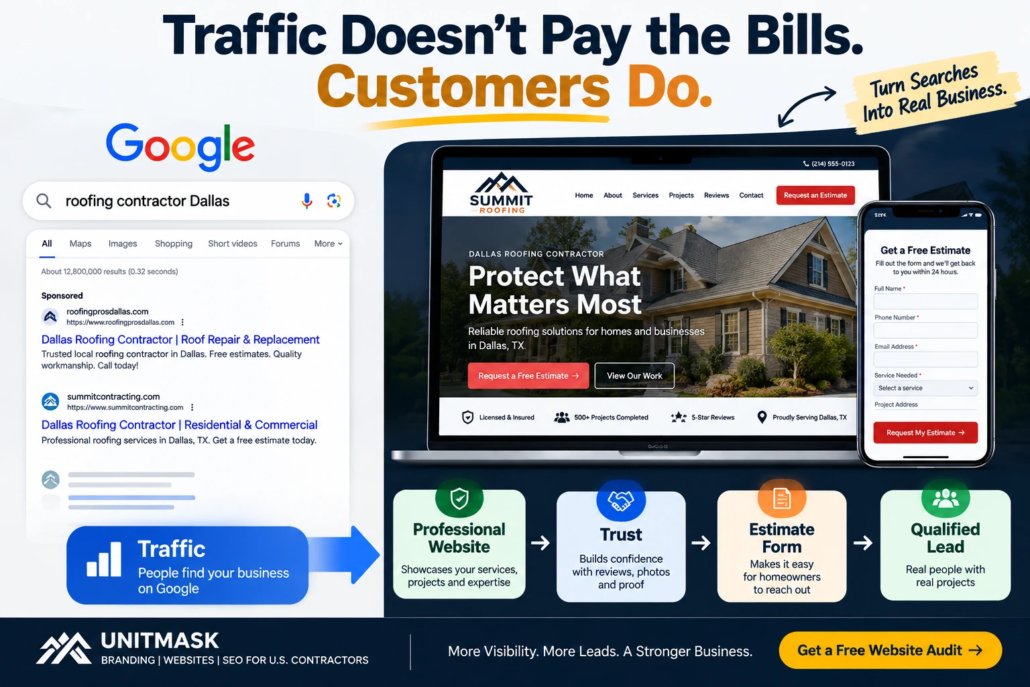
Traffic alone doesn’t grow a contracting business. SEO works best when Google visitors reach a professional website that builds trust and converts them into qualified estimate requests.
Ranking is only part of the job.
Imagine that 500 potential customers visit your website.
If they don’t understand what you do, trust your company or know how to contact you, traffic alone doesn’t help much.
That’s where SEO and conversion-focused web design meet.
Every important contractor landing or service page should make these elements easy to find:
What You Do
↓
Where You Work
↓
Why Homeowners Should Trust You
↓
Examples of Your Work
↓
Reviews / Proof
↓
Clear CTA
↓
Simple Estimate Form
Contractor SEO vs. Local SEO: What’s the Difference?
They’re closely related, but they aren’t identical.
Contractor SEO can include the entire organic search strategy:
- technical SEO;
- service pages;
- keyword targeting;
- content;
- internal linking;
- authority building;
- organic rankings.
Local SEO focuses more heavily on geographic visibility:
- Google Business Profile;
- Google Maps;
- local searches;
- reviews;
- location relevance;
- service areas;
- local authority.
For most small and midsize U.S. contractors, you need both.
Your customer doesn’t care whether they discovered you through the local pack or a traditional organic result.
They care whether you look like the right contractor for their project.
Why your construction company isn’t showing up on Google Maps
What Does a Strong Contractor SEO Strategy Look Like?
They’re closely related, but they aren’t identical.
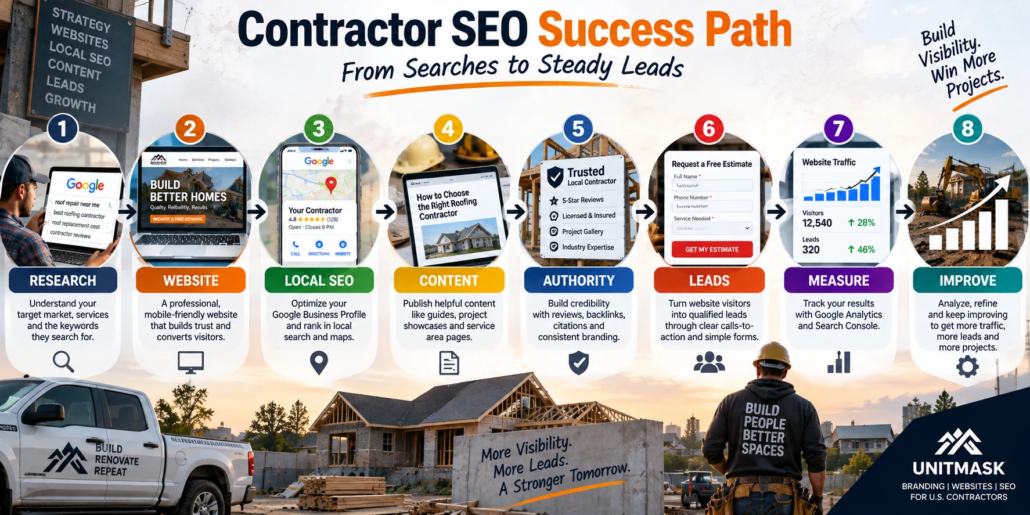
Step 1 — Research
Identify your most valuable:
Services + Locations + Customer Problems + Search Intent
Step 2 — Build
Create a logical website architecture with dedicated pages for major services.
Step 3 — Optimize
Improve titles, headings, page copy, images, internal links and conversion paths.
Step 4 — Localize
Strengthen your Google Business Profile, location signals, reviews and service area content.
Step 5 — Publish
Create useful content answering real customer questions.
Step 6 — Build Authority
Earn relevant local and industry mentions and links.
Step 7 — Measure
Track rankings, organic traffic, calls, forms and qualified leads.
Step 8 — Improve
Update pages based on actual performance rather than publishing content blindly.
Common Contractor SEO Mistakes
Even well-established construction companies can make basic SEO mistakes.
Some of the most common include:
Using one page for every service
If roofing, siding, remodeling and gutters all compete for attention on one generic page, Google and customers may struggle to understand which service the page primarily represents.
Creating dozens of duplicate city pages
Changing only the city name doesn’t make a page genuinely useful.
Ignoring Google Business Profile
For local-intent searches, your local presence can be extremely important.
Using generic website copy
Phrases such as “quality service you can trust” don’t explain why your company is different.
Having no review strategy
A contractor with strong proof may win the click even when another company appears nearby.
Publishing unrelated blog posts
Your content should strengthen your core service topics rather than chase random traffic.
Ignoring conversions
More traffic without more qualified inquiries isn’t the objective.
Expecting instant results
SEO is an ongoing process of improving relevance, authority, user experience and visibility.
What Should Contractors Measure?
Don’t judge SEO only by keyword rankings.
Track metrics that connect search visibility to business outcomes.
Useful contractor SEO KPIs can include:
Google Search impressions
Are more people seeing your business?
Organic clicks
Are searchers visiting your website?
Local visibility
Are you appearing for relevant searches in the markets you serve?
Qualified calls
Are potential customers calling?
Estimate requests
Are visitors submitting forms?
Conversion rate
What percentage of visitors become inquiries?
Lead quality
Are the inquiries actually relevant to your services?
Ultimately, the most important SEO metric isn’t traffic.
It’s whether organic search contributes to profitable projects.
Contractor SEO Checklist for 2026
Before investing heavily in SEO, make sure your foundation covers the essentials:
✓ Google Business Profile is accurate and complete
✓ Major services have dedicated pages
✓ Service areas are clearly explained
✓ Page titles and H1s describe the page accurately
✓ Website works well on mobile
✓ Important pages can be crawled and indexed
✓ Project images are optimized
✓ Customer reviews are being collected consistently
✓ Internal links connect related pages
✓ Content answers real customer questions
✓ Calls and forms are tracked
✓ Estimate CTAs are easy to find
✓ Search Console is configured
✓ Analytics is configured
✓ SEO performance is reviewed regularly
If several of these are missing, you probably have opportunities to improve your contractor’s search presence.
SEO Doesn’t Work Alone
There’s one final point contractors often overlook.
SEO can get someone to your website.
Your brand and website still have to win their trust.
A homeowner might compare three companies from the same Google search.
Contractor A has:
an outdated logo, slow website, weak project photos and no obvious CTA.
Contractor B has:
a professional identity, modern website, strong reviews, real projects and an easy estimate process.
Even if both companies offer excellent workmanship, their online presentation creates very different first impressions.
That’s why we think about contractor marketing as an ecosystem:
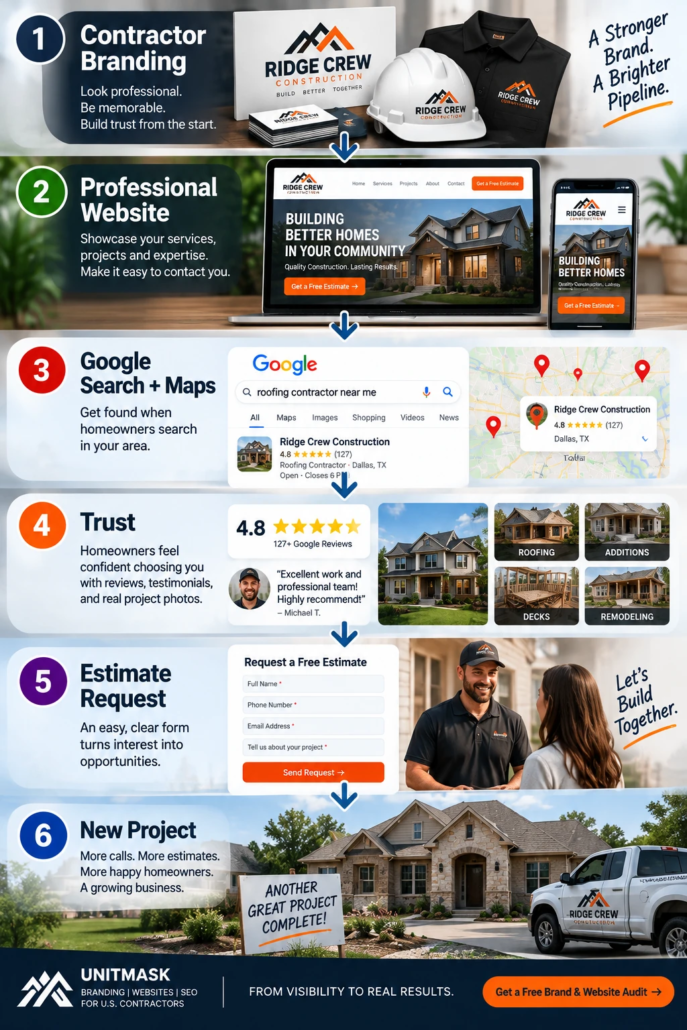
Branding → Website → SEO → Trust → Lead → Customer
SEO creates visibility.
Your brand builds credibility.
Your website turns that credibility into action.
Need More Leads From Google?
Your construction company may already have the experience, team and project portfolio customers are looking for.
The problem may simply be that they aren’t finding you—or your website isn’t turning enough of those visitors into inquiries.
At Unitmask, we help U.S. contractors improve the complete digital customer journey:
Google Search → Google Maps → Contractor Website → Trust → Estimate Request
We work across contractor SEO, website design and brand identity to build a more consistent online presence designed around generating qualified opportunities.
Find Out What’s Holding Your Contractor Website Back
Not sure where to start?
Request a Free Contractor SEO Audit.
We’ll review your current search presence, website structure, local SEO foundation and major opportunities—and show you what we’d prioritize first.
Frequently Asked Questions About Contractor SEO
What is SEO for contractors?
Contractor SEO is the process of improving a construction company’s website and online presence so potential customers can find the business when searching for relevant services on search engines such as Google.
Does SEO work for construction companies?
SEO can be an effective acquisition channel for construction companies when customers search online for the services they provide. Its effectiveness depends on factors including local demand, competition, website quality, authority and the contractor’s overall search strategy.
Is local SEO important for contractors?
Yes. Many contractor searches have local intent because customers need companies serving a specific geographic area. Local SEO helps contractors strengthen their visibility for these searches.
Should contractors create separate pages for every service?
Major services usually benefit from dedicated pages when the contractor can provide genuinely useful, unique information about each service. Avoid creating thin pages purely to target additional keywords.
Should contractors create a page for every city they serve?
Not automatically. Create location pages when you can provide meaningful information for customers in that location. Avoid mass-producing pages where only the city name changes.
How important are Google reviews for contractors?
Reviews can influence both customer trust and local search visibility. Google states that review count and positive ratings can contribute to local prominence.
How often should contractors publish blog content?
There is no universal publishing frequency required for SEO. Focus on publishing useful content that supports your services and answers genuine customer questions rather than publishing simply to meet a schedule.
How long does contractor SEO take?
There is no guaranteed timeframe. Results vary according to competition, location, website condition, authority, existing visibility and the quality of the SEO strategy.
What’s more important: SEO or Google Ads?
They serve different purposes. Paid search can generate immediate visibility while SEO is designed to build organic visibility over time. Many established contractors use both channels as part of a broader lead-generation strategy.
Can Unitmask help with contractor SEO?
Yes. Unitmask provides contractor-focused SEO, website design and branding services for U.S. construction businesses. Start with a Free Contractor SEO Audit to identify the highest-priority opportunities for your website and local search presence.