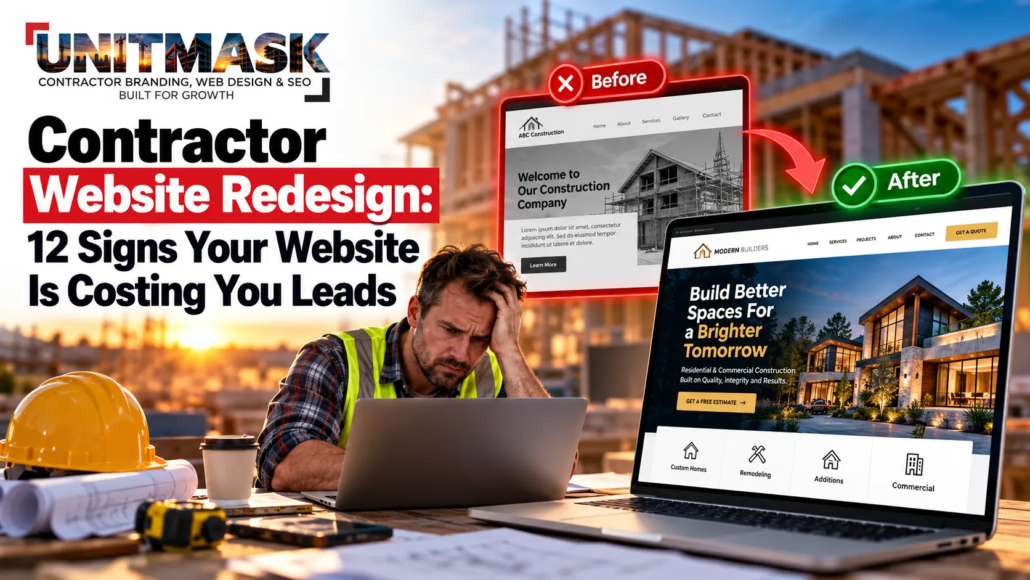
Contractor Website Redesign: 12 Signs Your Website Is Costing You Leads
Planning a contractor website redesign? Discover 12 signs your website may be costing leads and what U.S. contractors should fix first.
For U.S. contractors, that problem is bigger than an outdated design.
A website can look reasonably modern and still lose leads because it loads slowly, hides the phone number, lacks project proof, poorly explains service areas, sends visitors through a frustrating mobile experience, or gives Google too little information about the services the company actually provides.
Before spending money rebuilding everything, however, determine whether the problem is traffic, trust, conversion, structure—or a combination of them.
That distinction matters.
Does Your Contractor Website Actually Need a Redesign?
Not every underperforming contractor website needs to be rebuilt.
Sometimes the website needs better service pages.
Sometimes the problem is local SEO.
Sometimes traffic is arriving but the conversion path is weak.
And sometimes the underlying structure is so limiting that continuing to patch it is more expensive than rebuilding it properly.
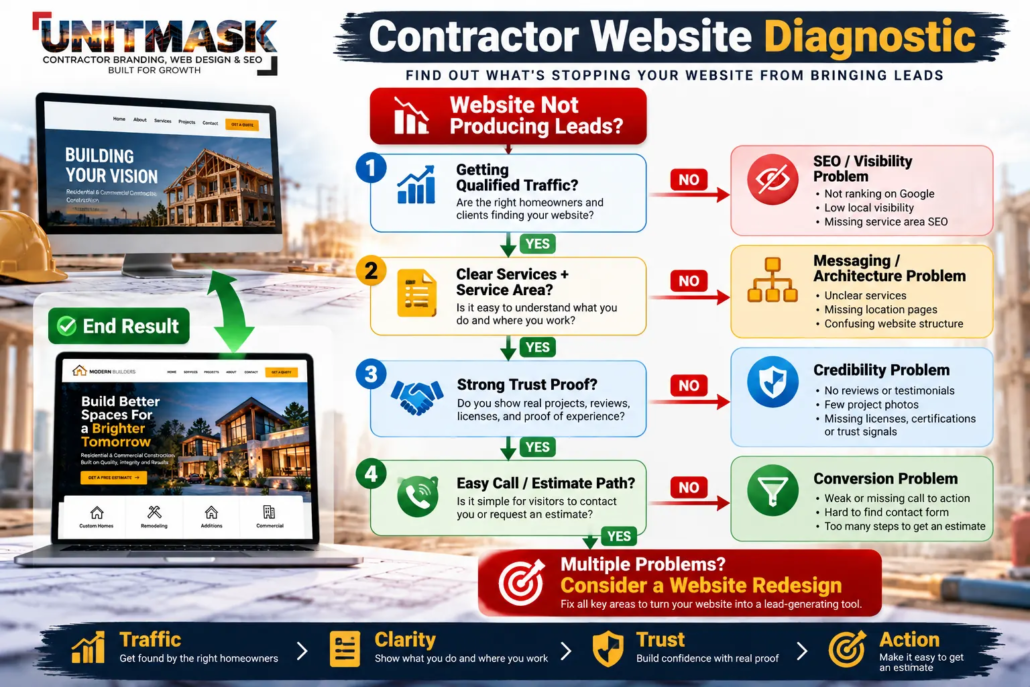
A useful diagnosis starts with four questions:
For U.S. contractors, investing in professional contractor website design helps turn online visitors into qualified leads through clear service messaging, strong trust signals, and easy estimate requests.
- Question
- Are qualified people finding the website?
- Do visitors understand your services and service area?
- Do they trust the company after viewing the site?
- Can they easily call or request an estimate?
- What It May Reveal
- SEO/traffic problem
- Messaging/structure problem
- Credibility problem
- Conversion problem
12 Signs Your Contractor Website Is Costing You Leads
1. Your Website Gets Traffic but Few Calls or Estimate Requests
Traffic without inquiries is one of the clearest signals that something between the search result and the contact action is failing.
Start by separating two situations.
Low traffic + low leads often points toward visibility, SEO, targeting or demand.
Meaningful qualified traffic + low leads points more strongly toward conversion problems.
For example, suppose a remodeling company is attracting homeowners through searches related to kitchen remodeling, bathroom renovation and whole-home remodeling. Visitors reach relevant pages but rarely call or submit an estimate request.
The problem may not be Google visibility anymore.
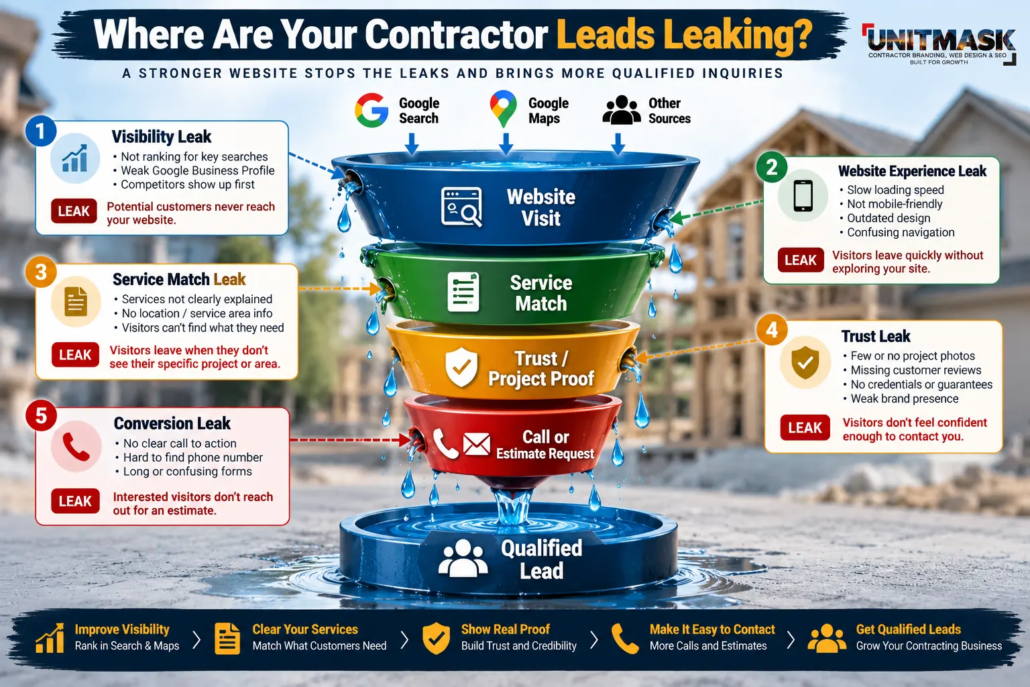
The site may be failing to answer:
- Do you serve my city?
- Have you completed projects like mine?
- Are you licensed and insured?
- What type of projects do you take?
- Why should I trust you in my home?
- What happens after I request an estimate?
A redesign should improve those answers—not merely change fonts and colors.
Contractor Lead Generation
2. Your Mobile Experience Makes It Hard to Take Action
For a local contractor, mobile usability is not optional.
Google uses the mobile version of website content for indexing and ranking, making mobile experience important for both customers and search visibility.
A homeowner may be comparing roofers from a phone after discovering a leak, researching HVAC companies when the AC stops working, or checking remodeling companies while discussing a project with their spouse.
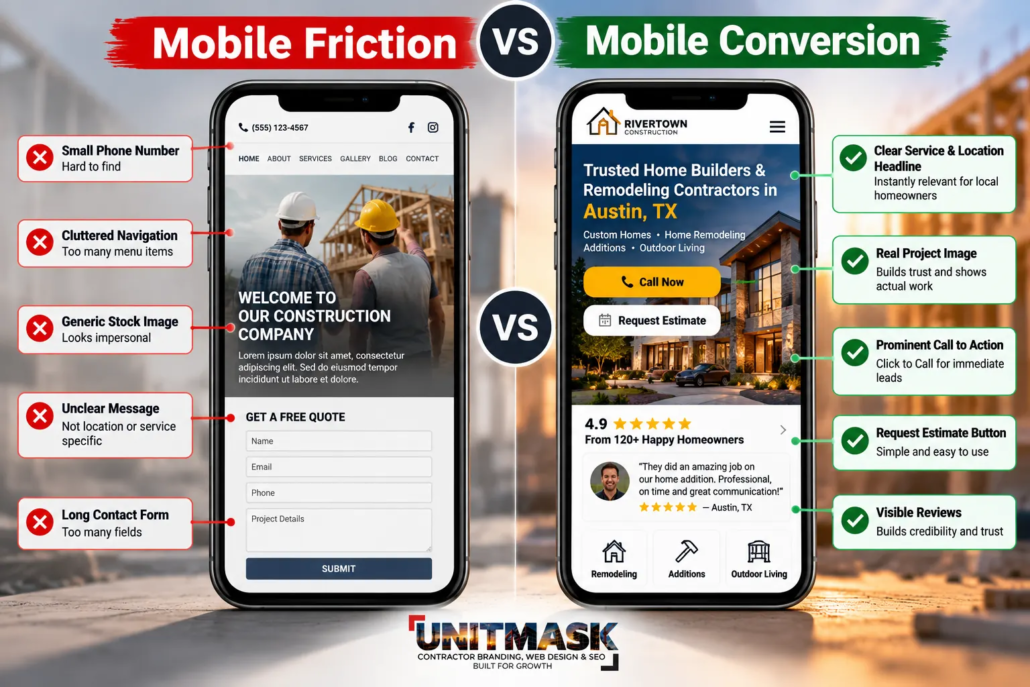
Test your website from an actual phone.
Look for:
- tiny text
- overlapping elements
- menus that are difficult to use
- buttons too close together
- forms requiring excessive typing
- project galleries that are awkward to swipe
- phone numbers that cannot be tapped
- popups covering important content
- horizontal scrolling
Your desktop website is not enough.
The contractor buying journey increasingly has to work from a thumb-sized screen.
3. Visitors Cannot Immediately Tell What You Do and Where You Work
A contractor homepage should not make prospects solve a puzzle.
Compare:
“Quality. Integrity. Excellence.”
with:
“Kitchen & Bathroom Remodeling for Homeowners Across North Dallas.”
The first sounds professional but communicates almost nothing.
The second immediately establishes service, customer and geography.
That matters because local prospects commonly compare multiple businesses before contacting one.
Your first screen should quickly establish:
What you do + where you do it + why you’re credible + what the visitor should do next.
For a roofing company, that could mean roof replacement and storm damage services in a specific metro.
For an excavation company, it might mean residential and commercial excavation across named counties.
For a custom builder, it may emphasize luxury custom homes in a defined market.
Clarity beats cleverness.
4. Your Phone Number and Estimate CTA Are Hard to Find
If someone has decided to contact your company, the website should not create another obstacle.
Contractor sites commonly bury their phone number in the footer or require users to visit a separate Contact page.
Instead, high-intent pages should offer an obvious next step.
Depending on the trade, that may include:
- Call Now
- Request an Estimate
- Schedule Service
- Discuss Your Project
- Request a Consultation
Urgent home services such as plumbing and HVAC may emphasize calling.
Custom home builders and remodelers may need a more detailed project inquiry.
The conversion path should match the type and value of the job.
Not Sure Where Your Website Is Losing Leads?
Get a contractor-focused review of your website’s mobile experience, trust signals, service structure and lead path before deciding whether you need a full redesign.
5. Your Website Is Slow or Unstable
Speed becomes particularly damaging when a prospect arrives with immediate intent.
Google’s Core Web Vitals measure real-world loading performance, responsiveness and visual stability.
Current Google guidance defines “good” targets as:
- LCP: within 2.5 seconds
- INP: under 200 milliseconds
- CLS: under 0.1
These metrics should not be treated as a magic ranking formula. Google explicitly notes that page experience involves more than one metric and that perfect scores alone do not guarantee rankings.
For contractors, the practical question is simpler:
Can a homeowner reach the information and action they need quickly without the page fighting them?
Common contractor-site performance problems include oversized project photos, heavy sliders, unnecessary plugins, third-party scripts, poorly configured hosting and bloated page builders.
6. Your Website Looks Less Established Than Your Actual Business
This is especially common among established contractors.
A company may have:
- 15 years of experience
- multiple crews
- branded trucks
- hundreds of completed projects
- strong Google reviews
- manufacturer certifications
…but still have a website that looks like a one-person startup.
That creates a credibility gap.
Your online presentation should reflect the company homeowners will actually hire.
Professional contractor branding does not require excessive animation or fashionable design trends.
It requires consistency:
- logo
- typography
- colors
- photography
- messaging
- trucks/signage
- proposals
- website
A contractor with a strong offline reputation should not look anonymous online.
For U.S. construction businesses, investing in professional contractor branding helps build homeowner trust, establish credibility, and create a consistent identity that supports higher-quality leads.
7. Your Best Projects Are Missing or Poorly Presented
Contractors possess something many other businesses do not:
visual proof of the finished product.
Yet many contractor websites waste it.
A gallery containing 40 unlabeled images forces visitors to interpret everything themselves.
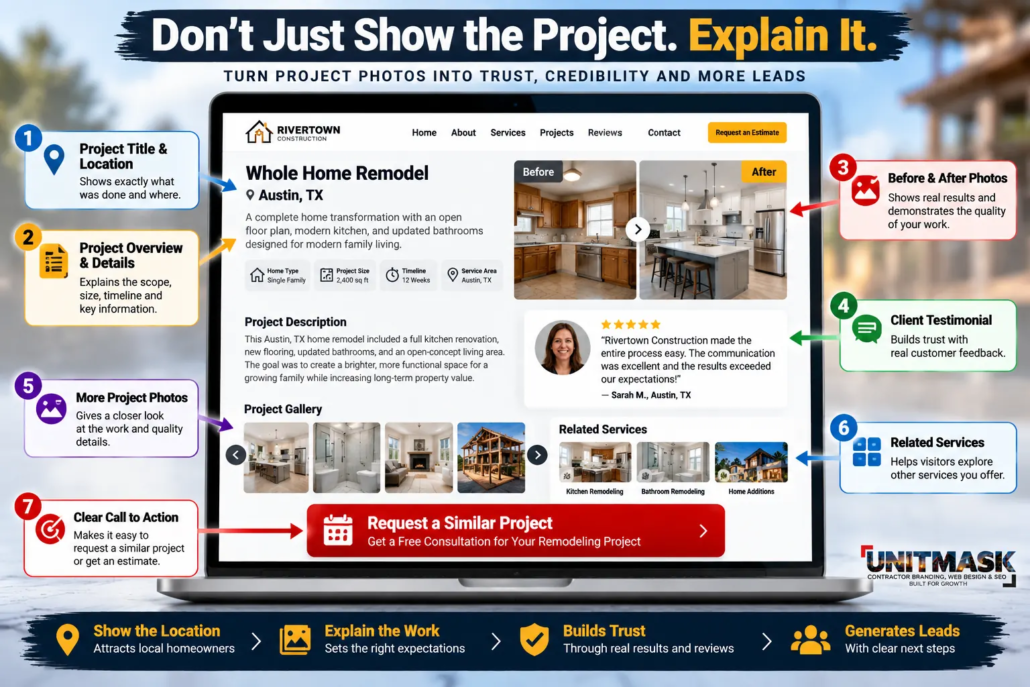
Instead, turn important projects into proof.
A strong project page can explain:
- project type
- city or service area
- client challenge
- scope of work
- materials or solution
- before photos
- progress photos
- finished result
- related service
For remodelers, roofers, landscapers, concrete contractors, builders and design-build firms, this can simultaneously strengthen trust, topical relevance and internal linking.
8. Reviews, Licenses and Trust Signals Are Weak or Buried
Hiring a contractor can involve substantial money, access to someone’s property and weeks or months of work.
Trust therefore cannot be treated as a footer element.
Relevant proof might include:
- Google review excerpts
- years in business
- license information where applicable
- insurance information
- manufacturer certifications
- trade associations
- warranties
- financing availability
- team photos
- completed project counts, if verifiable
- local project experience
Avoid inventing numbers or displaying credentials the business cannot substantiate.
The strongest proof is specific and verifiable.
9. All Your Services Are Packed Into One Generic Page
A generic Services page listing:
Roofing • Siding • Gutters • Windows
does little to answer the different questions behind each service.
Someone researching roof replacement has different concerns from someone researching gutter installation.
The same applies to:
- kitchen vs. bathroom remodeling
- AC repair vs. HVAC replacement
- residential vs. commercial electrical work
- excavation vs. grading
- concrete driveways vs. foundations
Dedicated service pages give businesses room to explain the service, process, proof, FAQs and appropriate next step.
They also create clearer search relevance than forcing every topic onto one page.
For U.S. construction businesses, a well-planned contractor SEO strategy helps improve Google visibility, attract homeowners searching for local services, and turn relevant website traffic into qualified project inquiries.
10. Your Service Areas Are Unclear
A homeowner should not have to call simply to find out whether you work in their city.
Clearly state your legitimate service area.
That does not mean creating dozens of near-identical city pages by swapping place names.
Useful local pages need genuine relevance.
Depending on the business, they can include:
- services available in that market
- local projects
- project photos
- testimonials from nearby clients
- regional considerations
- useful FAQs
- appropriate contact options
Your website and Google Business Profile should also accurately represent the real business.
Google says local results are primarily influenced by relevance, distance and prominence, while Business Profile information should accurately represent the company’s real-world location or service area.
For U.S. construction businesses, investing in local SEO for contractors helps improve visibility in Google Search and Maps, reach homeowners in targeted service areas, and generate more qualified local leads and estimate requests.
11. You Cannot Tell Which Website Visits Become Leads
A website redesign should not begin with:
“What colors should we use?”
It should begin with:
“What is happening now?”
At minimum, determine whether you can measure meaningful actions such as:
- phone-number clicks
- estimate-form submissions
- contact-form submissions
- booking actions
- important landing-page visits
- organic search traffic
- paid landing-page conversions
GA4 and Google Search Console can help distinguish visibility from on-site performance.
For example:
Search impressions growing + clicks growing + leads flat
may indicate a conversion problem.
Search visibility weak + almost no qualified traffic
suggests redesign alone will not solve the acquisition problem.
This distinction prevents contractors from spending thousands fixing the wrong thing.
12. Your Website No Longer Matches the Business You Are Building
Sometimes the strongest redesign signal is strategic rather than technical.
Perhaps you started as a small handyman company but now specialize in high-value remodeling.
Perhaps your construction company has expanded into commercial projects.
Perhaps your custom home building business has moved upmarket.
Or perhaps you are trying to reduce low-value inquiries and attract larger projects.
If the website continues positioning the company around yesterday’s business model, it can attract the wrong customers even when it generates leads.
A redesign is an opportunity to align:
brand positioning → services → target projects → geography → proof → conversion path.
That is fundamentally different from making an old homepage prettier.
Does Every Problem Require a Full Contractor Website Redesign?
No.
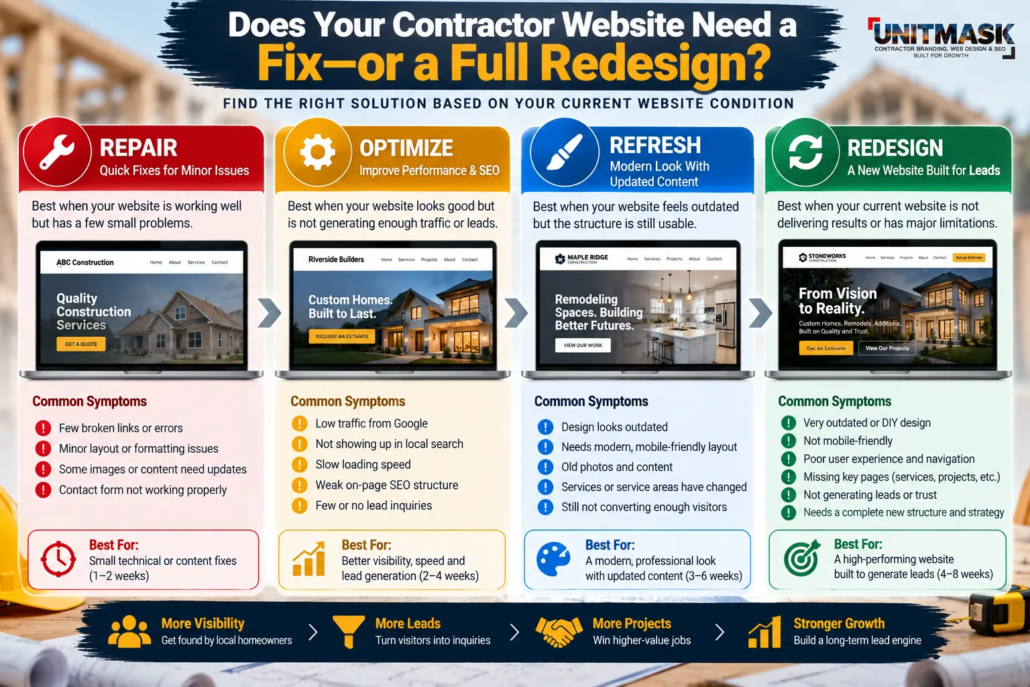
Use this framework:
- Situation
- Site works well but branding looks dated
- Strong structure but weak CTA/forms
- Good website but poor rankings
- Good traffic but weak project proof
- Slow site caused by isolated technical issues
- Conversion strategy
- Poor mobile UX + weak structure + outdated branding + bad conversion path
- Business model/services changed substantially
- Old platform makes every improvement difficult
- Likely Response
- Visual refresh
- Conversion optimization
- SEO/local SEO work
- Content + CRO improvements
- Performance optimization
- Minimal
- Full redesign
- Strategic redesign
- Rebuild/platform migration may be justified
A redesign should be the result of diagnosis—not the default recommendation.
Fix the Right Problem First
Before rebuilding your contractor website, identify whether you’re dealing with an SEO, credibility, mobile, structure or conversion problem.
What Should a Contractor Website Redesign Actually Fix?
A successful contractor website redesign should improve the entire path between discovery and inquiry.
The redesigned site should make five things obvious:
1. What do you do?
Your major services should be immediately understandable.
2. Where do you work?
Communicate the actual markets and service areas you cover.
3. Why should someone trust you?
Use real projects, reviews, credentials and company information.
4. What should the visitor do next?
Provide an appropriate call, estimate or consultation path.
5. Can Google understand the business?
Use logical site architecture, crawlable content, descriptive pages and internal links connecting related services, locations and projects.
That is what separates a contractor lead-generation website from an online brochure.
For U.S. construction companies, investing in modern contractor website design helps build homeowner trust, showcase completed projects, improve mobile usability, and turn website visitors into qualified leads and estimate requests.
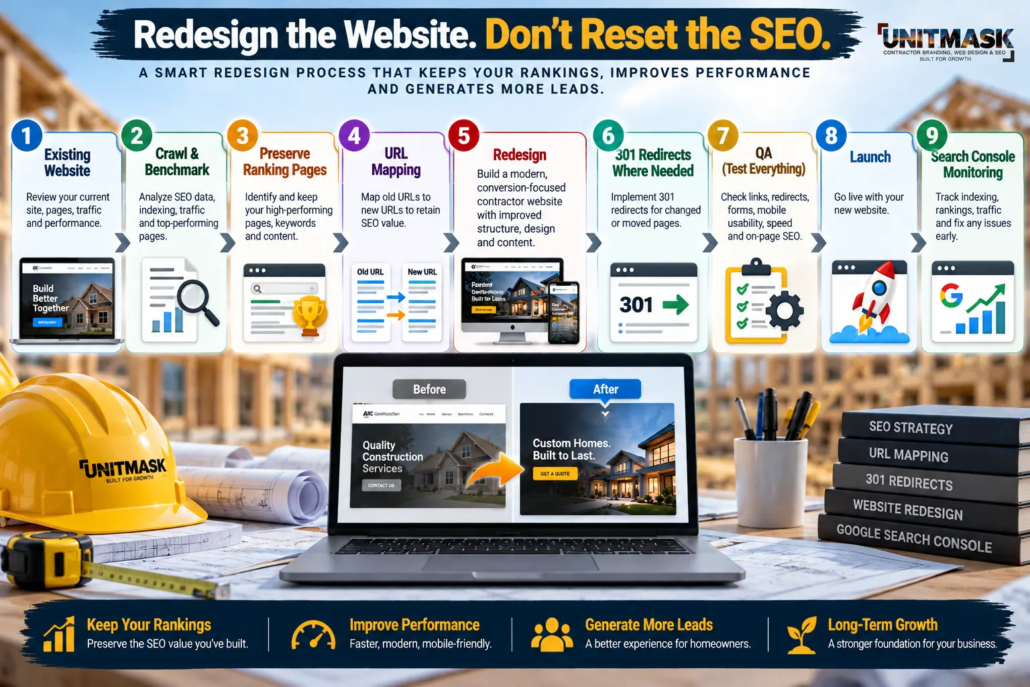
How to Redesign a Contractor Website Without Throwing Away Existing SEO
This is one of the most overlooked parts of website redesign.
A contractor may already have service pages ranking in Google, backlinks pointing to project pages, indexed URLs, and years of accumulated search history.
A careless redesign can remove or alter those assets.
Before launch:
- Crawl and inventory important existing URLs.
- Review Search Console performance.
- Identify pages receiving organic traffic and impressions.
- Identify backlinks to important pages.
- Preserve valuable URLs where practical.
- Map genuinely changed URLs to the most relevant new URLs.
- Implement permanent redirects where appropriate.
- Preserve important content rather than replacing everything blindly.
- Check titles, headings, canonical tags and indexability.
- Update internal links.
- Test forms and conversion tracking.
- Check the XML sitemap.
- Test mobile layouts.
- Monitor Search Console after launch.
Google has specifically advised site owners planning large redesigns to document what is changing and identify which changes have SEO implications. URL changes require particular care.
A redesign should therefore preserve what already works while fixing what does not.
For U.S. construction businesses, a well-planned Contractor SEO strategy helps improve Google rankings, increase visibility in local searches, attract homeowners actively looking for construction services, and generate more qualified leads and estimate requests.
A 10-Minute Contractor Website Redesign Test
Open your website on your phone as if you were a homeowner who had never heard of your company.
Then answer these questions:
- Can you understand the primary service within a few seconds?
- Is the primary service area clear?
- Can you tap the phone number?
- Is requesting an estimate obvious?
- Can you see real completed work?
- Can you find credible reviews?
- Are licenses/certifications visible where relevant?
- Can you easily navigate major services?
- Does the site load and respond smoothly?
- Does the company look as professional online as it does in the field?
- Can you identify what makes the company different?
- Would you trust this business enough to invite it to your property or discuss a major project?
If several answers are “no,” your website deserves more than a cosmetic update.
It needs a closer diagnosis.
Find Out Why is your contractor website not generating leads
Unitmask can review your website from a contractor lead-generation perspective—including mobile UX, service structure, trust signals, local relevance and conversion paths—before you decide what needs rebuilding.
What We Look for When Reviewing Contractor Websites
We ask a more important question:
Can a potential customer quickly understand the company, trust it, find the right service, and take the next step?
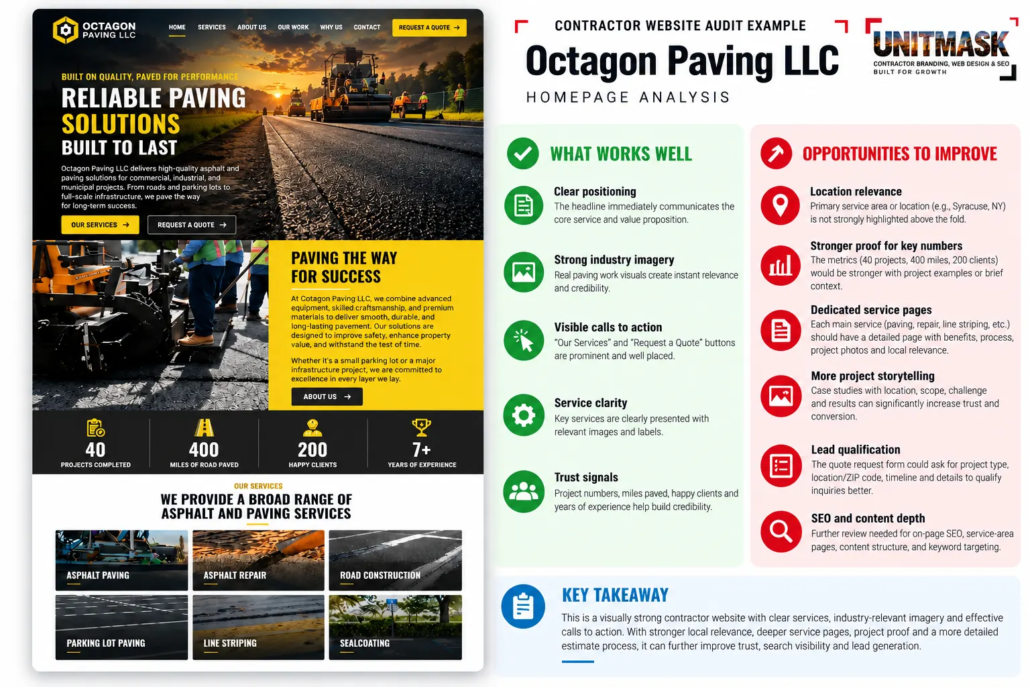
Take this paving contractor homepage as an example.
At first glance, several fundamentals are strong. The website immediately communicates the service through the headline “Reliable Paving Solutions Built to Last,” uses relevant project imagery instead of generic corporate visuals, and places Request a Quote and Our Services calls to action prominently near the top.
The homepage also creates a logical customer journey:
Service → credibility → capabilities → estimate → reputation → contact.
That is a much stronger foundation than a contractor website that simply lists company information.
But a visual review also reveals opportunities we would investigate further during a Unitmask website audit.
1. Location relevance could be clearer above the fold.
The homepage communicates paving immediately, but the visible hero doesn’t strongly establish the primary market or service area. For a local contractor, adding location context can help visitors confirm within seconds that the company serves them.
2. Strong numbers need supporting proof.
Metrics such as “400 Miles of Road Paved” and “200 Happy Clients” can build trust—but only when they are accurate and defensible. Wherever possible, strong claims should connect to real projects, case studies, or other evidence.
3. Service cards create a good starting point, but dedicated service pages matter.
Asphalt paving, asphalt repair, road construction, parking lot paving, line striping, and sealcoating represent different customer needs and potentially different searches. Each major service should lead to a useful page rather than relying on one general services page.
4. The project work deserves more storytelling.
Construction photography is valuable proof. It becomes substantially stronger when visitors can see the project location, scope, challenge, work completed, and result—not just an image gallery.
5. The estimate path could qualify leads better.
Instead of collecting only basic contact information, a contractor can potentially ask for project type, location or ZIP code, timeline, and project details. That can help the business understand the inquiry before the first conversation.
The Unitmask Audit Principle
A contractor website doesn’t need more design simply for the sake of design.
It needs fewer points of uncertainty between:
“I found this contractor” → “They do what I need” → “They serve my area” → “I trust them” → “I want an estimate.”
That is what we look for when reviewing contractor websites.
Construction Website Redesign FAQs
How do I know if my contractor website needs a redesign?
A contractor website may need redesigning when several problems occur together: poor mobile usability, slow performance, weak lead generation, confusing services, outdated branding, limited project proof, unclear service areas and difficult contact paths. One isolated problem may only require optimization rather than a complete rebuild.
Why is my contractor website getting traffic but no leads?
Traffic without leads can indicate mismatched search intent, weak messaging, insufficient trust, poor mobile usability, unclear services, weak project proof or a difficult estimate-request process. Review traffic sources and conversion tracking before assuming you simply need more visitors.
Will redesigning my contractor website hurt SEO?
It can if important URLs, content, internal links or technical SEO elements are changed carelessly. Audit existing search performance first, preserve valuable URLs where possible and correctly map changed URLs before launching the redesigned site.
What should a contractor website include?
Most contractor websites benefit from clear service pages, legitimate service-area information, real project examples, reviews, company information, relevant credentials, mobile-friendly calls to action and an easy estimate or contact process.
Should contractors have a separate page for every service?
Major services generally deserve dedicated pages when each service has distinct customer intent and enough useful information to justify its own page. Avoid creating thin pages simply to target additional keywords.
Should contractors create separate pages for every city they serve?
Only when those pages provide genuine local value. Creating dozens of nearly identical pages with city names swapped out is not a strong long-term local SEO strategy. Useful location content should reflect actual service coverage, projects, expertise and customer needs.
How often should a contractor redesign their website?
There is no universal redesign schedule. Performance, business changes, customer behavior and technical limitations matter more than the site’s age. A five-year-old site that performs well may need less work than a two-year-old site that fails to generate qualified inquiries.
What’s the difference between a website refresh and redesign?
A refresh typically updates visual elements such as colors, typography, images or individual sections. A redesign may change site architecture, messaging, mobile UX, service pages, conversion paths, SEO structure and underlying technology.
Can a website redesign generate more contractor leads?
It can improve lead generation when the existing website is creating conversion friction. But redesigning alone does not create search demand or guarantee traffic. SEO, local visibility, reputation, offers and follow-up also influence lead volume.
What’s more important: website design or SEO?
They solve different parts of the customer journey. SEO helps qualified prospects discover the business; website design, messaging and conversion strategy help those visitors understand, trust and contact it. Contractors pursuing online leads generally need the two to work together.
Are you a contractor, builder, or home service business owner?
What did you pay for your website—and looking back, was it worth the investment?If you’re currently comparing website quotes, you can also share what you’re being quoted and what’s included. Your experience may help other contractors make a better decision.
Comments are welcome from contractors, builders, construction professionals, and business owners. Please keep the discussion relevant and avoid promotional links or spam.
 Unitmask.cloud
 Unitmask.cloud
Leave a Reply
Want to join the discussion?Feel free to contribute!