SEO for Remodeling Contractors: 2026 Lead Generation Guide
Learn how SEO for remodeling contractors can improve Google visibility, attract qualified homeowners, and generate more kitchen, bath, and remodeling leads.
Great remodeling work doesn’t automatically produce Google visibility.
A remodeling company can have skilled crews, beautiful kitchens, strong client reviews and years of experience—and still lose online opportunities to competitors with a stronger search presence.
SEO for remodeling contractors is the process of making your remodeling company easier to discover, evaluate and contact when homeowners search Google for the services you provide.
But getting rankings isn’t the real objective.
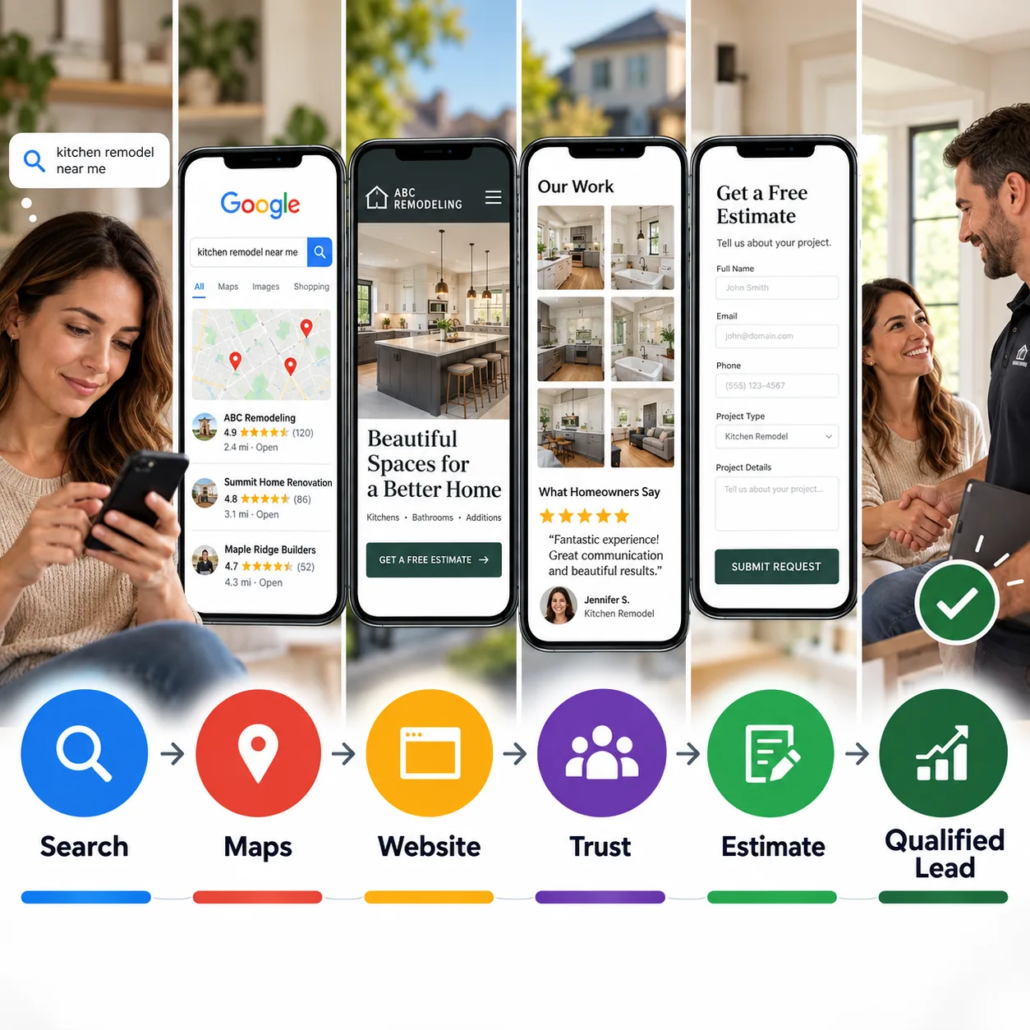
The system should move homeowners through:
Search → Google Maps → Website → Trust → Estimate Request → Qualified Lead → Project
That distinction matters for remodelers because a remodeling project isn’t usually an impulse purchase.
Houzz’s 2026 U.S. research found that 54% of surveyed homeowners renovated during 2025. Median renovation spending was $20,000, while the 90th percentile reached $150,000. Half of homeowners surveyed planned renovation activity in 2026. Houzz
For remodeling companies, that means Google visibility can put your company in front of homeowners researching potentially substantial purchases.
But only if your SEO strategy matches how those homeowners actually choose a contractor.
What Is SEO for Remodeling Contractors?
SEO for remodeling contractors helps a remodeling business appear when homeowners search for relevant remodeling services in its market.
That can include searches such as:
- kitchen remodeling contractor near me;
- bathroom remodeler in [city];
- home addition contractor;
- whole-home remodeling company;
- design-build contractor;
- basement remodeling company;
- remodeling contractor in [city].
A complete remodeling SEO strategy typically combines:
Website SEO + Local SEO + Google Business Profile + Content + Reviews + Technical SEO + Authority + Conversion Optimization
Getting one of these right while ignoring the others can limit results.
Contractor SEO: The Complete Guide for U.S. Contractors in 2026

Why Remodeling SEO Is Different From SEO for Other Home Services
A homeowner with a broken water heater may need help today.
A homeowner planning a major kitchen remodel may research for months.
That difference changes the SEO strategy.
Current remodeling-focused SERP competitors are increasingly recognizing this distinction as well. Hustle Marketers
A remodeling prospect may:
- search for ideas;
- investigate remodeling costs;
- compare project styles;
- research local remodelers;
- look through portfolios;
- read reviews;
- revisit several websites;
- evaluate credentials and process;
- request estimates.
SEO therefore needs to reach homeowners before the final “remodeler near me” search.
Remodeling is a search journey, not one keyword.
Consider this homeowner:
“kitchen remodeling ideas”
↓
“how much does a kitchen remodel cost”
↓
“design build kitchen remodel”
↓
“kitchen remodeling contractor Dallas”
↓
“best kitchen remodelers near me”
Different queries represent different levels of commercial intent.
Your SEO strategy should account for that journey.
How Homeowners Search for Remodeling Contractors
There are four useful groups of remodeling searches.
- Search Stage
- Research
- Comparison
- Hiring
- Example
- Kitchen Remodeling Ideas
- Design-build vs General Contractor
- Kitchen Remodeling Contractor Near Me
- Intent
- Informational
- Commercial Investigation
- Transactional/Local
This matters because your homepage cannot realistically satisfy every query.
You need a site architecture that matches different search intents.
Think beyond rankings.
The Remodeling SEO Lead Generation Funnel
A strong remodeling SEO funnel looks like:
Visibility → Relevance → Trust → Conversion → Qualification
Visibility
Can homeowners find you?
Relevance
Does your page clearly match the project they’re considering?
Trust
Do your reviews, photos, projects, credentials and website make your company feel credible?
Conversion
Can visitors easily request an estimate or consultation?
Qualification
Are those inquiries the type of projects you actually want?
This final stage is often overlooked.
Ten poor-fit inquiries are not necessarily more valuable than three homeowners looking for the exact projects your company wants to build.
Is Your Remodeling Website Turning Google Traffic Into Leads?
Get a quick review of the SEO, trust and conversion gaps that may be costing your remodeling company qualified inquiries.
1. Start With High-Intent Remodeling Keyword Research
Keyword research shouldn’t begin with search volume alone.
Begin with your actual services.
For example:
Kitchen Remodeling
Potential themes:
- kitchen remodeling contractor
- kitchen remodeler near me
- kitchen remodeling [city]
- custom kitchen renovation
- kitchen design-build contractor
- kitchen renovation cost [city]
Bathroom Remodeling
Potential themes:
- bathroom remodeling contractor
- bathroom remodeler
- bathroom renovation company
- primary bathroom remodel
- bathroom remodeling [city]
Home Additions
Potential themes:
- home addition contractor
- room addition contractor
- home additions [city]
- second-story addition contractor
Whole-Home Remodeling
Potential themes:
- whole house remodeling
- whole home renovation contractor
- luxury home remodeling
- design-build remodeling company
Don’t optimize everything around “remodeling contractor.”
Someone specifically looking for a $75,000 kitchen project may respond better to a dedicated kitchen-remodeling page than a generic services page.
2. Build One Strong Page for Each Remodeling Service
A common contractor website structure looks like:
Home → Services → Contact
That’s often too broad.
A more useful structure might be:
Home
├── Kitchen Remodeling
├── Bathroom Remodeling
├── Whole-Home Remodeling
├── Home Additions
├── Basement Remodeling
└── Design-Build
Each important service deserves enough information to answer the homeowner’s questions.
A strong service page can include:
- what the service covers;
- who it’s appropriate for;
- your process;
- real projects;
- before/after photos;
- common project considerations;
- FAQs;
- service area;
- reviews or testimonials where appropriate;
- clear next step.
Avoid creating dozens of thin pages just to target keyword variations.
3. Optimize Your Google Business Profile and Google Maps Presence
For local remodeling searches, your website is only part of the search landscape.
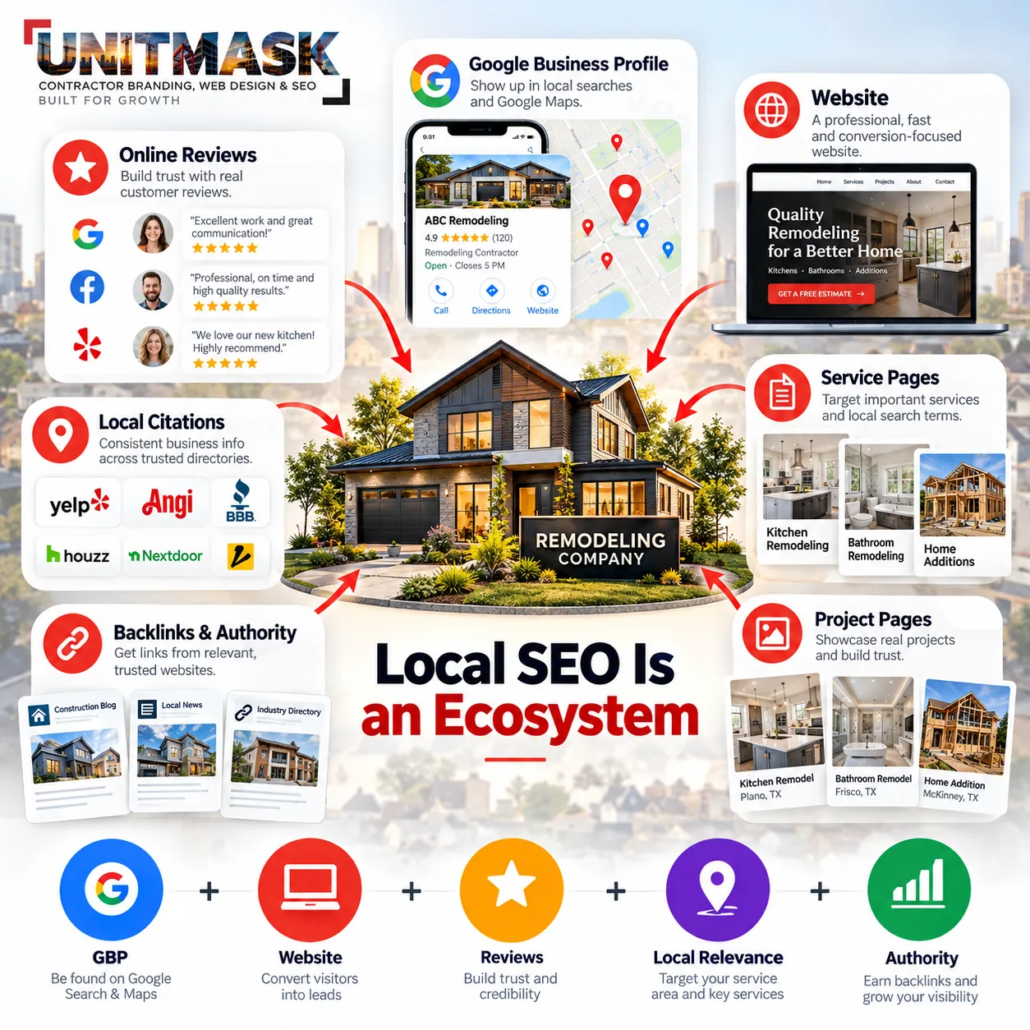
Your Google Business Profile matters too.
Google says local results are mainly determined by relevance, distance and prominence. Complete and accurate business information can help Google understand when a profile matches a search; reviews and links are among the signals associated with prominence. Google Help
For a remodeling company, GBP optimization should include accurate:
- business name;
- primary and relevant secondary categories;
- service information;
- service areas;
- business hours;
- phone number;
- website;
- project photos;
- business description.
Do not turn your business name into a keyword list.
Do not create fake locations simply to rank in more cities.
And don’t treat Google Maps optimization as an isolated activity.
Your profile, website, reviews, local references and broader business presence should reinforce the same real-world company.
4. Create Useful Service-Area Pages
A remodeling company serving multiple cities may need geographic pages.
But:
City pages should exist because you genuinely serve those locations—not because you can replace one city name with another.
A useful location page might contain:
- services offered in that market;
- completed projects nearby;
- neighborhood/property considerations;
- original project photos;
- relevant testimonials;
- local service details;
- FAQs;
- links to relevant project pages.
For example:
/kitchen-remodeling/plano-tx/
can be valuable if you genuinely serve Plano and have enough relevant information to make the page useful.
A page that merely swaps “Dallas” for “Plano” provides far less value.
5. Turn Completed Projects Into SEO Assets
This is one of the biggest opportunities available to remodeling businesses.
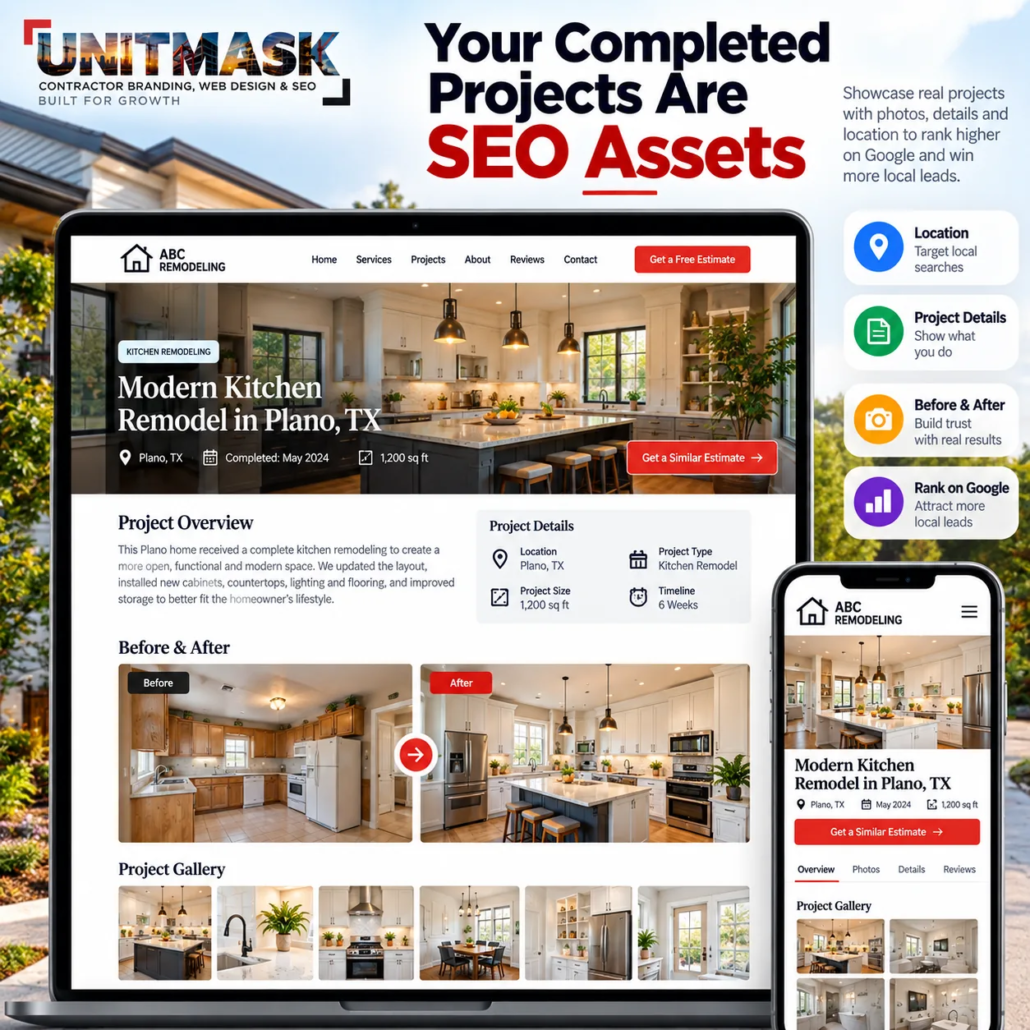
Your completed work is not only a portfolio.
It can become search content.
Instead of uploading 12 images to a gallery with no explanation, build a project page around the work.
For example:
Modern Kitchen Remodel in Plano, Texas
Include:
Project type: Kitchen remodeling
Location: Plano, TX
Scope: Cabinets, island, flooring, lighting and layout changes
Challenge: Explain the original homeowner problem
Solution: Explain what was changed
Photos: Before → during → after
Outcome: Describe the completed project without inventing customer claims.
This simultaneously demonstrates:
Experience + location relevance + service expertise + visual proof
That’s far more useful than another generic “10 kitchen trends” article.
6. Build Reviews and Local Trust
Reviews influence both homeowner decisions and your local search presence.
Google explicitly says that review count and positive ratings can help local ranking. Google Help
But remodelers should think beyond the total number of reviews.
A useful review naturally describes what the homeowner experienced.
For example, a genuine review might mention:
- kitchen remodel;
- communication;
- design process;
- schedule;
- craftsmanship;
- project location.
Never dictate positive wording or fabricate reviews.
Build a repeatable process for requesting feedback from real clients after meaningful project milestones or completion.
7. Create Content Around the Remodeling Research Journey
Don’t publish simply because someone says “Google likes fresh content.”
Create resources corresponding to questions homeowners actually ask before hiring.
Examples:
Cost content
- How Much Does a Kitchen Remodel Cost in [Market]?
- Bathroom Remodeling Cost in [Market]
- Home Addition Cost: What Affects the Budget?
Decision content
- Design-Build vs General Contractor
- Remodel or Move?
- Kitchen Remodel: What Should You Do First?
Process content
- How Long Does a Kitchen Remodel Take?
- What Happens During a Whole-Home Remodel?
- How to Prepare for a Major Renovation
Qualification content
- What Should You Ask a Remodeling Contractor?
- How to Compare Remodeling Estimates
- What Should a Remodeling Contract Include?
This creates visibility earlier in the homeowner’s decision process.
8. Fix Technical SEO Problems
Great content cannot compensate for a site that search engines struggle to crawl, understand or index.
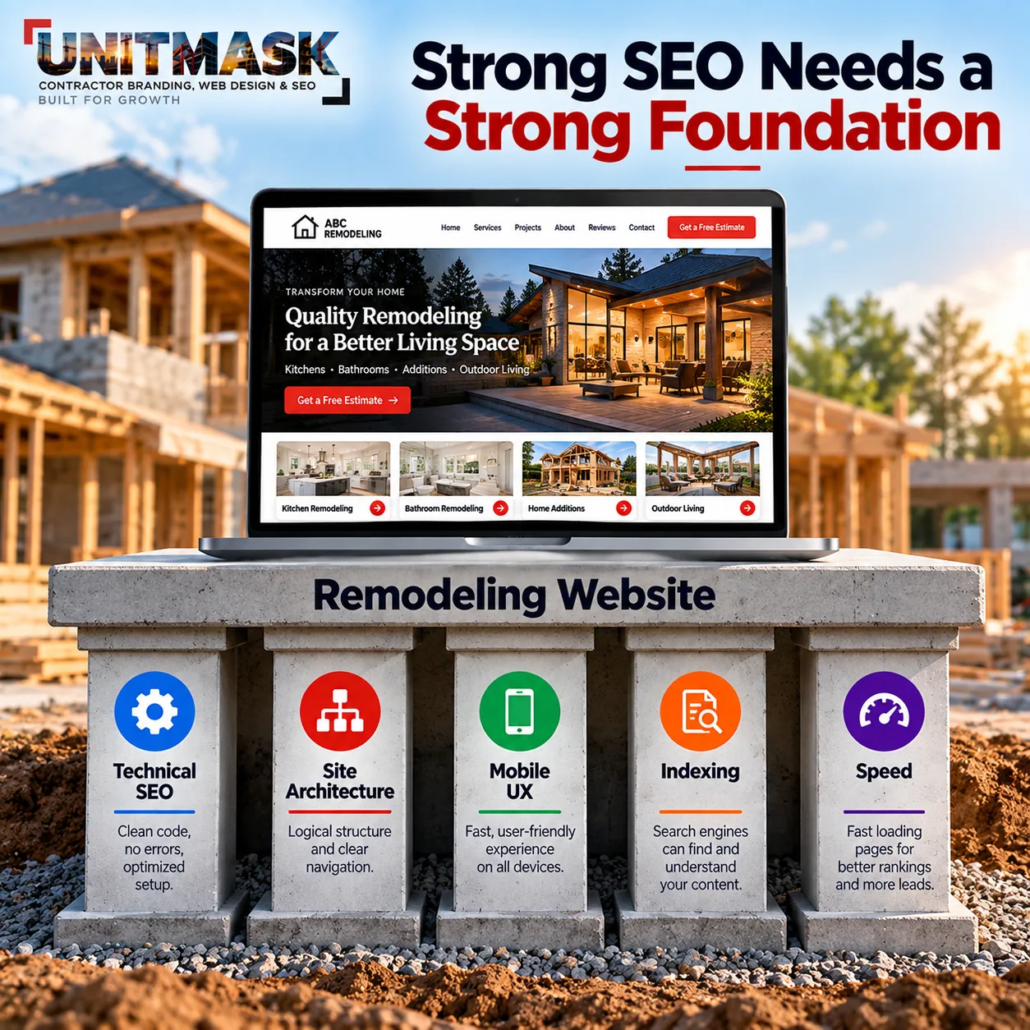
Technical priorities include:
- HTTPS;
- crawlability;
- indexability;
- canonical URLs;
- XML sitemap;
- logical internal linking;
- mobile usability;
- image optimization;
- Core Web Vitals;
- redirects;
- broken links;
- duplicate pages;
- structured data where appropriate.
Google provides LocalBusiness structured-data documentation for communicating relevant business information in a standardized format. Google for Developers
For remodelers, image performance deserves particular attention.
Project photography is critical for conversion—but uploading massive original images can unnecessarily slow the site.
Compress images appropriately while maintaining enough quality to showcase the work.
9. Make Your Remodeling Website Convert Traffic Into Leads
Traffic doesn’t pay your crews.

Projects do.
So SEO shouldn’t stop when someone reaches the website.
A homeowner arriving from Google should quickly understand:
What do you do?
Where do you work?
Can you handle a project like mine?
Can I trust you?
What should I do next?
Your remodeling website should prominently show:
- core services;
- service area;
- completed projects;
- before/after photography;
- reviews;
- process;
- credentials where applicable;
- clear contact information;
- estimate/consultation CTA.
Avoid forcing the homeowner to hunt through five pages before finding a contact option.
10. Build Local Authority and Backlinks
Backlinks still matter, but remodelers don’t need thousands of random links.
Look for legitimate relationships and references connected to the real business.
Potential opportunities include:
- local business organizations;
- chambers of commerce;
- supplier/manufacturer relationships;
- industry organizations;
- community sponsorships;
- local press;
- architecture/design collaborations;
- legitimate business directories;
- project partners.
The objective isn’t:
“How many links can we buy?”
It’s:
“What legitimate sources would naturally reference this remodeling business?”
Local SEO for Contractors: How to Rank Higher on Google Maps in 2026
SEO for AI Search and Google AI Overviews
Search is no longer limited to ten traditional blue links.
Homeowners can encounter synthesized answers and AI-driven search experiences while researching projects.
That makes clear, extractable answers increasingly useful.
For example:
What is remodeling contractor SEO?
Remodeling contractor SEO is the process of improving a remodeling company’s website, local search presence and content so homeowners can discover the business when researching or hiring remodelers through search engines.
Does a remodeling company need separate service pages?
Usually, important services such as kitchen remodeling, bathroom remodeling and home additions should have dedicated pages when each represents a meaningful service with distinct homeowner questions and search intent.
Does AI SEO replace traditional SEO?
No. Strong AI-search visibility still benefits from clear content, crawlable pages, recognizable entities, authoritative information and trustworthy first-party evidence.
Don’t create awkward paragraphs simply to “optimize for ChatGPT.”
Create content that is easy for both humans and machines to understand.
What Should Remodeling Contractors Measure?
Rankings are useful diagnostic indicators.
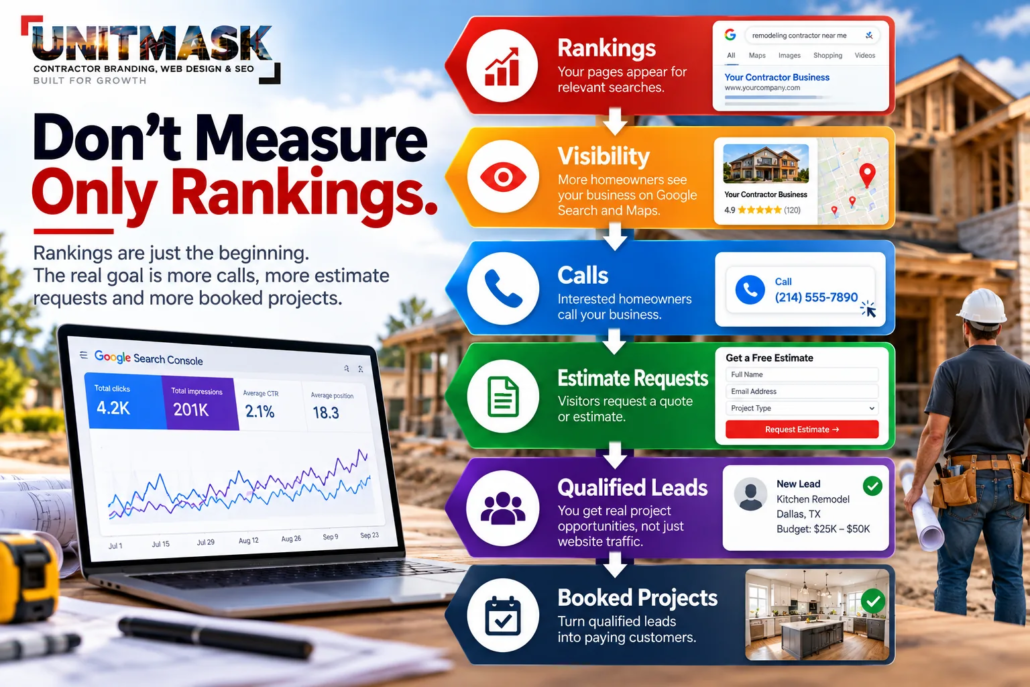
- KPI
- Search impressions
- Organic clicks
- GBP interactions
- Calls
- Estimate forms
- Qualified leads
- Booked projects
- Revenue by source
- What it tells you
- Whether visibility is growing
- Whether searchers visit
- Local search engagement
- Direct inquiries
- Conversion performance
- Lead quality
- Business outcome
- Commercial impact
This gives you a better framework:
Rankings → Visibility → Calls → Estimates → Qualified Leads → Booked Projects
A 90-Day Remodeling SEO Roadmap
SEO isn’t a 90-day magic trick.
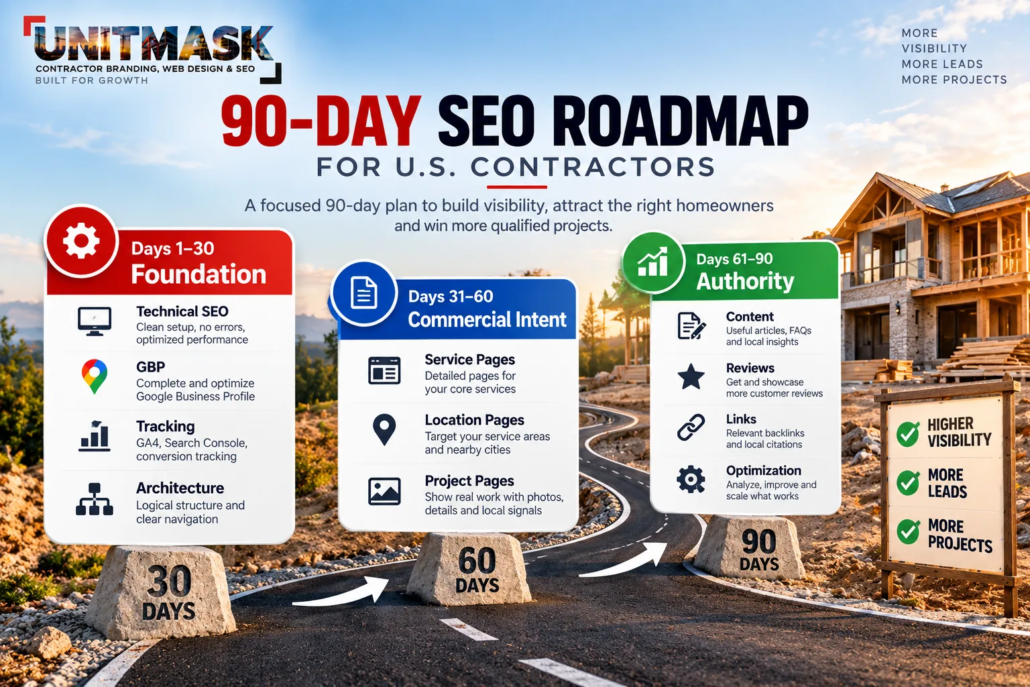
But the first 90 days can establish the right foundation.
Days 1–30: Foundation
Prioritize:
- technical SEO audit;
- Search Console;
- analytics;
- indexation;
- keyword mapping;
- GBP audit;
- site architecture;
- conversion audit;
- competitor review.
Fix major technical and structural problems before aggressively publishing content.
Days 31–60: Commercial Pages
Build or improve:
- kitchen remodeling;
- bathroom remodeling;
- home additions;
- whole-home remodeling;
- important service-area pages;
- project/case-study pages.
Add strong internal links between relevant pages.
Days 61–90: Authority + Content
Begin publishing:
- local cost guides;
- homeowner decision resources;
- project pages;
- FAQs;
- comparison articles.
Continue:
- review acquisition;
- local authority development;
- GBP improvement;
- conversion measurement.
How Long Does SEO Take for a Remodeling Contractor?
There is no credible universal timeline.
Results depend on:
- current website authority;
- market competition;
- website condition;
- Google Business Profile;
- existing reviews;
- domain history;
- content quality;
- service-area competition;
- backlink profile;
- technical problems.
Be cautious with anyone guaranteeing a specific Google ranking by a specific date.
Instead, look for progressive indicators:
Indexation → impressions → ranking breadth → clicks → inquiries → qualified leads
Some improvements can appear early, while meaningful competitive growth often requires sustained work.
How Much Does Remodeling Contractor SEO Cost?
There is no single appropriate SEO price for every remodeling company.
Cost depends on factors such as:
- market size;
- number of services;
- number of locations;
- current website condition;
- competition;
- content requirements;
- link/authority requirements;
- whether the website needs redevelopment;
- reporting and conversion tracking.
A contractor serving one suburban market with four core services has a very different SEO requirement from a multi-location design-build firm targeting an entire metro.
The better question is:
Contractor SEO Company vs Freelancer vs DIY: Which Is Right for Your Business?
What We See When Auditing Remodeling Contractor Websites
This is where I recommend adding a distinctly Unitmask section rather than another generic SEO paragraph.
When auditing a remodeling website, review the relationship between:
Search Visibility
What queries already generate impressions?
Google Maps Coverage
Where is the company actually visible for relevant local searches?
Service Pages
Are kitchen, bathroom, addition and other profitable services properly represented?
Search Intent
Does each page match what homeowners are actually trying to find?
Project Proof
Are completed projects being used as searchable evidence of experience?
Conversion Gaps
Can a homeowner easily move from project research to an estimate request?
Find the Gaps in Your Remodeling SEO
We’ll review how your remodeling business appears across Google, your service-page structure and the path homeowners take before requesting an estimate.
FAQs: SEO for Remodeling Companies
Is SEO worth it for remodeling contractors?
SEO can be valuable for remodelers because homeowners use search throughout the renovation research and contractor-selection process. Its value depends on whether the campaign produces relevant local visibility and qualified inquiries—not simply rankings.
What is local SEO for remodeling contractors?
Local SEO improves a remodeling company’s visibility for geographically relevant searches across Google Search and Maps through its website, Google Business Profile, reviews, local relevance and authority.
What keywords should remodeling contractors target?
Prioritize service-and-location combinations with genuine business relevance, such as kitchen remodeling, bathroom remodeling, home additions, whole-home remodeling and related local searches. Informational cost and planning queries can support homeowners earlier in their research.
Does a remodeler need a Google Business Profile?
For remodeling companies pursuing local customers, a properly maintained Google Business Profile is an important component of Google Search and Maps visibility.
Should every remodeling service have its own page?
Major services with distinct search intent usually benefit from dedicated, useful pages. Don’t create separate thin pages for trivial keyword variations.
Should remodeling contractors create city pages?
Yes, when the company genuinely serves those markets and can create useful location-specific content. Avoid mass-producing nearly identical city pages.
Can project galleries help SEO?
Yes—especially when completed projects become detailed pages containing original photography, project type, location, scope and useful explanations rather than image-only galleries.
How long does remodeling SEO take?
There is no universal timeframe. Competition, existing authority, technical condition, content, reviews and market size all affect progress. Measure early improvements through indexing, impressions, ranking breadth and qualified inquiries rather than expecting an arbitrary guaranteed ranking date.
Is Google Maps more important than the remodeling website?
They serve different purposes. Maps can create discovery, while the website provides deeper information about services, projects, experience and the next step. Strong local marketing connects the two.
What should a remodeling contractor measure from SEO?
Track impressions and rankings, but connect them to calls, estimate requests, qualified opportunities, booked projects and revenue whenever your tracking setup allows it.
Continue Reading: U.S. Contractor Website & Marketing Guides
How Much Does a Contractor Website Cost in 2026?
Contractor Website Redesign: 12 Signs Your Website Is Costing You Leads
15 Best U.S. Contractor Website Examples That Win More Clients (2026)
Contractor SEO: The Complete Guide for U.S. Contractors in 2026
How Much Does Contractor SEO Cost in the U.S. in 2026?
What Is Included in Contractor SEO? 2026 Guide for U.S. Contractors
Contractor SEO Company vs Freelancer vs DIY: Which Is Right for Your Business?
SEO for Roofing Companies: How to Get More Roofing Leads From Google
Local SEO for Contractors: How to Rank Higher on Google Maps in 2026
Are you currently investing in SEO for your construction business?
What has been the biggest challenge—Google Maps visibility, website rankings, or generating qualified leads? Share your experience or question in the comments below.
 Unitmask.cloud
 Unitmask.cloud
Leave a Reply
Want to join the discussion?Feel free to contribute!