SEO for Roofing Companies: How to Get More Roofing Leads From Google
Learn how SEO for roofing companies can improve Google Maps and organic visibility, build homeowner trust, and generate more qualified roofing leads.
When a homeowner discovers a roof leak, sees missing shingles after a storm, or realizes their aging roof needs replacement, one of their next steps is often a Google search.
They may search:
“roof repair near me”
“roof replacement Dallas”
“roofing company Fort Worth”
or:
“emergency roofer near me.”
SEO for roofing companies is the process of making your roofing business more visible during those searches—and then turning that visibility into calls, estimate requests, and qualified roofing opportunities.
But rankings alone don’t generate revenue.
Your roofing company needs an entire system:
Google visibility → relevant landing page → trust → estimate request.
That’s what effective roofing SEO should build.

What Is SEO for Roofing Companies?
SEO for roofing companies is the process of improving a roofing contractor’s visibility across Google Search and local search results for the services and geographic markets the company actually serves.
That normally involves:
- Google Business Profile optimization
- Roofing keyword research
- Service pages
- Location/service-area pages
- Technical SEO
- On-page SEO
- Reviews
- Local citations
- Project content
- Helpful roofing resources
- Relevant authority/link building
- Conversion optimization
The goal isn’t simply to increase website traffic.
The goal is to attract homeowners and property owners who are actually capable of becoming customers.
Why Google Matters for Roofing Lead Generation
Roofing is inherently local.
A homeowner in Dallas looking for roof repair isn’t looking for the most authoritative roofing website in America.
They’re looking for a contractor who can actually service their property.
That’s why roofing companies generally need visibility across two connected areas:
Google Maps / local results
and
traditional organic search results.
Google explains that its local ranking systems primarily consider relevance, distance and prominence. Google Help
That distinction matters.
You cannot SEO your way around geography.
A contractor should therefore focus on becoming highly relevant and trustworthy within the markets it legitimately serves rather than trying to create hundreds of thin city pages.
How Homeowners Actually Search for Roofing Companies
Not every roofing keyword represents the same customer. Understanding intent is one of the most important parts of roofing SEO.
Emergency roofing searches
Examples:
- emergency roof repair near me
- leaking roof repair near me
- emergency roofer
- storm damage roof repair
These searchers often need help quickly.
The corresponding page should make the next action extremely obvious:
Call Now
or:
Request Emergency Roof Repair
Don’t bury the phone number underneath three screens of marketing copy.
Service searches
Examples:
- roof replacement company
- residential roofing contractor
- commercial roofing contractor
- metal roofing contractor
- shingle roof replacement
These users know approximately what service they need.
Dedicated service pages are usually appropriate.
Location searches
Examples:
- roofing company Dallas
- roofer Fort Worth
- roof repair Plano TX
- roofing contractor Frisco TX
These queries combine service + geography.
They’re especially important for roofing companies covering multiple legitimate service areas.
Research searches
Examples:
- how much does roof replacement cost
- metal roof vs shingles
- how long does a roof last
- signs a roof needs replacement
- does insurance cover storm damage
These searchers may not be ready to hire today.
But useful content can introduce your roofing company earlier in the buying journey.

The Roofing SEO System
Roofing SEO becomes easier to understand when you stop viewing it as a collection of isolated tactics.
Think of it as a system.
FOUNDATION
Technical SEO + Website Architecture
↓
RELEVANCE
Services + Locations + Roofing Expertise
↓
LOCAL VISIBILITY
Google Business Profile + Maps
↓
AUTHORITY
Projects + Reviews + Content + Links
↓
CONVERSION
Website UX + Calls + Estimate Forms
↓
GROWTH
Measurement + Optimization + Expansion
No single component replaces the others.
A great Google Business Profile connected to a poor website can lose leads.
A beautiful roofing website nobody can find won’t generate much organic demand.
Traffic without conversion isn’t the objective either.
Is Your Roofing Website Helping—or Hurting—Your Google Visibility?
Unitmask can review your roofing website’s SEO foundation, local visibility, content structure and lead-generation experience to identify practical opportunities for improvement.
Step 1: Build Your Roofing Keyword Strategy
Don’t begin with:
“What roofing keywords have the highest search volume?”
Begin with:
“What roofing jobs do we actually want?”
Suppose your company offers:
- Roof replacement
- Roof repair
- Storm damage restoration
- Metal roofing
- Commercial roofing
Those services form your first keyword clusters.
Then connect them with legitimate markets.
For example:
- Service
- Roof Repair
- Metal Roofing
- Storm Damage
- Commercial Roofing
- Local Intent
- Roof Repair Dallas
- Metal Roofing Contractor Dallas
- Storm Damage Roof Repair Dallas
- Commercial Roofing Contractor Dallas
Don’t create a separate page for every tiny keyword variation.
Group searches that represent the same underlying need into one strong page.
Step 2: Optimize Your Google Business Profile
For roofing contractors, the Google Business Profile can be a major part of local visibility.
At minimum, maintain accurate:
- Business information
- Business category
- Phone number
- Website
- Business hours
- Service areas
- Services
- Photos
And actively collect legitimate customer reviews.
Google explicitly recommends keeping Business Profile information complete and accurate and explains that reviews and positive ratings can contribute to local prominence.
Important warning for roofing companies
Many roofers operate as service-area businesses.
If customers do not visit your business location, don’t create fake storefronts simply to target additional cities.
Google’s guidelines state that service-area businesses generally should have one profile for the central office/location and shouldn’t use an unstaffed virtual office.
Google currently allows businesses to specify up to 20 service areas and recommends that the overall area generally stay within roughly two hours’ driving time from the business base, though exceptions may apply.
Google Business Profile guidelines for service-area businesses
Step 3: Build Dedicated Roofing Service Pages
One generic /services/ page is rarely the best way to represent several materially different roofing services.
If they’re meaningful parts of the business, consider dedicated pages such as:
/roof-repair/
/roof-replacement/
/commercial-roofing/
/metal-roofing/
/storm-damage-roof-repair/
Each page should answer the questions a prospective customer has about that specific service.
A strong roof-replacement page might include:
- Who the service is for
- Signs replacement may be necessary
- Roofing materials offered
- The company’s process
- Relevant completed projects
- Service area
- FAQs
- Warranty information where applicable
- Reviews/testimonials
- Estimate CTA
This creates relevance for Google while also creating a better landing experience for the homeowner.
Step 4: Build Useful Service-Area Pages
Location pages can be powerful.
They can also become one of the easiest ways to create a low-quality roofing website.
Avoid creating pages where the only meaningful difference is the city name:
Roofing Company Dallas
Roofing Company Plano
Roofing Company Frisco
with essentially identical paragraphs underneath.
Instead, make a service-area page genuinely useful.
Include information such as:
- Services offered in that market
- Relevant projects
- Neighborhoods/service areas
- Locally relevant roofing considerations
- Real customer proof
- Photos from completed projects
- Appropriate local FAQs
- Clear estimate options
A useful location page demonstrates actual relevance.
A mass-produced doorway page merely swaps keywords.
Step 5: Turn Completed Roofing Jobs Into SEO Assets

This is one of the biggest opportunities for roofing companies.
Every completed job potentially creates original content that another roofing company cannot simply reproduce.
Imagine a project page titled:
Asphalt Shingle Roof Replacement in Plano, TX
It could document:
Problem:
Aging shingles and storm-related damage.
Solution:
Existing roofing removed and replaced with the selected roofing system.
Location:
Plano, Texas.
Project photos:
Before → During → After
Service:
Roof Replacement
Then link that project to:
Roof Replacement → Plano Roofing → Relevant Educational Content
Now your website contains evidence of actual work—not just marketing claims.
Step 6: Improve Roofing Website On-Page SEO
Each important roofing page should clearly communicate:
What service is offered?
Where is it offered?
Why should the homeowner trust this company?
Start with fundamentals:
- Descriptive title tag
- Clear H1
- Logical H2/H3 hierarchy
- Natural keyword usage
- Relevant internal links
- Descriptive image alt text
- Useful service information
- Clear conversion action
Don’t write pages for Google first.
Write pages that help homeowners understand whether your company can solve their roofing problem—and make that information easy for search engines to interpret.
Step 7: Strengthen Technical SEO
Roofing SEO cannot compensate indefinitely for a technically weak website.
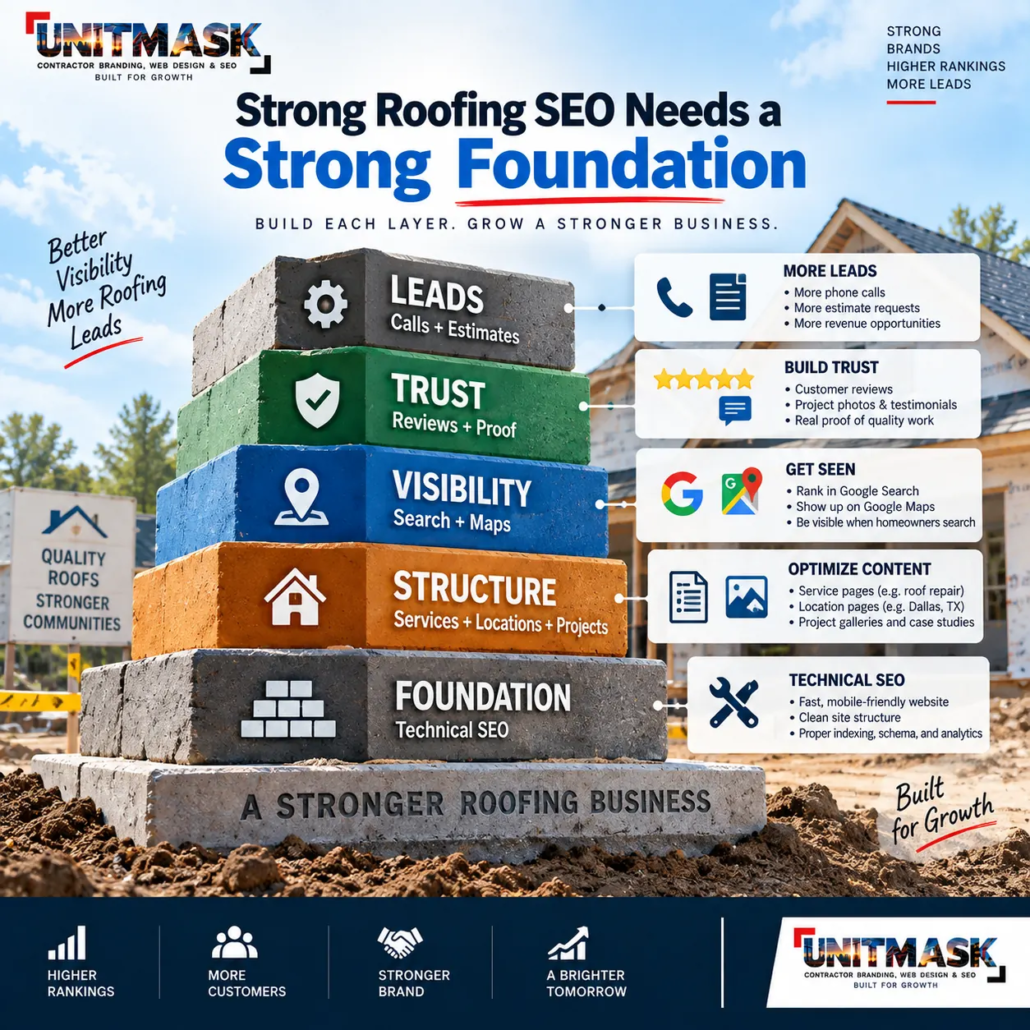
Check:
- Crawlability
- Indexability
- XML sitemap
- Canonicals
- HTTPS
- Mobile usability
- Page performance
- Broken links
- Redirects
- Duplicate URLs
- Structured data
- Internal architecture
Where appropriate, valid LocalBusiness structured data can also help Google understand business information. Google recommends following its structured-data guidelines and validating implementations with the Rich Results Test.
Google local businesss seo guide
Before hiring an SEO provider, understand what contractor SEO services should actually include.
Step 8: Build Reviews and Local Trust
Reviews aren’t merely decorative stars on your website.
They help prospective customers evaluate whether they trust your roofing company.
Create a repeatable process for requesting reviews from legitimate customers after appropriate project milestones.
But don’t script fake keyword-heavy reviews.
Ask customers for genuine feedback.
Your website can then reinforce this proof through:
- Testimonials
- Project pages
- Before/after galleries
- Certifications
- Manufacturer relationships where applicable
- Warranty information
- Team information
- Years of relevant experience
- Real jobsite photography
Google also identifies reviews as one source of information associated with local prominence.
Local SEO for Contractors: How to Rank Higher on Google Maps in 2026
Step 9: Create Roofing Content That Supports Revenue
A roofing blog shouldn’t exist merely because someone said:
“Google likes fresh content.”
Create content around actual homeowner decisions.
Examples:
Cost
- How Much Does Roof Replacement Cost in Dallas?
- Metal Roofing Cost vs Asphalt Shingles
Problems
- What Causes Roof Leaks After Heavy Rain?
- When Does Storm Damage Require Roof Replacement?
Materials
- Metal Roof vs Asphalt Shingles
- How Long Do Architectural Shingles Last?
Decisions
- Roof Repair vs Replacement
- What to Ask Before Hiring a Roofing Contractor
Local expertise
- Common Roofing Problems After North Texas Hailstorms
- Roofing Materials for Texas Heat
The strongest content can then link naturally into commercial service pages.
Step 10: Build Local and Industry Authority
Links still matter, but roofing companies shouldn’t reduce authority building to buying backlinks.
Look for legitimate opportunities such as:
- Local chambers
- Community organizations
- Supplier/manufacturer relationships
- Industry associations
- Local sponsorships
- Relevant construction publications
- Partnerships
- Useful original research/resources
The principle is straightforward:
Build relationships and resources worth mentioning.
Your Roofing Website Must Convert Rankings Into Leads
Getting someone onto your website is only half the job.

Consider two roofing companies.
Company A
Ranks well.
Website has:
- Generic stock imagery
- Small phone number
- Weak service explanation
- No projects
- Few trust signals
- Complicated contact form
Company B
Ranks similarly.
Website immediately shows:
- Roofing specialization
- Service area
- Real project photos
- Reviews
- Services
- Credentials
- Strong phone CTA
- Simple estimate form
SEO brought both companies a visitor.
The website determines what happens next.
Getting Traffic but Not Enough Roofing Leads?
Your rankings may not be the entire problem. Unitmask can review the SEO, trust signals, mobile experience and conversion path of your roofing website.
SEO for Google Maps vs Organic Search vs AI Search
Roofing companies increasingly need to think beyond one set of blue links.
Google Maps
Best suited to strong local-intent searches.
Focus on legitimate Business Profile optimization, reputation and genuine local relevance.
Organic Search
Supports service, location, project and informational searches.
This is where your website architecture and content depth become especially important.
AI-powered search
Don’t create a separate pile of “AI SEO” content.
Google’s current guidance says its normal SEO fundamentals remain relevant for AI Overviews and AI Mode and that there are no special technical requirements or special schema required merely to appear in these experiences.
That means roofing companies should prioritize:
- Helpful original content
- Clear answers
- Real project information
- Strong internal linking
- Accessible text
- High-quality supporting imagery
- Accurate structured data where applicable
- Up-to-date business information
Instead of trying to manipulate AI search, become a genuinely useful source.
How to Measure Roofing SEO Performance
Don’t judge SEO only by rankings.
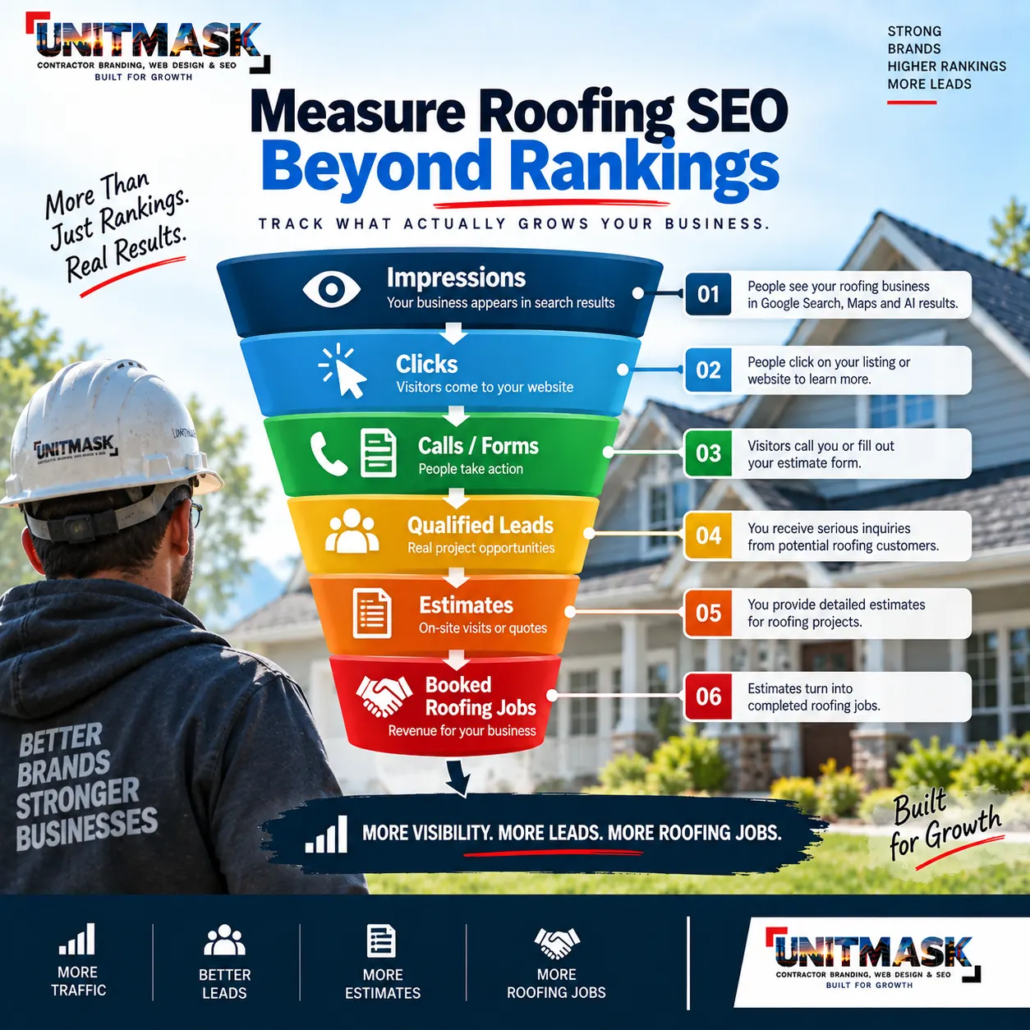
Track the complete funnel:
Search visibility
↓
Organic visitors
↓
Calls / forms
↓
Qualified opportunities
↓
Estimates
↓
Booked roofing projects
Useful measurements include:
- Search impressions
- Organic clicks
- Google Business Profile interactions
- Landing-page performance
- Phone calls
- Estimate submissions
- Conversion rate
- Qualified leads
- Lead source
- Closed projects
A keyword moving from position 18 to position 8 may look impressive in a report.
But the business question remains:
Did it help generate profitable roofing opportunities?
Common Roofing SEO Mistakes
Several mistakes repeatedly weaken roofing websites:
Creating dozens of near-identical city pages
More URLs don’t automatically create more local authority.
Using only one general services page
Different roofing services often deserve dedicated pages.
Ignoring the Google Business Profile
Organic SEO and local visibility need to work together.
Publishing generic AI content at scale
If another roofing company can replace your company name and publish essentially the same article, you’ve created very little differentiation.
Buying low-quality links
Quantity isn’t a substitute for relevance or legitimacy.
Tracking traffic instead of leads
Traffic is an intermediate metric.
Ignoring conversion
A roofing website is part of the SEO system.
How Long Does SEO for Roofing Companies Take?
There is no responsible universal promise such as:
“SEO takes exactly three months.”
Results depend on factors including:
- Market competition
- Existing domain/site history
- Technical condition
- Current rankings
- Website authority
- Competition in the service area
- Content quality
- Google Business Profile strength
- Reviews
- Implementation speed
A roofing company starting with an established website and strong local reputation is in a different position from a new company launching its first website.
Evaluate SEO as a compounding growth channel rather than expecting an arbitrary guaranteed ranking deadline.
SEO investment varies based on competition, market size, services, and the scope of work. If you’re budgeting for SEO, see our guide to contractor SEO costs in the U.S.
DIY SEO vs Freelancer vs Roofing SEO Company
- Model
- DIY
- Freelancer
- SEO Company
- Integrated Growth Partner
- Best Fit
- Small Company
- Defined SEO Tasks
- Broader Ongoing Strategy
- SEO + Website + Conversion Needs
- Main Constraint
- Owner Time
- Capacity may be limited
- Higher Investment
- Requires Broader Engagement
The right model depends on the complexity of the business.
A roofing company targeting one small service area has different requirements from a multi-location contractor competing across a major metro.
Contractor SEO Company vs Freelancer vs DIY: A Decision Guide for U.S. Contractors
A Practical 90-Day Roofing SEO Roadmap

Days 1–30 — Foundation
Audit:
Website → Technical SEO → Search Console → GBP → Keywords → Competitors
Fix major crawl/indexation and architecture problems first.
Map commercial roofing keywords to appropriate pages.
Days 31–60 — Relevance
Build or improve:
Core Services → Priority Locations → Project Content → GBP → Internal Links
Prioritize the services and markets most important to revenue.
Days 61–90 — Authority & Conversion
Expand:
Projects → Helpful Content → Reviews → Relevant Links → Conversion Optimization
Then measure what actually produces calls and estimate requests.
FAQs: SEO for Roofing Companies
Does SEO work for roofing companies?
Yes, SEO can help roofing companies become visible when homeowners search for services such as roof repair, replacement, storm damage and commercial roofing. Results depend on market competition, the company’s website, local presence and execution.
What is roofing SEO?
Roofing SEO is the process of improving a roofing company’s visibility in Google Search and local results using website optimization, local SEO, service and location content, technical SEO, reviews and authority building.
What are the best SEO keywords for roofers?
There isn’t one universal list. High-value keywords generally combine a roofing service, problem or material with local intent—for example, roof repair + city, roof replacement + city, or emergency roofer near me.
How do I rank my roofing company on Google Maps?
Start with an accurate and eligible Google Business Profile, correct categories and business information, legitimate reviews, relevant website content and strong local prominence. Google says local results primarily consider relevance, distance and prominence.
Does every city need a roofing location page?
No. Create location pages where your company genuinely serves the market and where you can provide useful, differentiated local information. Avoid producing large numbers of nearly identical city pages.
Should roofing companies have separate service pages?
Usually, important services such as roof repair, roof replacement, commercial roofing and storm-damage repair benefit from dedicated pages when each represents a distinct customer need.
How long does roofing SEO take?
There is no fixed timeline. Competition, website history, technical health, local authority, content and implementation all affect how quickly meaningful improvements occur.
Is Google Business Profile important for roofers?
Yes. Because roofing searches frequently have local intent, Google Business Profile can be an important component of visibility in Google Maps and local results.
Can roofing companies appear in AI search results?
Potentially. Google’s current guidance says normal SEO best practices continue to apply to AI Overviews and AI Mode; there isn’t a special schema or separate technical requirement solely for appearing there.
Is roofing SEO better than Google Ads?
They serve different purposes. Ads can buy immediate visibility while SEO builds organic and local visibility over time. Many roofing businesses can use both rather than treating them as mutually exclusive channels.
What We See When Auditing Roofing Contractor Websites

After reviewing contractor and roofing websites, we often find that poor SEO performance isn’t caused by one major problem. It’s usually a combination of technical, content, local SEO, and conversion issues.
Common problems include pages that aren’t indexed, missing or weak service pages, limited local keyword targeting, poor internal linking, slow page speed, incomplete schema markup, and under-optimized Google Business Profiles.
Google Search Console can help reveal where visibility is being lost—from low impressions and weak click-through rates to indexing problems and pages that struggle to gain search traction.
For roofing companies, fixing these gaps can create a stronger path from Google visibility → website traffic → qualified leads → estimate requests.
Not sure what’s holding your roofing website back?
Get a Free Contractor Website & SEO Audit from Unitmask to identify the most important opportunities to improve visibility, trust, and lead generation.
Are you currently investing in SEO for your construction business?
What has been the biggest challenge—Google Maps visibility, website rankings, or generating qualified leads? Share your experience or question in the comments below.
 Unitmask.cloud
 Unitmask.cloud
Leave a Reply
Want to join the discussion?Feel free to contribute!