Contractor SEO Company vs Freelancer vs DIY: Which Is Right for Your Business?
If you’re comparing a contractor SEO company vs freelancer vs DIY SEO, don’t choose based on price alone.
The right choice depends on four things: how competitive your market is, how complicated your SEO needs are, how much work your team can handle internally, and how important Google is to your lead-generation strategy.
A contractor operating in one small service area may be able to handle some SEO internally. A growing roofing, HVAC, remodeling, plumbing, or general contracting company targeting several cities may need a coordinated SEO system involving technical SEO, local search, content, service pages, project pages, reviews, and conversion optimization.
So the better question isn’t:
“Which option is cheapest?”
It’s:
“Which option can consistently execute the SEO system my construction business actually needs?”

Quick Answer: Contractor SEO Company, Freelancer, or DIY?
Here’s the simplest way to think about it.

- DIY SEO
- SEO Freelancer
- Contractor SEO Company
- You’re small, have time, and compete in a relatively manageable market
- You need specialist help with a defined scope
- SEO involves multiple services, locations, technical work, content and ongoing growth
- Owner time and learning curve
- Capacity and skill coverage depend heavily on one person
- Higher financial commitment
None of these models is automatically better.
A highly experienced freelancer can outperform a poorly managed agency. An owner who understands the local market can sometimes handle basic SEO better than an inexpensive provider following a generic checklist.
The question is fit.
Why SEO Is Different for Contractors
SEO for a contractor isn’t simply publishing blog posts and trying to rank for industry keywords.
Your potential customer might search:
“roof replacement Dallas”
or:
“kitchen remodeling contractor near me.”
They may then compare:
Google Search → Google Maps → Website → Projects → Reviews → Estimate Request
That means contractor SEO can involve multiple connected systems.
Google itself says local search results are mainly determined using relevance, distance, and prominence. Google also states that complete business information, links, and reviews can influence local visibility.
For contractors, SEO may therefore include:
- Technical website optimization
- Google Business Profile optimization
- Service-page development
- Service-area/location pages
- Project/case-study pages
- Review strategy
- Local citations
- On-page SEO
- Content strategy
- Internal linking
- Authority building
- Search Console analysis
- Conversion optimization
That’s why choosing who manages SEO matters.
What Does DIY Contractor SEO Actually Involve?
DIY SEO means the owner, office manager, marketer, or another internal team member handles most search optimization.
And yes—basic SEO can absolutely be learned.
Google’s own SEO Starter Guide is written partly for website owners and small businesses and explains fundamental practices for making content understandable to search engines and useful to searchers.
The difficulty isn’t necessarily understanding SEO.
The difficulty is executing it consistently while running a construction business.
Advantages of DIY SEO
DIY gives you maximum control.
Nobody knows your business better than you do.
You understand:
- which projects are most profitable,
- which neighborhoods you want to serve,
- what customers repeatedly ask,
- which services you want more of,
- what separates your crews from competitors,
- and which completed projects are worth showcasing.
That first-party knowledge is extremely valuable.
DIY also minimizes direct service fees.
Limitations of DIY SEO
The cost isn’t zero.
You’re paying with time.
A contractor owner trying to handle keyword research, Google Business Profile updates, project content, technical problems, service pages, internal linking, Search Console and analytics is spending hours that could otherwise go toward estimating, operations, customers, crews, or business development.
There’s also an execution problem.
Knowing that your website needs more location-specific relevance is different from knowing:
- which pages should exist,
- how they should be structured,
- which keywords they should target,
- how to prevent near-duplicate location pages,
- and how those pages should connect to services and projects.
When DIY SEO makes sense

DIY can make sense when:
- You’re a small contractor.
- You serve one primary market.
- Competition is relatively manageable.
- Your website is technically healthy.
- You have time to learn.
- You don’t need aggressive growth immediately.
- Someone internally can consistently execute the work.
DIY is much less attractive when SEO has become a major growth channel but nobody has clear ownership of it.
Not Sure What Your SEO Actually Needs?
Before hiring anyone—or spending hours doing it yourself—identify the technical, local, content, and conversion issues limiting your search visibility.
What Do You Get From an SEO Freelancer?
A freelancer sits between DIY and a full SEO company.
Instead of building an entire external team, you’re hiring one person for their knowledge and execution capacity.
This can work extremely well when the scope is clear.
For example, you may need someone specifically for:
- Keyword research
- Google Business Profile optimization
- Technical auditing
- On-page optimization
- Content planning
- SEO writing
- Link outreach
A strong specialist can bring considerable expertise without the overhead of a larger company.
Advantages of hiring an SEO freelancer
The biggest advantage is often direct access.
You’re frequently communicating with the same person doing the work.
Freelancers may also provide:
- Flexible engagements
- Lower overhead
- Specialist knowledge
- Faster decision-making
- Project-based work
Current industry pricing research also shows that freelancers generally charge less than agencies, although actual pricing varies dramatically by experience, geography and scope. Ahrefs’ survey of 439 providers found average monthly retainers of about $1,349 for freelancers versus $3,209 for agencies. Those are market averages—not contractor-specific quotes.
Limitations of freelancers
The same thing that makes freelancing attractive can also become its limitation:
you’re relying heavily on one person.
One freelancer may be excellent at technical SEO but weaker at conversion copy.
Another may understand content extremely well but depend on your developer to implement technical recommendations.
Another may specialize in Google Business Profile management but not broader website strategy.
This isn’t necessarily a quality problem.
It’s a capacity and coverage problem.
When a freelancer makes sense
A freelancer may be a strong fit when:
- Your SEO problem is clearly defined.
- You already have internal marketing support.
- You need a specialist.
- Your website isn’t particularly complex.
- You’re targeting a limited geographic area.
- Someone internally can manage implementation.
What Does a Contractor SEO Company Provide?
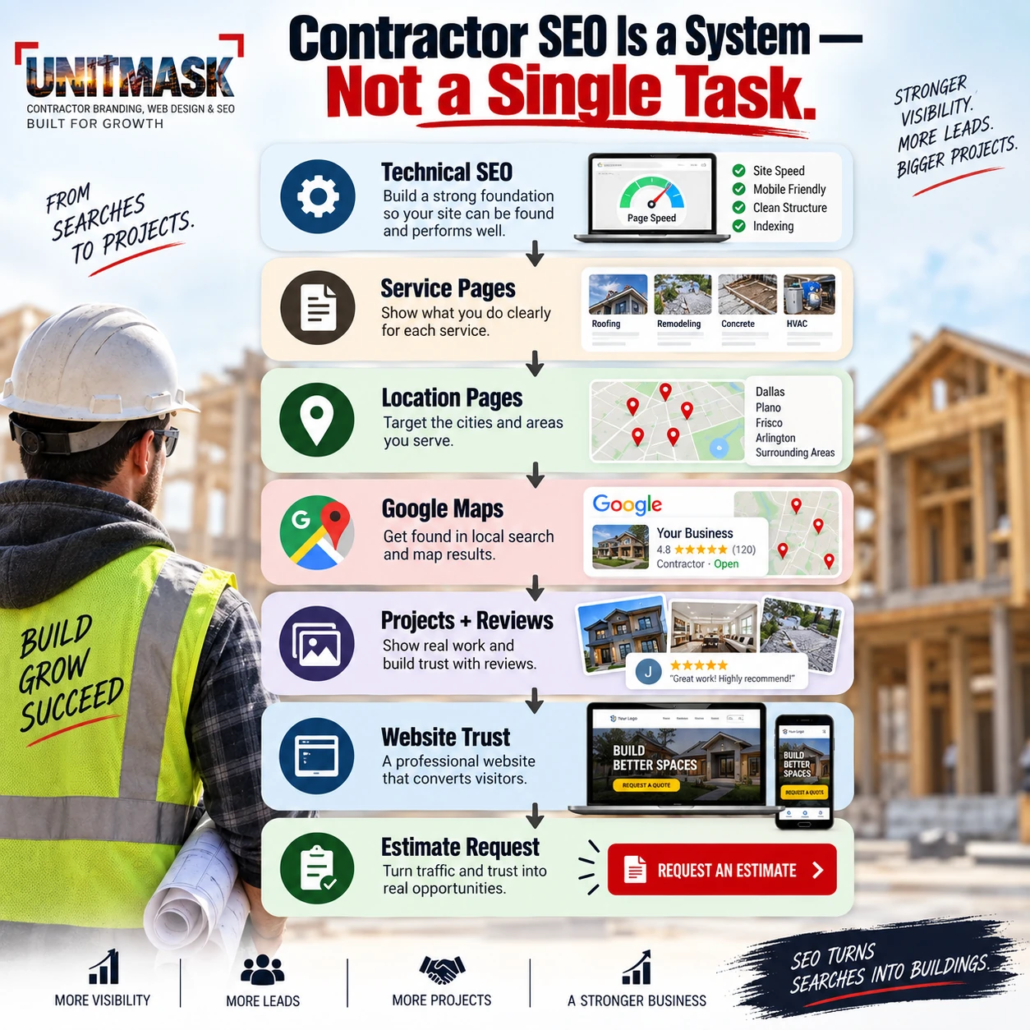
A contractor SEO company is most useful when SEO stops being a collection of individual tasks and becomes a coordinated growth system.
Instead of asking:
“Who can optimize this page?”
you’re asking:
“How do we increase our visibility for the services and markets that can produce profitable projects?”
That may require multiple disciplines working together.
For example:
Technical SEO
↓
Service + Location Architecture
↓
Google Business Profile / Local SEO
↓
Project + Educational Content
↓
Authority + Reviews
↓
Website Conversion
↓
Measurement
That’s where a company or coordinated specialist team can become more useful.
Local SEO for Contractors: How to Rank Higher on Google Maps in 2026
Advantages of a contractor SEO company
Potential advantages include:
- Broader expertise
- Greater execution capacity
- Technical + content coordination
- More structured processes
- Continuity
- Strategy and implementation under one system
- Ability to scale into additional services or markets
For a contractor, this becomes particularly valuable when the website, local SEO, content, branding, and conversion experience need to work together.
Limitations of an SEO company
A company isn’t automatically better.
Possible problems include:
- Higher cost
- Long contracts
- Generic strategies
- Poor communication
- Junior staff doing most execution
- Vanity-metric reporting
- Outsourced content that doesn’t understand construction
- Focusing on rankings instead of qualified opportunities
The word “agency” isn’t evidence of expertise.
Contractors should evaluate the actual strategy, people, deliverables, reporting, and understanding of the construction market.
Contractor SEO Company vs Freelancer vs DIY: Side-by-Side Comparison
- Factor
- Direct financial cost
- Owner/team time
- Expertise breadth
- Technical SEO
- Local SEO
- Content strategy
- Implementation capacity
- Scalability
- Communication
- Continuity
- Best use
- DIY
- Lowest
- High
- Depends on you
- Learning required
- Learning required
- Internal
- Limited internally
- Low–moderate
- Internal
- Internal responsibility
- Small/simple situation
- Freelancer
- Moderate
- Moderate
- Depends on individual
- Depends on specialist
- Often available
- Depends on scope
- Limited by individual
- Moderate
- Direct
- Single-person dependency
- Defined specialist need
- Contractor SEO Company
- Usually highest
- Lower
- Potentially broader
- Often available
- Usually available
- Often coordinated
- Usually greater
- Higher
- Depends on company
- Usually team-based
- Coordinated growth
Notice what’s intentionally missing:
“Winner.”
There isn’t one.
The best operating model depends on your business.
How Much Does Contractor SEO Company vs Freelancer vs DIY Cost?
Price varies substantially by competition, geography, scope, provider experience, website condition, content requirements, and whether the engagement includes local SEO.
As a broad industry benchmark, Ahrefs’ survey found average monthly retainers of approximately:
Freelancer: $1,349/month
Agency: $3,209/month
and an overall average of roughly $2,917 per month. Ahrefs also reported local SEO averaging approximately $1,557 monthly.
A separate Backlinko survey of more than 300 SEO professionals reported average monthly SEO costs in the $1,000–$2,500 range, with agencies charging more on average than freelancers.
These numbers should be treated as industry benchmarks rather than contractor-specific pricing.
DIY is harder to price because the biggest expense may be internal labor rather than an invoice.
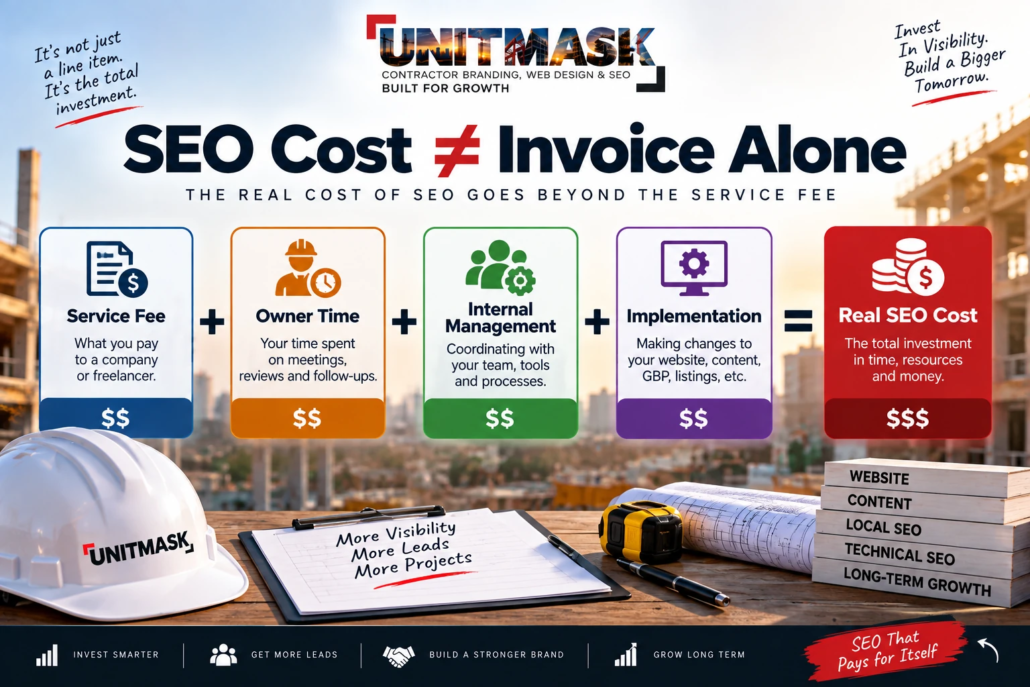
The Hidden Cost Contractors Often Miss: Owner Time
Suppose you save $1,000 per month by managing SEO yourself.
That sounds like $12,000 saved annually.
But that’s incomplete accounting.
If SEO takes several hours every week, ask:
What is an hour of the owner’s time worth?
And:
What business activity isn’t happening while SEO is being handled?
For a contractor, that could mean:
- Estimates
- Sales follow-ups
- Project management
- Hiring
- Supplier coordination
- Customer communication
- Business development
DIY becomes expensive when the owner’s time is worth more elsewhere.
The same principle applies to freelancers.
If you hire inexpensive SEO help but your team must manage the strategy, rewrite content, coordinate developers and check every deliverable, the real cost is higher than the invoice.
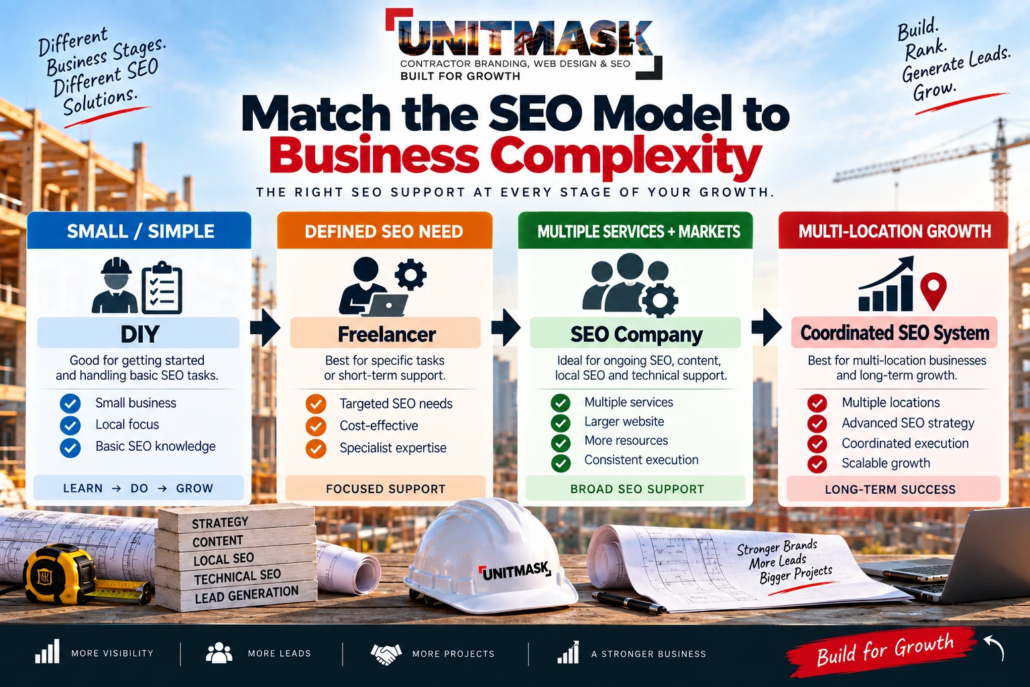
Which SEO Option Fits Your Construction Business?
Instead of deciding from price, match the operating model to the business.
Solo or very small contractor
DIY or targeted freelance help may be sufficient when you’re serving one market with a relatively simple website.
Focus first on fundamentals:
- Accurate Google Business Profile
- Core service pages
- Project photos
- Customer reviews
- Basic technical health
- Search Console
- Clear estimate CTA
Google recommends maintaining complete and accurate Business Profile information and explains that local rankings are based primarily on relevance, distance and prominence.
Established local contractor
Imagine a roofing company targeting:
Dallas + Plano + Frisco + McKinney.
Now the SEO system becomes more complicated.
You may need:
Roofing services
+
City relevance
+
Google Maps
+
Project evidence
+
Reviews
+
Technical SEO
+
Content
+
Conversion optimization
A strong freelancer may still manage this if the scope is controlled.
But as the number of services and markets grows, coordination becomes increasingly important.
Growing multi-service contractor
Consider a remodeler offering:
- Kitchen remodeling
- Bathroom remodeling
- Whole-home remodeling
- Home additions
- Outdoor living
across several cities.
Now SEO isn’t one campaign.
It’s an architecture.
Services × Locations × Projects × Search Intent
This is where a coordinated contractor SEO company can become more practical.
Multi-location construction company
Once a company operates across multiple physical locations or markets, SEO can involve:
- Multiple Google Business Profiles
- Market-specific landing pages
- Location-specific content
- Review management
- Local authority building
- Tracking by market
- Duplicate-content management
- Conversion tracking
- Ongoing technical oversight
At this stage, SEO increasingly resembles an ongoing marketing operation rather than an occasional optimization task.
Which SEO Model Does Your Contractor Business Actually Need?
We’ll review your website, local visibility, service structure, and current search presence to identify the biggest opportunities before you commit to an SEO plan.
When Should You Move From DIY SEO to Professional SEO?
Consider professional help when one or more of these starts happening:
Your competitors consistently outrank you.
You don’t know what to prioritize.
SEO work keeps getting postponed.
You’re expanding into additional cities.
Your company offers multiple high-value services.
Your website has technical problems.
Traffic exists but estimate requests don’t.
Nobody is measuring what produces leads.
Your Google Business Profile isn’t producing sufficient visibility.
Content is being published without a clear strategy.
Perhaps the clearest sign is this:
SEO has become important enough to matter—but nobody has enough time to own it properly.
What Should You Look for Before Hiring a Contractor SEO Provider?
Whether you’re considering a freelancer or company, ask what will actually happen after you sign.
1. Do they understand contractor search intent?
Ranking for informational traffic isn’t necessarily the same as attracting homeowners or commercial buyers who need your services.
2. Do they understand local SEO?
Ask how they approach:
- Google Business Profile
- Reviews
- Service areas
- Location pages
- Local authority
- Maps visibility
3. Do they understand your website?
SEO recommendations that never get implemented don’t create much value.
Determine who handles:
- Website changes
- Page creation
- Technical fixes
- Conversion improvements
4. What do they measure?
Ranking reports alone aren’t enough.
Google Search Console provides query, click, impression and page-level search-performance data that can help businesses understand how users find their websites.
Contractors should eventually connect visibility to business outcomes such as:
Organic visibility → qualified traffic → estimate requests → opportunities → projects.
5. What exactly is included?
Ask for clarity around:
- Technical SEO
- Local SEO
- Content
- GBP
- Service pages
- Location pages
- Project pages
- Links
- Reporting
- Conversion tracking
Red Flags Contractors Should Avoid
Be cautious if an SEO provider:
- Guarantees #1 rankings.
- Can’t explain the strategy clearly.
- Talks only about backlinks.
- Produces dozens of thin location pages.
- Doesn’t ask about profitable services.
- Doesn’t ask which markets matter.
- Doesn’t understand Google Business Profile.
- Reports rankings without business outcomes.
- Publishes generic AI content without subject expertise.
- Can’t explain who actually performs the work.
Google explicitly notes that there are no secrets that automatically rank a site first, and its Search Essentials also prohibit practices intended to manipulate rankings through spam.
A legitimate provider should be able to explain both what they’re doing and why it matters to the business.
What Is Included in Contractor SEO? 2026 Guide for U.S. Contractors
A Better Way to Make the Decision
Use these four questions.
1. How complicated is your SEO?
One service + one market is very different from eight services across twelve cities.
2. How competitive is your market?
“General contractor” in a smaller community is not the same SEO environment as roofing, HVAC or remodeling in a major metro.
3. How much can you execute internally?
SEO recommendations have little value if nobody implements them.
4. How important is organic search to future growth?
If SEO is experimental, you may not need a large commitment.
If Google Search and Maps are expected to become major lead-generation channels, the execution system becomes more important.
Simple decision framework
Choose DIY when:
your needs are basic and you genuinely have the time.
Consider a freelancer when:
you know what needs to be done and need specialist execution.
Consider a contractor SEO company when:
strategy, technical SEO, local SEO, content, website improvements and measurement need to work together.
Contractor SEO: The Complete Guide for U.S. Contractors in 2026
FAQ : Contractor SEO Company vs Freelancer vs DIY: Which Is Right for Your Business
Is an SEO company better than a freelancer for contractors?
Not automatically. A freelancer can be a strong choice for a defined SEO problem, while a company may make more sense when technical SEO, local SEO, content, website work and multiple markets need coordinated execution.
Can contractors do SEO themselves?
Yes. Contractors can handle fundamentals such as maintaining their Google Business Profile, gathering reviews, adding project information and improving website content. DIY becomes harder as the number of services, locations and technical requirements grows.
How much does contractor SEO cost?
Costs vary significantly based on market competition, services, locations, website condition and scope. Industry pricing research shows large differences between freelancers and agencies, so contractors should compare deliverables rather than monthly fees alone.
Is DIY SEO free?
There may be little or no provider fee, but DIY SEO still consumes owner or employee time and may require paid tools, website development or content resources.
When should a contractor hire an SEO company?
Professional help becomes more useful when SEO is strategically important but internal execution is inconsistent, or when multiple services, cities, technical requirements and content initiatives need to be coordinated.
Should a small contractor hire an SEO freelancer?
A freelancer can make sense for a small contractor when the scope is defined—for example, keyword research, a technical audit, Google Business Profile optimization or on-page SEO.
How long does contractor SEO take?
There is no universal timeframe. Results depend on the site’s existing authority, technical condition, competition, location, content, links and starting visibility. Be cautious of providers promising guaranteed rankings within a fixed period.
What should contractor SEO services include?
Depending on the business, a comprehensive program can include technical SEO, keyword research, service-page optimization, local SEO, Google Business Profile work, content, location strategy, project pages, internal linking, authority building and performance measurement.
Before You Hire Anyone, Find Out What’s Actually Holding Back Your Visibility
Unitmask can review your contractor website, search visibility, local presence, content structure, and conversion path to identify where the biggest opportunities exist.
Are you currently investing in SEO for your construction business?
What has been the biggest challenge—Google Maps visibility, website rankings, or generating qualified leads? Share your experience or question in the comments below.
 Unitmask.cloud
 Unitmask.cloud
Leave a Reply
Want to join the discussion?Feel free to contribute!