SEO for General Contractors: Proven Strategies for 2026
SEO for general contractors is the process of improving a construction company’s visibility across Google Search, Google Maps, and other search experiences when homeowners, property owners, developers, or businesses search for the projects and services that contractor provides.
But ranking is only part of the job.
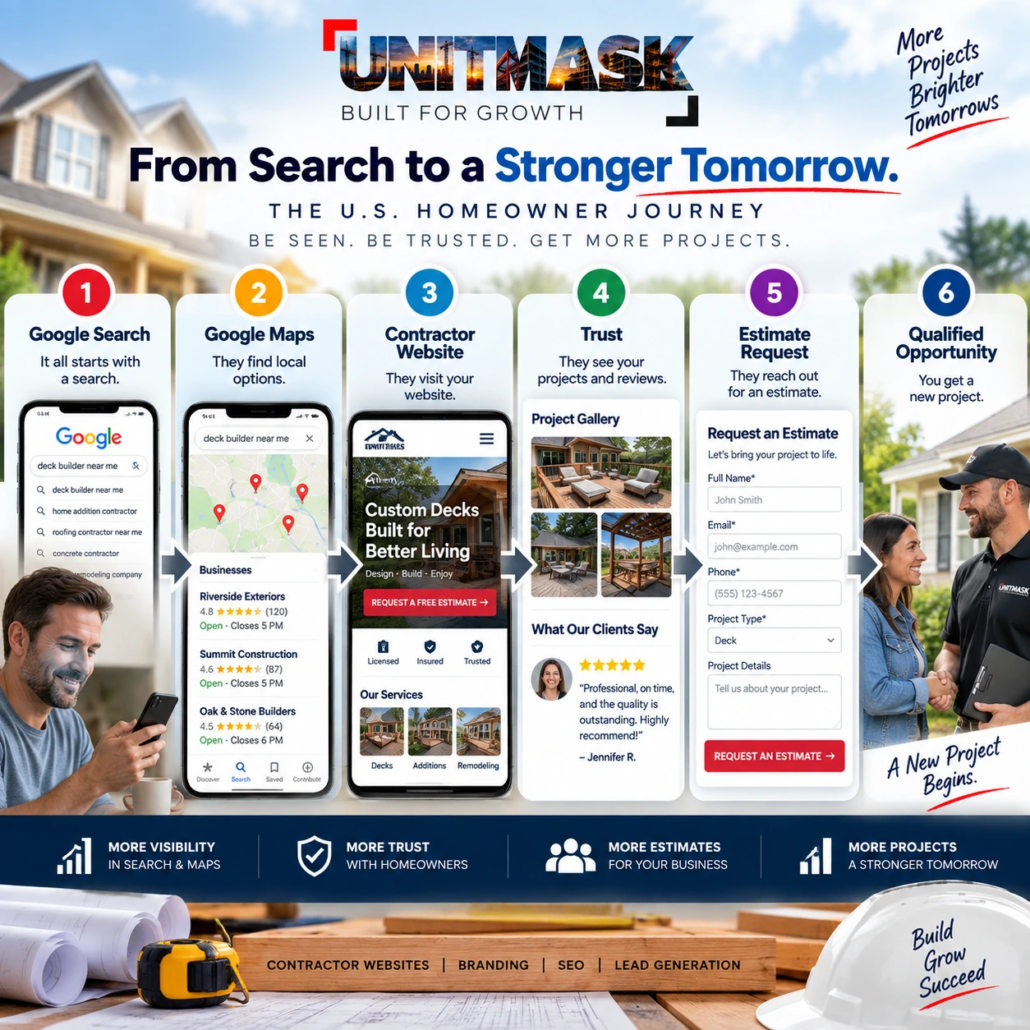
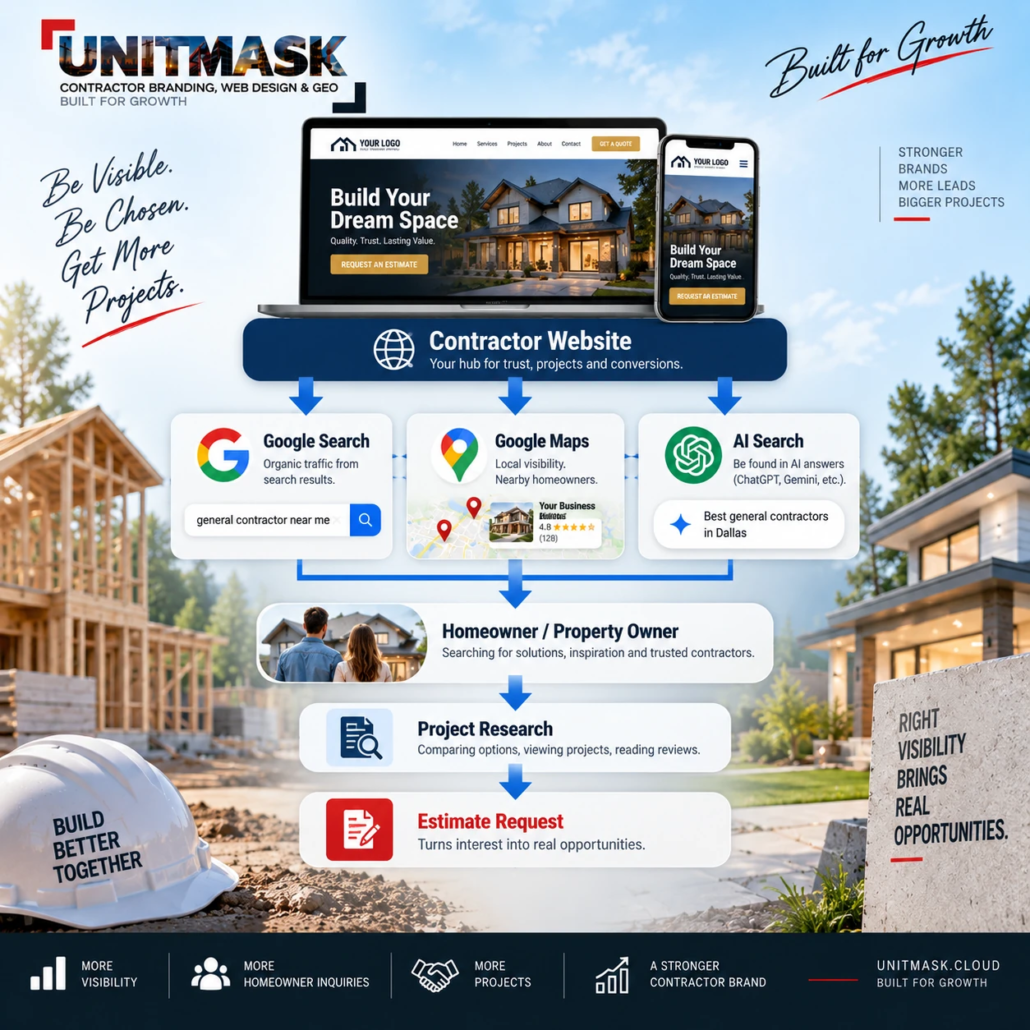
For a general contractor, effective SEO should connect the entire customer journey:
Search → Visibility → Website → Trust → Estimate Request → Qualified Opportunity
A contractor can generate more organic traffic and still see little business impact if the website does not establish credibility, explain project capabilities, show completed work, or make requesting an estimate easy.
That is why general contractor SEO in 2026 should be treated as a business growth system rather than a collection of keywords.
What Is SEO for General Contractors?
SEO for general contractors means making it easier for search engines to understand your contracting business and easier for potential customers to find it when they search for the work you actually perform.
For example, a contractor in Dallas may want visibility for searches such as:
- general contractor Dallas
- general contractor near me
- home addition contractor Dallas
- kitchen remodeling contractor Dallas
- commercial general contractor Dallas
- custom home builder Dallas
- whole house remodeling Dallas
These searches don’t necessarily belong on one page.
Someone looking for a kitchen remodel has a different need from someone planning a commercial tenant improvement. A strong SEO strategy creates enough structure for Google—and the potential customer—to understand those differences.
Google describes SEO more broadly as helping search engines understand content and helping users find a site and decide whether they should visit it. There is also no technique that guarantees a #1 Google ranking.
Google’s SEO guidance → Google SEO Starter Guide
Why SEO for General Contractors Is Different in 2026
General contractors face an SEO problem that many single-service businesses do not:
breadth.
A roofing company may concentrate heavily on roof repair and replacement.
A general contractor might handle:
- Kitchen remodeling
- Bathroom remodeling
- Home additions
- Whole-home renovations
- New construction
- Custom homes
- Commercial renovations
- Tenant improvements
- Design-build projects
Putting every service into one generic “Services” page makes it harder to create a highly relevant result for specific project searches.
Instead, your website needs to communicate both:
Broad capability + project-specific expertise.
Your Google presence also needs to establish that the company is real, serves the stated market, and has credible experience.
For higher-consideration construction projects, prospects may evaluate your projects, reviews, website, credentials, team and overall presentation before contacting you.
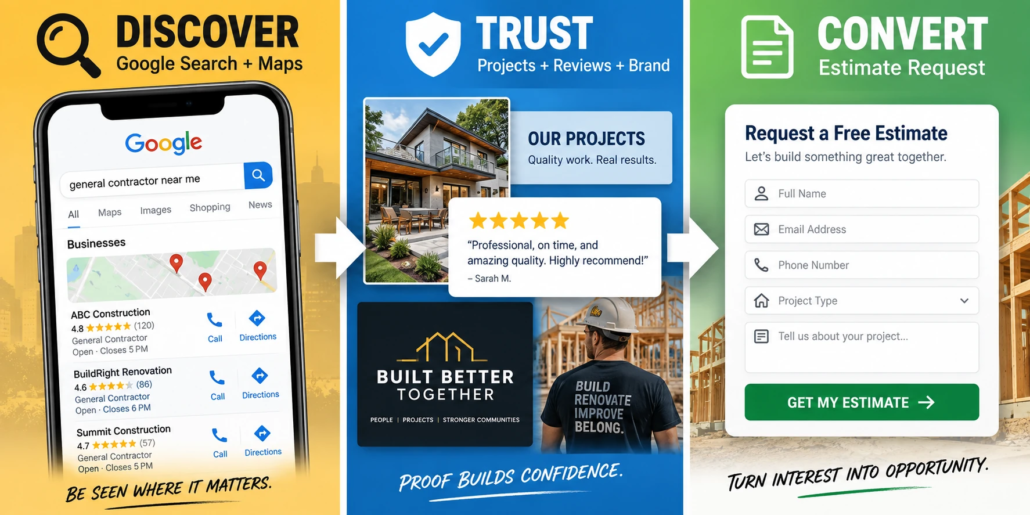
The three jobs of general contractor SEO
Think about the system in three layers:
1. Get discovered.
Become eligible and relevant for the searches that matter.
2. Build confidence.
Give prospects enough evidence to believe your company can handle their project.
3. Create action.
Make the next step—calling, requesting an estimate, or scheduling a consultation—obvious.
How Do Customers Search for General Contractors?
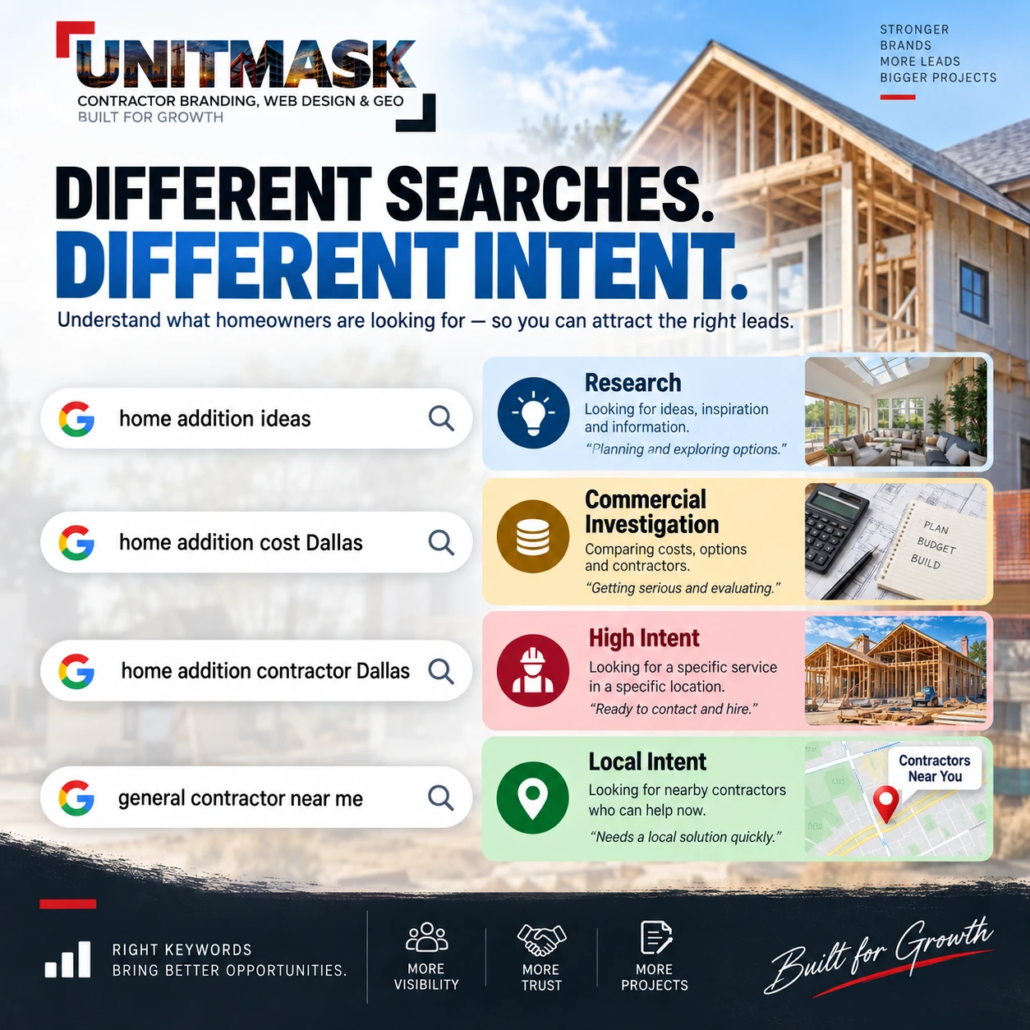
A common SEO mistake is targeting only:
“general contractor + city.”
Real search behavior is much broader.
1. Contractor-category searches
Examples:
“general contractor near me”
“general contractor Austin”
“general contractors in Phoenix”
These searches indicate that the prospect knows the type of business they want.
2. Project-specific searches
Examples:
“home addition contractor Austin”
“kitchen remodeling company Phoenix”
“commercial renovation contractor Dallas”
These can be extremely important because they reveal what the prospect actually wants built.
3. Research searches
Examples:
“How much does a home addition cost?”
“How long does a kitchen remodel take?”
“Do I need a general contractor for a renovation?”
These users may not be ready to request an estimate yet, but helpful content can introduce your company earlier in their decision process.
4. Trust and comparison searches
Examples:
“best general contractors in [city]”
“[company name] reviews”
“licensed general contractor [city]”
At this stage, your reputation and proof matter heavily.
Build keywords around the project, not just the trade
A useful keyword architecture can follow:
Service + Location + Intent
For example:
Kitchen Remodeling + Dallas + Contractor
becomes:
kitchen remodeling contractor Dallas
This gives you a much stronger framework than creating dozens of pages around slight keyword variations.
local ranking factors → Google Business Profile local ranking guidance
Local SEO for General Contractors: Google Maps Matters
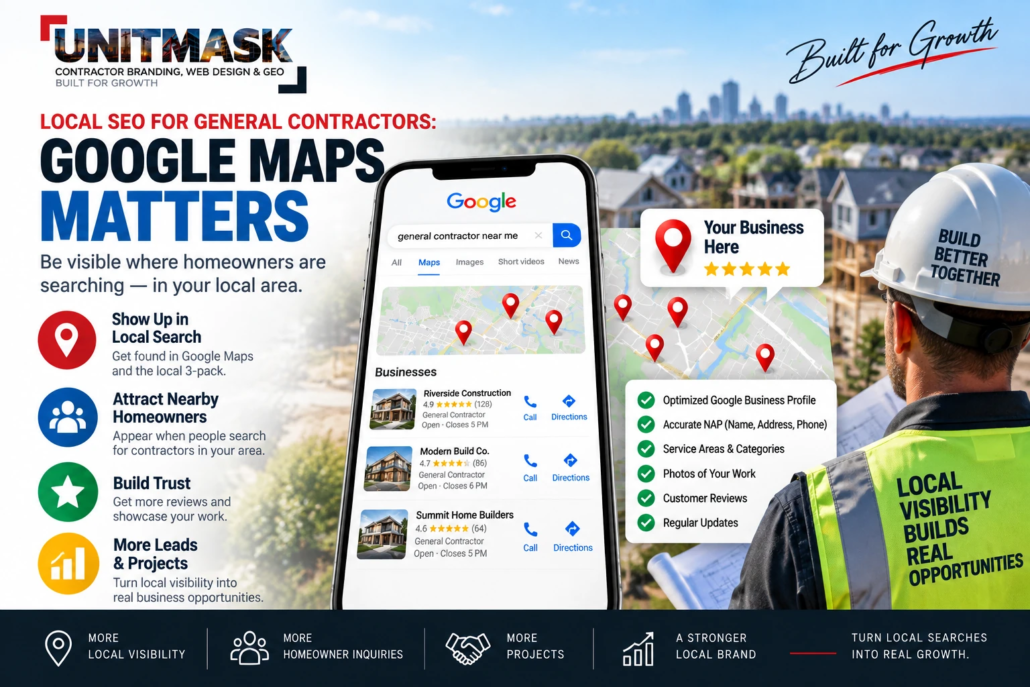
SEO for general contractors depends heavily on local visibility because most construction companies compete within defined service areas.
For many general contractors, SEO has two important visibility surfaces:
Google Maps/local results and organic website results.
They overlap, but they are not identical.
Google says local ranking is primarily determined by relevance, distance and prominence. Google also explicitly states that businesses cannot request or pay Google for better local rankings.
That makes accurate business information and legitimate local authority more important than tricks.
Optimize your Google Business Profile
Start with:
- Accurate business name
- Correct business category
- Accurate address or service-area configuration
- Phone number
- Website
- Business hours
- Services
- Business description
- Project photographs
- Reviews
- Relevant updates
Do not add keywords to your official business name unless they are genuinely part of the real-world business name.
Important for service-area contractors
Many contractors travel to customers rather than receiving customers at an office.
Google’s current guidelines say a service-area business that does not serve customers at its business address should remove/hide that address and specify its service area instead.
Google currently allows up to 20 service areas, and recommends keeping the overall area within roughly two hours of driving time from the business base in most cases.
Do not create fake offices or virtual locations simply to rank in additional cities.
Local SEO for Contractors: How to Rank Higher on Google Maps in 2026
Should General Contractors Create Service-Area Pages?
Yes—but only when those pages provide genuine value.
A contractor serving Dallas, Plano and Frisco could reasonably create separate pages when the company genuinely serves those markets and has enough information to make each page useful.
A strong location page might contain:
General Contractor in Plano, TX
Then explain:
- Services available in Plano
- Relevant projects completed in or around the market
- Neighborhood/property considerations where useful
- Project photographs
- Customer proof
- Service process
- FAQs
- Related services
- Estimate CTA
What to avoid
Do not create:
Dallas General Contractor
Plano General Contractor
Frisco General Contractor
McKinney General Contractor
…and then use virtually identical copy with only the city name changed.
Location pages should demonstrate genuine market relevance.
service area SEO strategy
Reviews Are Both Search and Sales Assets
Reviews matter beyond star ratings.
Google says review quantity and positive ratings can contribute to local prominence.
But from the customer’s perspective, reviews also answer questions like:
“Will this company communicate?”
“Did they finish the project professionally?”
“Would previous clients hire them again?”
“Do they seem experienced with projects like mine?”
That makes reviews part of both SEO and conversion optimization.
Ask legitimate customers for genuine feedback and make the process easy.
Never manufacture reviews.
Then reinforce that reputation on the website with authentic testimonials and relevant project proof.
contractor reviews and local SEO
Your Project Portfolio Can Become an SEO Asset
A photo gallery alone is useful for visual proof, but detailed project pages can do much more.
Instead of:
Project 17
create something like:
Whole-Home Renovation in Plano, Texas
Then document:
- Project type
- General scope
- Property/project challenge
- Approach
- Important construction details
- Before-and-after photographs where available
- Completed result
- Related service
- Location context
Do not reveal private customer information.
These pages can simultaneously strengthen:
Experience + local relevance + service relevance + conversion trust.

On-Page SEO for General Contractor Service Pages
Every important service page needs a clear search purpose.
For a page targeting:
Kitchen Remodeling Contractor in Austin
the page title might be:
Kitchen Remodeling Contractor in Austin, TX | Brand Name
The H1 could be:
Kitchen Remodeling Contractor in Austin, TX
But optimization should go far beyond inserting the phrase.
Explain:
- What you build
- Who you serve
- Your process
- What makes the service different
- Relevant completed projects
- Frequently asked questions
- Geographic coverage
- Next step
Use related language naturally rather than repeating the same exact keyword.
Optimize the basic elements
Review:
- SEO title
- Meta description
- H1
- H2/H3 hierarchy
- URL
- Opening paragraph
- Internal links
- Image alt text
- Image filenames
- Calls to action
Alt text should describe the image rather than become another place to stuff keywords.
service-area business rules → Google Business Profile service-area guidelines

Technical SEO: Build the Foundation First
Technical optimization creates the foundation that SEO for general contractors depends on.
Great content cannot perform at its full potential if search engines struggle to crawl or understand the website.
Your contractor website should be:
- Secure
- Mobile-friendly
- Fast enough for practical use
- Crawlable
- Indexable
- Logically structured
- Easy to navigate
Google specifically recommends websites that are secure, fast, accessible and functional across devices.
Check these technical elements
Review:
Indexing
Can Google access the pages you want indexed?
Canonicalization
Are duplicate or near-duplicate URLs being handled correctly?
Sitemap
Does the XML sitemap contain the important canonical pages?
Internal links
Can Google and users reach important pages logically?
Redirects
Are deleted or changed URLs handled appropriately?
Mobile usability
Can homeowners easily browse projects and request an estimate from a phone?
Structured data
Where appropriate, valid LocalBusiness structured data can help Google understand business information.
Google recommends validating structured data using the Rich Results Test and checking pages through URL Inspection.
Outbound link opportunity: Google Search Central — LocalBusiness structured data.
LocalBusiness structured data → Google Search Central LocalBusiness documentation
Content Marketing for General Contractors
Content supports SEO for general contractors by answering the questions property owners ask before requesting an estimate.
Do not start a contractor blog simply because an SEO checklist says “publish content.”
Create resources around real questions prospects ask before hiring.
Examples include:
Cost
“How Much Does a Kitchen Remodel Cost in Dallas?”
Process
“What Happens During a Whole-Home Remodel?”
Comparison
“Design-Build vs. General Contractor: What’s the Difference?”
Planning
“What Should You Ask a General Contractor Before Signing a Contract?”
Local
“Planning a Home Addition in [Market]: What Homeowners Should Consider”
These articles can support commercial service pages through contextual internal links.
Build topical clusters
For example:
Pillar: Kitchen Remodeling
Supporting content:
→ Kitchen remodel cost
→ Kitchen remodel timeline
→ Kitchen layout planning
→ Remodeling permits
→ How to choose a kitchen remodeling contractor
→ Kitchen remodeling project case study
This helps create a deeper topic resource instead of disconnected blog posts.
Build Authority Beyond Your Own Website
Backlinks can contribute to Google’s understanding of a business’s prominence, but link building should not mean purchasing random links.
For a legitimate construction company, opportunities may come from:
- Industry associations
- Local organizations
- Suppliers
- Manufacturers
- Architects/design partners
- Community involvement
- Local media
- Useful project features
- Business partnerships
The objective is not simply to accumulate the largest number of links.
Build a web presence that reflects the company’s real-world reputation.
Contractor SEO: The Complete Guide for U.S. Contractors in 2026
SEO for General Contractors in the Age of AI Search
Contractors now need to think beyond ten blue links.
Potential customers may encounter businesses through traditional organic results, Google Maps, AI Overviews, AI Mode and other answer engines.
But that does not mean contractors need a completely separate “AI SEO” strategy.
Google states that the fundamental SEO best practices used for Search continue to apply to its generative AI features and that there are no special technical requirements just to appear in AI Overviews or AI Mode.
A practical strategy therefore focuses on making information:
Clear. Specific. Verifiable. Useful. Well structured.
Make contractor content easier to understand
Instead of burying an answer beneath 500 words, answer important questions directly.
For example:
How does SEO help a general contractor?
SEO helps a general contractor become more visible when potential customers search for relevant construction services and projects. A complete strategy combines website optimization, local SEO, Google Business Profile management, useful content, reputation signals and conversion-focused website design.
That structure is good for readers and makes important information easier for search systems to interpret.
Traffic Alone Does Not Make Contractor SEO Successful
Imagine two contractors.
Contractor A
Gets 2,000 monthly organic visitors.
The website has:
- Weak project photography
- Few reviews
- Generic messaging
- Hidden contact information
- No strong estimate CTA
Contractor B
Gets fewer visitors but has:
- Clear service positioning
- Strong project proof
- Reviews
- Professional design
- Clear service areas
- Prominent estimate requests
Which website has the stronger business system?
Traffic is valuable only when the right visitor can understand and trust the company enough to take the next step.
This is why contractor SEO and contractor website design should work together.
Is Your Contractor Website Turning Search Traffic Into Opportunities?
Get a practical review of the SEO, trust and conversion issues that may be making it harder for homeowners to find or contact your business.
How Should General Contractors Measure SEO?
Do not judge SEO using rankings alone.
Track the funnel.
Search visibility
Monitor:
- Search impressions
- Search clicks
- Queries
- Landing pages
- Organic visibility
Local visibility
Track relevant Google Business Profile activity and local search performance.
Website engagement
Monitor whether visitors reach important:
- Service pages
- Project pages
- Contact pages
- Estimate forms
Lead actions
Track:
- Estimate requests
- Calls
- Form submissions
- Consultation bookings
Business outcomes
Where your CRM/process allows it, continue tracking:
Lead → Qualified Opportunity → Estimate → Won Project
This prevents a common mistake:
assuming an increase in traffic automatically means an increase in revenue.
Google Search Console is particularly useful for understanding how a site is performing in Google Search.
How Long Does SEO Take for a General Contractor?
There is no universal ranking timeline.
Results depend on factors such as:
- Current website condition
- Market competition
- Existing authority
- Google Business Profile strength
- Website architecture
- Content quality
- Technical problems
- Reviews and reputation
- Service-area competition
- Previous SEO work
A newer contractor website in a highly competitive metropolitan market may require significantly more work than an established business with years of projects, reviews and local recognition.
Avoid any agency promising:
“#1 rankings in 30 days.”
Google itself makes clear that there are no secrets that automatically rank a website first.
A better SEO engagement defines the work, tracks leading indicators and measures whether visibility is gradually creating meaningful business opportunities.
A Practical 90-Day General Contractor SEO Roadmap
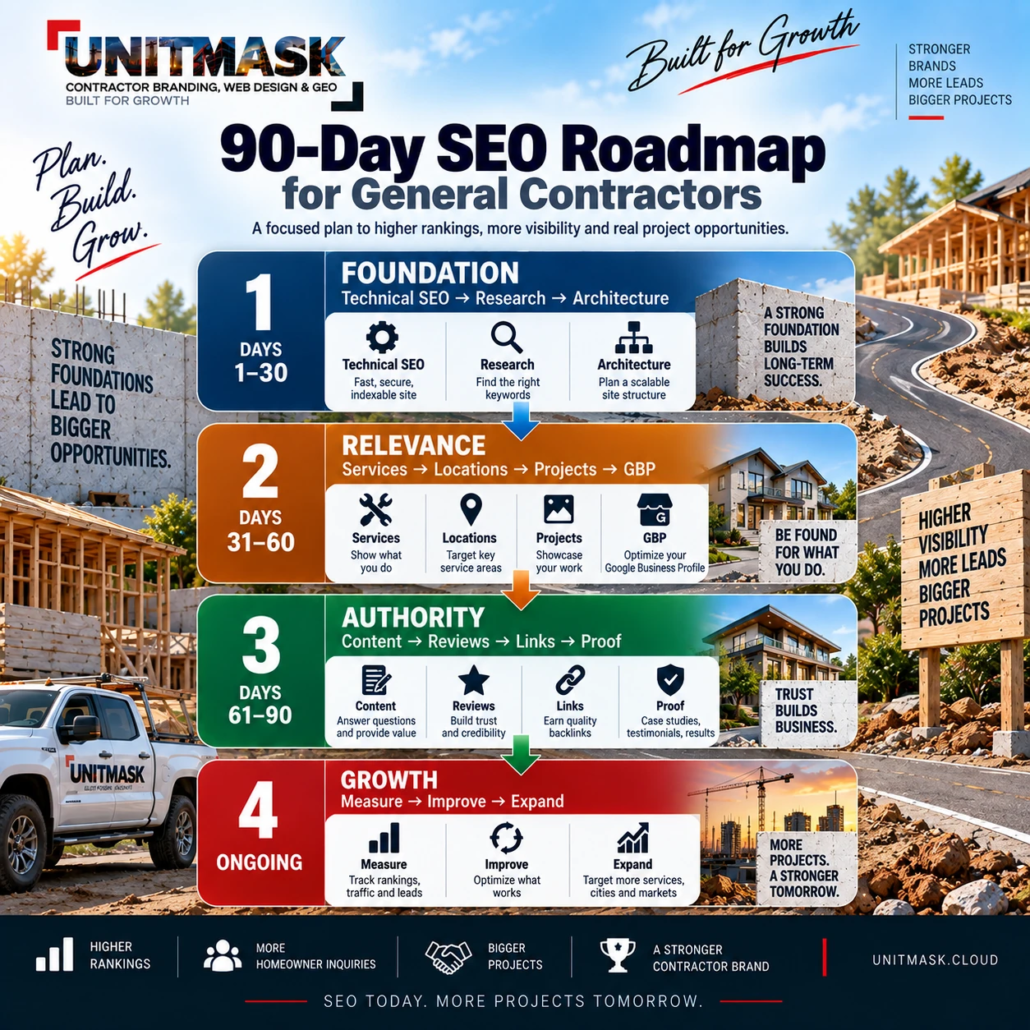
SEO for general contractors works best when improvements are implemented in a logical sequence rather than trying to fix everything at once.
Days 1–30: Build the Foundation
Audit:
- Indexing
- Technical SEO
- Website structure
- Google Business Profile
- Existing rankings
- Services
- Locations
- Reviews
- Conversion paths
Then establish the keyword-to-page map.
Decide which page should own each important search intent.
Days 31–60: Build Commercial Relevance
Improve or create:
- Core service pages
- Project pages
- Important service-area pages
- Internal links
- Titles and metadata
- Calls to action
- Google Business Profile content
Days 61–90: Build Authority and Information Depth
Start developing:
- Helpful supporting articles
- Additional project case studies
- Review acquisition process
- Local/industry authority opportunities
- Search Console reporting
- Lead tracking
Then use actual performance data to decide what to improve next.
General Contractor SEO Is a Growth System, Not a One-Time Fix
SEO for general contractors is most effective when search visibility, local presence, website experience, project proof, and conversion strategy work together as one connected growth system.
They connect:
Technical SEO
↓
Service + Location Relevance
↓
Google Search + Maps Visibility
↓
Content + Project Authority
↓
Professional Contractor Website
↓
Trust
↓
Estimate Request
↓
Qualified Opportunity
That is the larger objective.
Not simply ranking for more keywords.
Not simply publishing more blog posts.
And not simply increasing traffic.
The goal is to create a search presence that helps the right prospects discover, evaluate and contact your contracting business.
Frequently Asked Questions About SEO for General Contractors
What is SEO for general contractors?
SEO for general contractors is the process of improving a contracting company’s visibility in search engines for relevant construction services, projects and local searches. It typically combines website SEO, local SEO, Google Business Profile optimization, content, reputation signals and technical improvements.
Does SEO work for general contractors?
SEO can help a general contractor become more discoverable when potential customers search for relevant services. Results depend on competition, market, website quality, local presence, authority and execution, so no legitimate provider can guarantee a particular ranking or number of leads.
Is local SEO important for general contractors?
Yes. General contractors usually serve defined geographic markets, making local search particularly important. Google says local results are primarily influenced by relevance, distance and prominence.
How can a general contractor rank higher on Google Maps?
Start with an accurate and complete Google Business Profile, correct categories, legitimate service-area information, consistent business details, useful photos, genuine reviews and a strong broader web presence. There is no method to pay Google for a better organic local ranking.
Should general contractors create a page for every city?
Not automatically. Create service-area pages when you genuinely serve the location and can provide unique, useful information. Avoid mass-producing nearly identical city pages simply to target keywords.
Should every contracting service have its own page?
Important services with distinct customer intent generally benefit from dedicated pages. Kitchen remodeling, home additions and commercial renovations, for example, answer different needs and deserve different content when they are genuine core services.
Do project portfolio pages help contractor SEO?
They can. Detailed project pages provide original evidence of experience and can reinforce service and geographic relevance while helping prospective customers evaluate the contractor.
How long does contractor SEO take?
There is no fixed timeline. Results depend on competition, the website’s starting condition, local authority, technical issues, content, reviews and many other factors. Be cautious of guaranteed ranking timelines.
Does AI search change contractor SEO?
It changes where prospects may discover information, but Google’s current guidance says foundational SEO best practices continue to apply to AI Overviews and AI Mode. Clear, useful, original and well-structured contractor content therefore remains important.
What should a general contractor track from SEO?
Track more than rankings. Monitor search impressions, clicks, important landing pages, local visibility, calls, estimate forms, qualified opportunities and—where possible—projects ultimately won from organic search.
What We See When Auditing General Contractor Websites
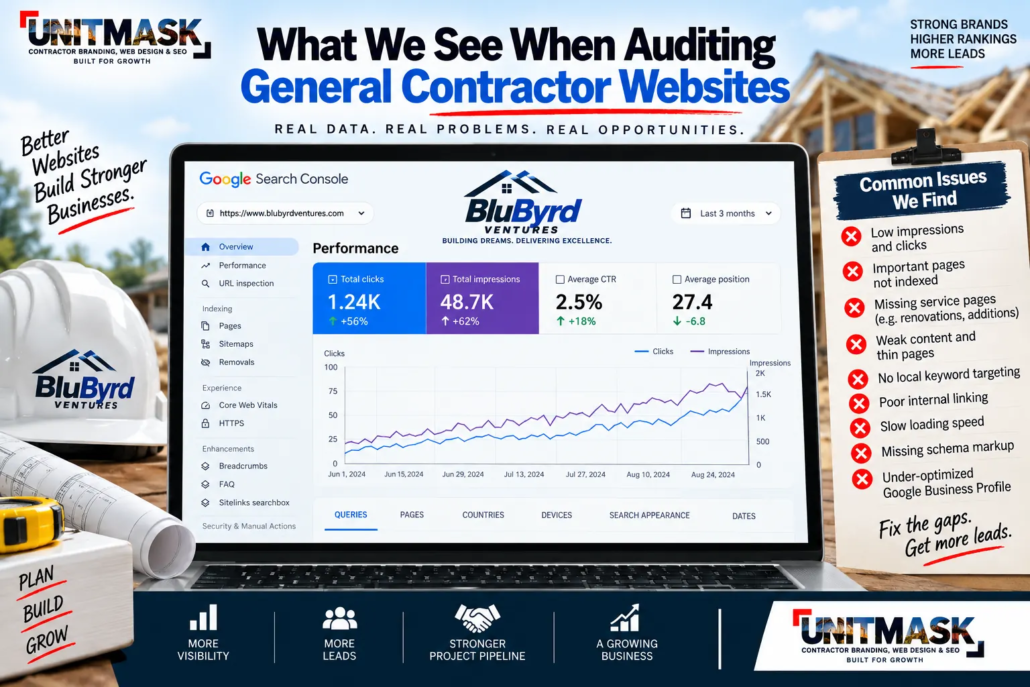
When we audit general contractor websites, the biggest SEO problems are rarely limited to rankings. We often find a combination of technical SEO issues, weak service pages, indexing gaps, poor local targeting, and missing trust signals that make it harder for potential customers to find and choose the contractor.
Common issues include important pages not being indexed, thin content, missing pages for services such as remodeling, additions, commercial construction, and design-build, weak location targeting, poor internal linking, slow page speed, and incomplete schema markup.
We also review Google Search Console to understand which pages and search queries are generating impressions and clicks—and where the website is losing opportunities. Combined with the website structure and Google Business Profile, this can reveal gaps between search visibility and actual contractor leads.
For a general contractor, the goal isn’t simply to rank for more keywords. The website should create a clear path from:
Google Search → Relevant Service Page → Project Proof + Trust → Call or Estimate Request
Not sure what’s limiting your contractor website’s Google visibility?
Get a Free Contractor Website & SEO Audit from Unitmask to identify technical, content, local SEO, and conversion opportunities.
Are you currently investing in SEO for your construction business?
What has been the biggest challenge—Google Maps visibility, website rankings, or generating qualified leads? Share your experience or question in the comments below.
 Unitmask.cloud
 Unitmask.cloud
Leave a Reply
Want to join the discussion?Feel free to contribute!