What Is Included in Contractor SEO? 2026 Guide for U.S. Contractors
What is included in contractor SEO in 2026? For U.S. contractors, effective SEO goes far beyond rankings. It combines local visibility, website optimization, service and location pages, content, reviews, authority building, and lead tracking to turn Google searches into real business opportunities.

Hiring an SEO company for your construction business shouldn’t mean paying every month for a vague report filled with rankings, impressions, and technical jargon.
For a U.S. contractor, SEO should have a much clearer purpose:
Help the right homeowners, property owners, developers, or commercial clients find your business when they’re actively searching for the services you provide.
Whether you run a roofing company, remodeling business, HVAC company, plumbing company, concrete contractor, electrical business, landscaping company, or general contracting firm, a complete contractor SEO strategy should connect:
Google Search + Google Maps → Contractor Website → Trust → Estimate Request → Qualified Lead
But what exactly should be included in professional contractor SEO services?
This guide breaks down the major components U.S. construction businesses should expect from an SEO provider in 2026—and the warning signs that may indicate you’re paying for activity rather than meaningful growth.
If you’re wondering what is included in contractor SEO, the answer goes far beyond adding keywords to a website. A complete strategy should connect technical SEO, local visibility, content, authority, and conversion tracking.
What Are Contractor SEO Services?
Contractor SEO services are a combination of website, content, local search, authority-building, and technical strategies designed to improve a construction company’s visibility when potential customers search online.
For example, a roofing contractor in Dallas may want to appear for searches such as:
- roofing contractor Dallas
- roof replacement Dallas TX
- commercial roofing company Dallas
- storm damage roof repair near me
- roofing company near me
The objective isn’t simply to rank for as many keywords as possible.
The objective is to become visible for searches that can realistically turn into business opportunities.
That’s an important distinction.
Ranking #1 for a low-value informational keyword may produce traffic without producing projects.
Ranking prominently when a homeowner searches “kitchen remodeling contractor near me” could be much more valuable.
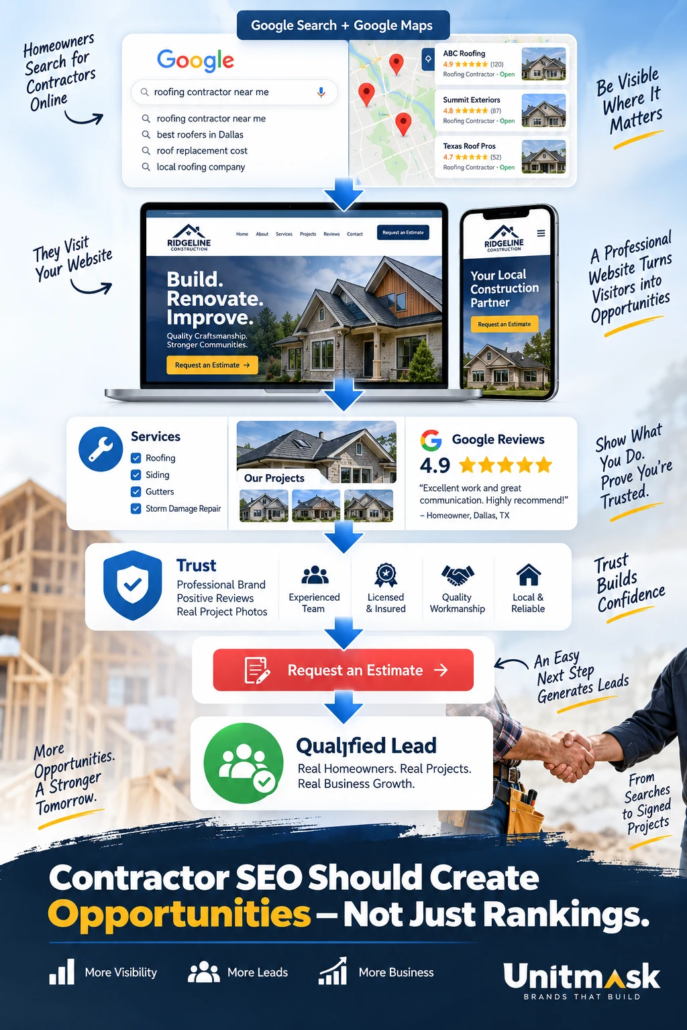
What Is Included in Contractor SEO in 2026?
Understanding what is included in contractor SEO makes it easier to evaluate an SEO strategy based on leads and business opportunities—not rankings alone.
Think of contractor SEO as a system rather than a single tactic.
Technical SEO → Keyword Strategy → Website Optimization → Local SEO → Content → Authority → Conversion → Measurement
If an SEO provider concentrates on only one piece of that system, growth may eventually hit a ceiling.
Here are the major components you should look for.
1. Contractor SEO Audit and Competitor Analysis
SEO shouldn’t begin by randomly adding keywords to your website.
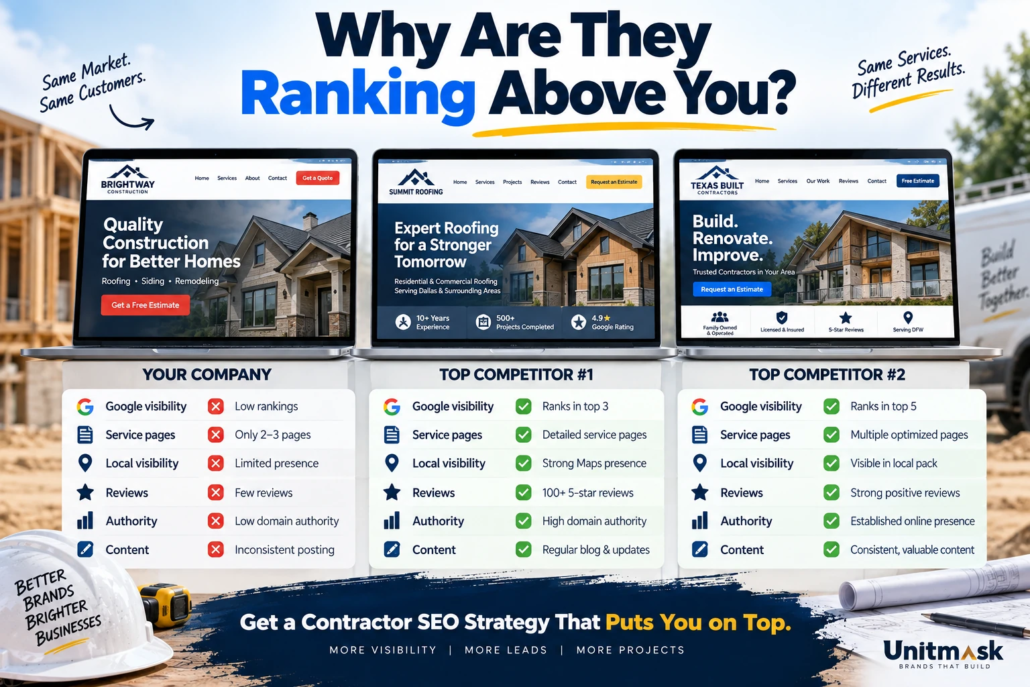
It should begin with understanding your current position.
A professional contractor SEO audit should evaluate areas such as:
- current Google visibility
- pages currently receiving organic traffic
- keywords already ranking
- technical website problems
- indexation issues
- website architecture
- existing service pages
- local SEO presence
- Google Business Profile
- backlinks
- competitors
- content gaps
- conversion opportunities
Competitor analysis is particularly important.
If three roofing companies consistently appear above you for important searches in your market, the SEO strategy should investigate why.
Perhaps they have stronger service pages.
Perhaps they have substantially more local authority.
Perhaps their websites cover individual services better.
Perhaps they have stronger backlinks or more useful project content.
Perhaps their Google Business Profiles are better aligned with the searches customers perform.
SEO strategy should come from those gaps—not from a generic checklist.
2. Keyword Research Based on Contractor Search Intent
Keyword research for contractors should go much deeper than finding high-volume phrases.
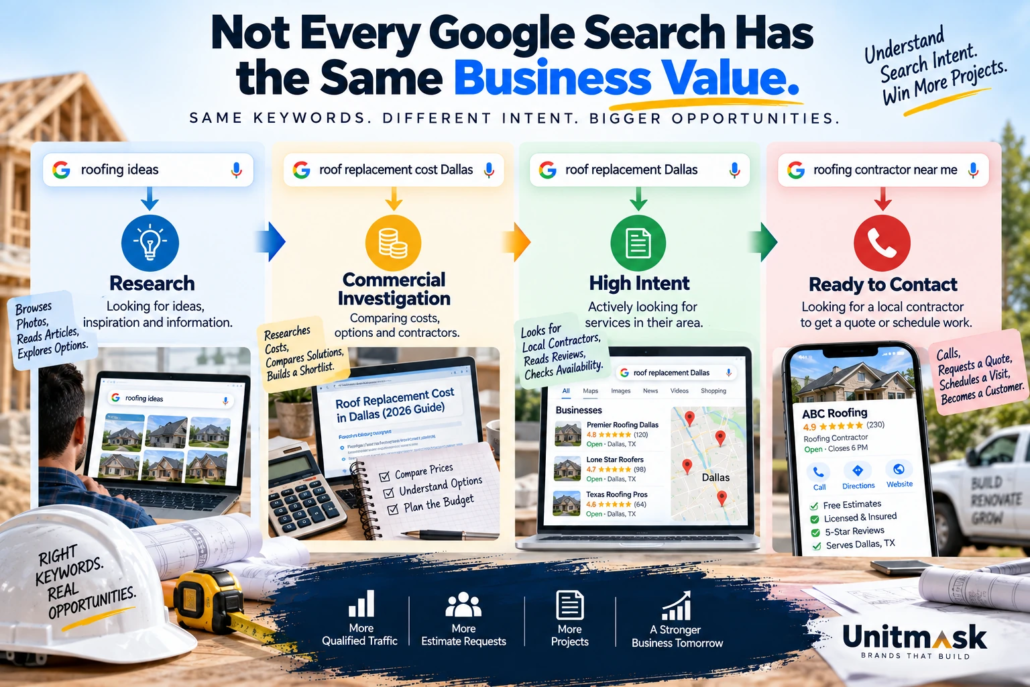
Your SEO provider should identify the searches people use at different stages of the buying process.
For example:
Informational intent
“how long does a roof last”
The homeowner is researching.
Commercial investigation
“roof replacement cost Dallas”
The homeowner may be moving closer to hiring.
Transactional/local intent
“roofing contractor Dallas”
The homeowner is actively looking for a contractor.
These searches shouldn’t all receive the same priority.
For most contractors, some of the highest-value SEO opportunities come from combinations of:
Service + Location
Examples include:
“bathroom remodeling contractor Austin”
“HVAC repair Phoenix”
“concrete contractor Tampa”
“commercial electrician Houston”
“roof replacement Dallas”
A strong keyword strategy therefore maps different search terms to the appropriate pages instead of trying to rank the homepage for everything.
3. Website Architecture and Service Page Strategy
This is one of the most important elements of contractor SEO.
Imagine a general contractor offering:
- Kitchen Remodeling
- Bathroom Remodeling
- Home Additions
- Whole-Home Remodeling
- Outdoor Living
Putting every service into a few paragraphs on the homepage can make it difficult to build strong search relevance for each service.
Instead, the website may need a structure such as:
Home
↓
Services
├── Kitchen Remodeling
├── Bathroom Remodeling
├── Home Additions
├── Whole-Home Remodeling
└── Outdoor Living
Each important service deserves enough useful, original information to answer the questions potential customers actually have.
That might include:
- what the service involves
- who it’s for
- common project types
- process
- materials or options
- completed work
- FAQs
- service areas
- testimonials
- next steps
This simultaneously improves SEO relevance and helps visitors understand why they should contact you.
Contractor SEO: The Complete Guide for U.S. Contractors in 2026
4. On-Page SEO
Once the correct pages exist, each important page should be optimized around its actual search purpose.
Professional on-page SEO services can include optimization of:
- title tags
- meta descriptions
- H1 headings
- H2/H3 structure
- page copy
- keyword targeting
- image alt text
- image filenames
- internal links
- URLs
- calls to action
- content hierarchy
But optimization doesn’t mean repeating “Dallas roofing contractor” twenty times.
The page should first be useful to the person reading it.
Search optimization should strengthen that usefulness—not destroy readability.
5. Local SEO for Contractors
For many contractors, local SEO is one of the most commercially important parts of SEO.
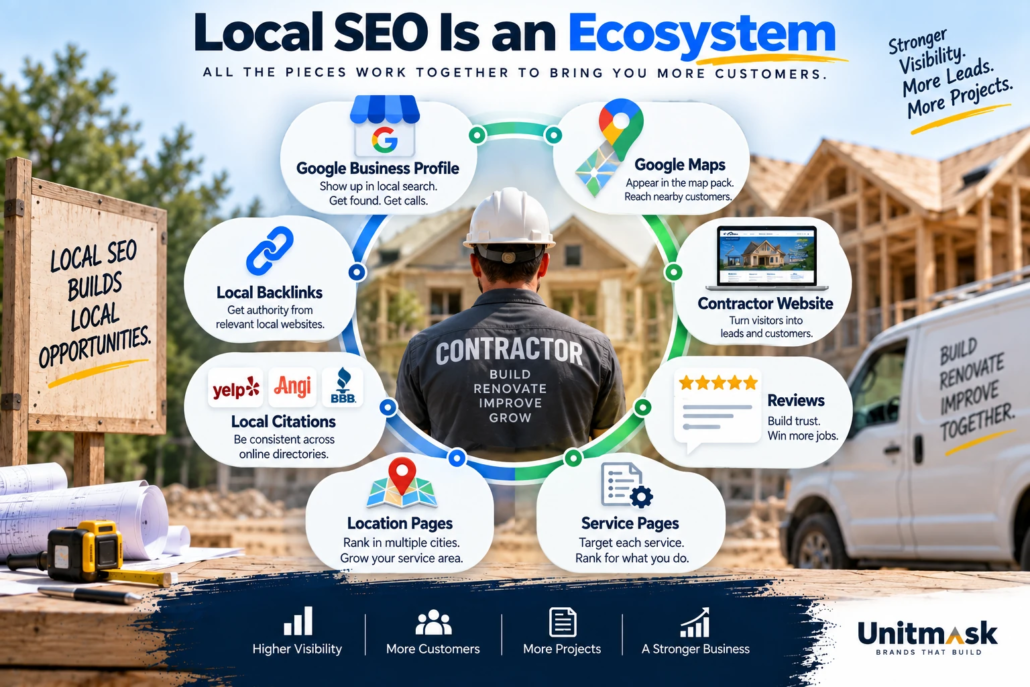
Why?
Because contractors typically don’t need traffic from everywhere in the United States.
They need customers in the areas they actually serve.
A contractor operating around Dallas, Plano and Frisco needs visibility among potential customers in those markets.
Local SEO can include:
- Google Business Profile optimization
- service-area strategy
- local keyword research
- local landing pages
- business information consistency
- reviews
- local citations
- locally relevant content
- local links
- Google Maps visibility analysis
Google itself explains that local results are primarily determined by relevance, distance and prominence.
That means there isn’t a button an SEO agency can press to guarantee the #1 Maps position.
Instead, your strategy should improve the signals you can realistically influence.
Contractor Local SEO: How to Rank for “Near Me” Searches in 2026
According to Google’s official guidance on local search ranking, local results are primarily based on relevance, distance, and prominence.
6. Google Business Profile Optimization
Your Google Business Profile shouldn’t be treated as an isolated listing.
It should work alongside your website.
Optimization should examine elements such as:
- correct business category
- additional relevant categories
- services
- business description
- contact information
- hours
- photos
- reviews
- service areas
- website connection
- ongoing accuracy
Google recommends keeping Business Profile information complete and accurate and says reviews and photos can help businesses stand out in local results.
Google also specifically states that more reviews and positive ratings can contribute to local prominence.
The important point is that your website SEO and Business Profile strategy should support each other.
Google Business Profile Optimization for Contractors
Local SEO for Contractors: How to Rank Higher on Google Maps in 2026
7. Contractor Service Area Pages
Contractors serving multiple markets may benefit from dedicated location or service-area content.
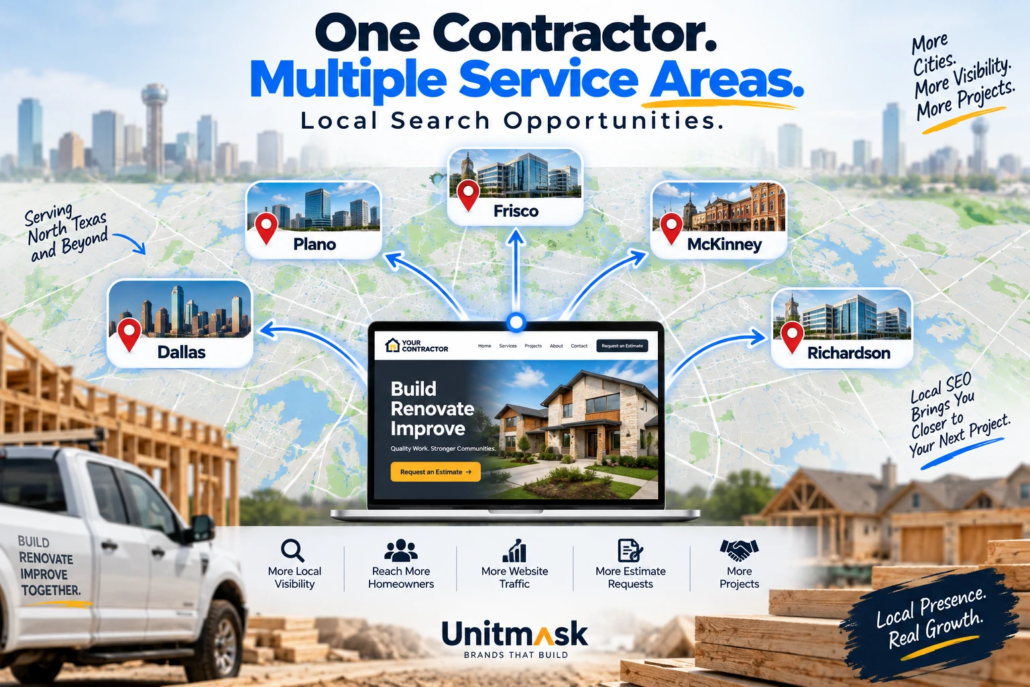
For example, an HVAC company might serve:
Dallas
Plano
Frisco
McKinney
Richardson
But creating five pages and replacing only the city name is not a strong strategy.
Each location page should have a legitimate reason to exist and provide useful local information.
That can include:
- services available in the area
- projects completed nearby
- relevant testimonials
- neighborhoods served
- local project considerations
- photos
- FAQs
- local proof
- appropriate contact information
The goal should be genuinely useful location content rather than mass-produced doorway-style pages.
How to Create Contractor Service Area Pages That Rank Without Duplicate Content
8. Technical SEO
Even excellent content can struggle when the underlying website has significant technical problems.
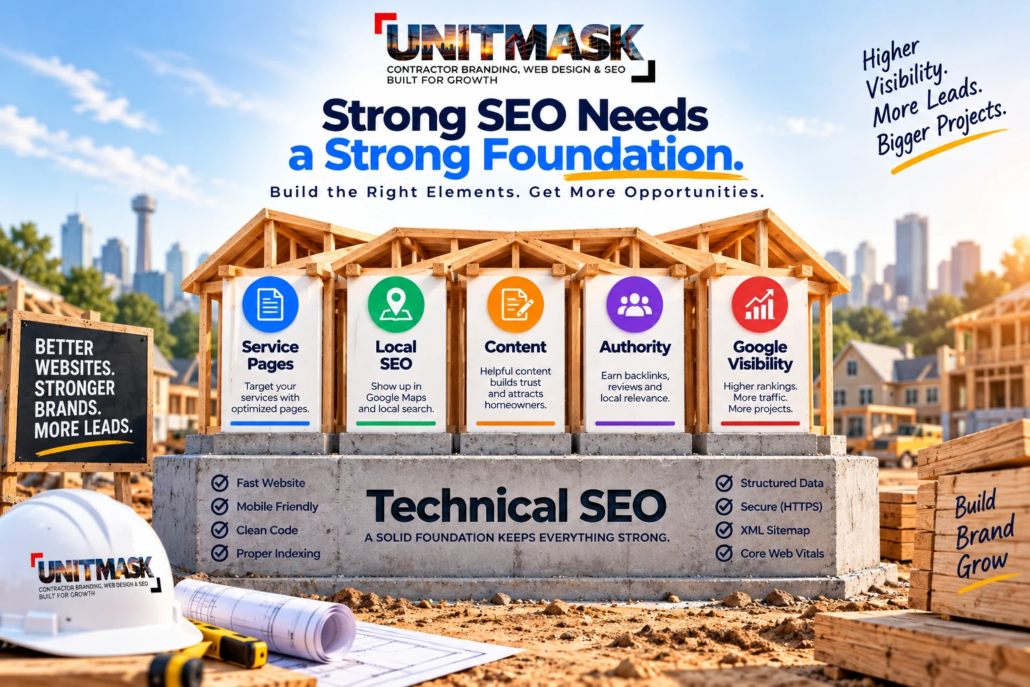
Contractor SEO services should therefore include ongoing technical monitoring.
Important areas can include:
- crawlability
- indexability
- XML sitemap
- robots directives
- canonicalization
- broken links
- redirects
- duplicate content
- mobile usability
- page performance
- HTTPS
- structured data where appropriate
- website architecture
Google supports structured data that can help it understand information about businesses and pages. LocalBusiness structured data, for example, can communicate relevant business information in a standardized format.
Technical SEO isn’t glamorous.
But it creates the foundation upon which the rest of your SEO strategy operates.
Google also provides official LocalBusiness structured data documentation for helping search engines understand business information.
9. Content Strategy
Contractor SEO isn’t finished when your core service pages are optimized.
Your website should gradually become a useful resource around the services customers are researching.
For example, a remodeling company might publish content around:
- kitchen remodeling costs
- bathroom remodeling timelines
- remodeling permits
- material comparisons
- renovation planning
- common remodeling mistakes
- project preparation
- local remodeling considerations
This creates opportunities to reach homeowners before they’re ready to request an estimate.
The strategy becomes:
Research → Discover Contractor → Build Trust → Compare Options → Request Estimate
Content should therefore support the customer’s buying journey—not exist simply because someone said Google likes blogs.
10. Internal Linking
Internal linking is frequently overlooked on contractor websites.
Suppose you’ve published:
How Much Does a Roof Replacement Cost in Dallas?
That article could naturally link to your:
Roof Replacement Service
page.
Your roof replacement page could link to:
Roofing Contractor Dallas
where appropriate.
Related educational articles can link to one another.
The result is a connected content ecosystem rather than dozens of isolated pages.
For your visitors, those links help them continue researching.
For search engines, they help clarify page relationships and site structure.
11. Authority and Link Building
Strong websites don’t exist in isolation.
Google’s own explanation of local prominence notes that information such as links to a business can contribute to how prominent it is considered locally.
For contractors, authority building can potentially include legitimate links and mentions from:
- local organizations
- industry associations
- manufacturers
- suppliers
- business partners
- chambers of commerce
- relevant publications
- sponsorships
- project collaborations
- useful industry resources
Be cautious when an SEO company promises hundreds or thousands of backlinks every month.
Quality, relevance and legitimacy matter much more than a giant spreadsheet of questionable links.
12. Review and Reputation Strategy
Reviews aren’t just about SEO.
They’re about whether someone trusts your company enough to make contact.
Imagine two contractors appearing next to each other.
One has a poorly maintained profile with little recent customer feedback.
The other has a strong collection of genuine reviews, professional responses and recent project photos.
Which one feels safer to contact?
Your SEO strategy should therefore connect visibility with reputation.
How to Get More Google Reviews for Your Construction Business
13. Conversion Optimization
This is where contractor SEO often goes wrong.
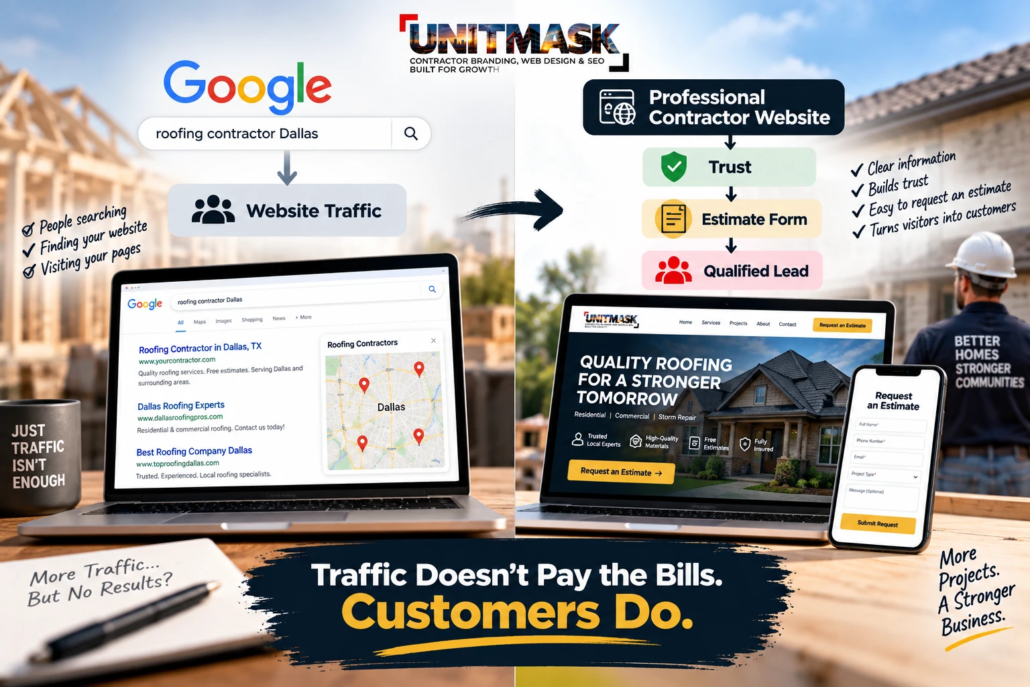
An agency generates traffic.
Traffic increases.
Everyone celebrates.
But estimate requests barely change.
SEO shouldn’t stop at getting someone onto the website.
The website also needs to turn relevant visitors into opportunities.
Important conversion elements include:
- clear headline
- visible phone number
- Request an Estimate CTA
- project photos
- testimonials
- reviews
- credentials
- service-area information
- mobile-friendly design
- simple estimate form
- clear services
- trust signals
14. Tracking and Reporting
“Rankings increased 18%.”
The business owner needs to understand whether search visibility is contributing to actual opportunities.
Useful measurement can include:
- organic search visibility
- Google Search Console clicks
- impressions
- important keyword trends
- organic landing pages
- Google Business Profile performance
- calls
- estimate form submissions
- conversion rate
- qualified leads
- lead sources
Where the tracking setup permits it, you ultimately want to understand:
SEO → Lead → Estimate → Project → Revenue
That gives SEO a business context.
What Is Included in Monthly Contractor SEO?
Understanding what is included in contractor SEO each month is important because the priorities should change as your website and local visibility improve.
SEO shouldn’t be the exact same checklist every month.
Priorities should change as the campaign develops.
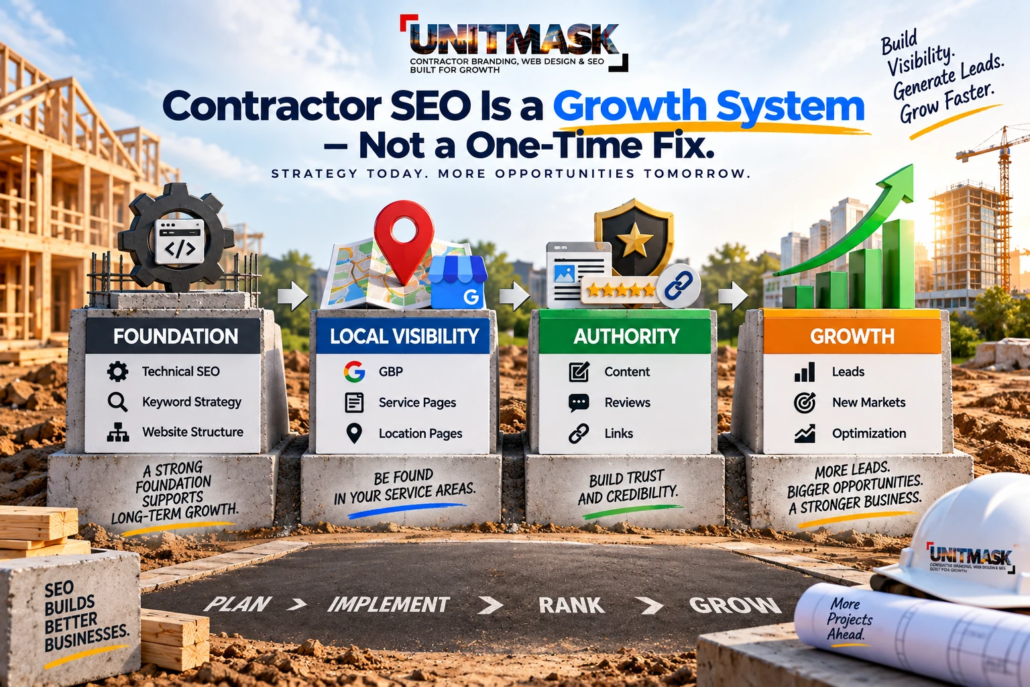
An early-stage campaign might concentrate heavily on:
Audit → Technical Fixes → Keyword Mapping → Service Pages → Google Business Profile
Later, the focus may shift toward:
Content → Location Expansion → Authority → Conversion Optimization
And eventually:
Competitive Gaps → Additional Markets → Authority Growth → Continuous Improvement
Red Flags When Hiring a Contractor SEO Company
Not every SEO service is equally useful.
Be cautious if an SEO provider:
- guarantees #1 Google rankings
- promises instant SEO results
- can’t explain what they’re changing
- talks only about traffic
- sends generic reports without business context
- creates hundreds of thin location pages
- purchases large quantities of questionable backlinks
- ignores Google Business Profile
- ignores conversion tracking
- doesn’t understand your services or service area
Google explicitly states that businesses cannot request or pay Google for better local rankings.
Any SEO company guaranteeing a specific Maps position should therefore be treated carefully.
Contractor SEO Checklist: What Should Be Included?
Before hiring an SEO provider, use this checklist.
Your contractor SEO package should potentially address:
☐ SEO audit
☐ Competitor research
☐ Keyword research
☐ Search-intent mapping
☐ Website architecture
☐ Service-page optimization
☐ On-page SEO
☐ Technical SEO
☐ Google Business Profile
☐ Local SEO
☐ Service-area strategy
☐ Content strategy
☐ Internal linking
☐ Review strategy
☐ Authority/link building
☐ Conversion optimization
☐ Analytics and Search Console
☐ Lead/conversion tracking
☐ Ongoing reporting
☐ Continuous optimization
If several of these are completely missing, ask your provider why.
How Much Do Contractor SEO Services Cost?
There isn’t one universal price for contractor SEO.
The amount of work required depends on factors such as:
- number of services
- number of locations
- market competitiveness
- current website condition
- existing authority
- content requirements
- technical problems
- competitors
- growth objectives
A roofing company competing across several major metropolitan markets may require a significantly different strategy from a specialized contractor serving one smaller market.
Rather than asking only:
“How much does SEO cost?”
Ask:
“What exactly is included, and how does each part help us generate more qualified opportunities?”
→ See our complete guide: How Much Does Contractor SEO Cost in the U.S. in 2026?
Should Contractors Invest in SEO?
SEO can make sense when potential customers are already searching Google for the services you provide.
Consider the customer journey:
A homeowner discovers a roof leak.
They search:
“roof repair near me.”
They compare contractors.
They look at reviews.
They visit websites.
They view projects.
They request estimates.
SEO helps put your company into that decision-making process.
But visibility alone isn’t enough.
The strongest strategy connects:
Contractor Branding → Professional Website → Google Search + Maps → Trust → Estimate Request → New Project
That’s why contractor SEO should be approached as part of the company’s overall digital growth system rather than an isolated marketing tactic.
FAQs: What Is Included in Contractor SEO?
What should contractor SEO services include?
A comprehensive contractor SEO service should typically address technical SEO, keyword research, service-page optimization, local SEO, Google Business Profile optimization, content, internal linking, authority building, conversion optimization and performance measurement.
Is local SEO important for contractors?
For businesses serving specific geographic markets, local SEO can be extremely important because many potential customers search for contractors by service and location or use searches such as “contractor near me.”
Does contractor SEO include Google Maps?
A complete local SEO strategy should consider Google Business Profile and Google Maps visibility alongside website optimization. However, no legitimate SEO provider can guarantee a specific Maps ranking.
How long does contractor SEO take?
SEO is an ongoing process rather than an instant advertising channel. The timeline varies depending on competition, the website’s current condition, market, authority and the amount of work required.
Do contractors need separate service pages?
Often, yes. Important services usually benefit from dedicated pages when there is enough unique information and search demand to justify them. A roofing contractor, for example, may need separate pages for roof replacement, roof repair and commercial roofing rather than trying to rank one generic page for everything.
Do contractors need city pages?
They can be useful when a contractor genuinely serves multiple markets and each page provides meaningful, unique local value. Simply cloning the same page and replacing the city name is not a strong long-term strategy.
Can SEO guarantee contractor leads?
No. SEO can increase qualified search visibility and opportunities, but lead volume depends on competition, demand, location, rankings, website quality, reputation, offer, conversion rate and other factors.
Final Takeaway
Contractor SEO shouldn’t be sold as a mysterious monthly service.
A construction business owner should be able to understand exactly what is being improved and why.
The strongest contractor SEO strategies connect:
Technical Foundation
↓
Service + Location Relevance
↓
Google Search + Maps Visibility
↓
Authority + Trust
↓
Professional Contractor Website
↓
Estimate Requests
↓
Qualified Opportunities
When evaluating an SEO provider, don’t just ask about rankings. Ask what is included in contractor SEO and how each activity contributes to visibility, estimate requests, and qualified opportunities.
Want to Know What’s Holding Your Contractor Website Back on Google?
If you’re a U.S. contractor and you’re unsure whether your website, Google visibility, local SEO or service-page structure is limiting your lead generation, Unitmask can review the current setup.
Get a Free Contractor SEO Audit
We’ll identify potential visibility gaps, website issues and opportunities that may be preventing your construction business from getting more value from Google Search and Maps.
Are you currently investing in SEO for your construction business?
What has been the biggest challenge—Google Maps visibility, website rankings, or generating qualified leads? Share your experience or question in the comments below.
 Unitmask.cloud
 Unitmask.cloud
Leave a Reply
Want to join the discussion?Feel free to contribute!