How Much Does a Contractor Website Cost in 2026?
Contractor websites can cost hundreds to $15,000+. See 2026 U.S. pricing, what each option includes, hidden costs, SEO, and what your business needs.
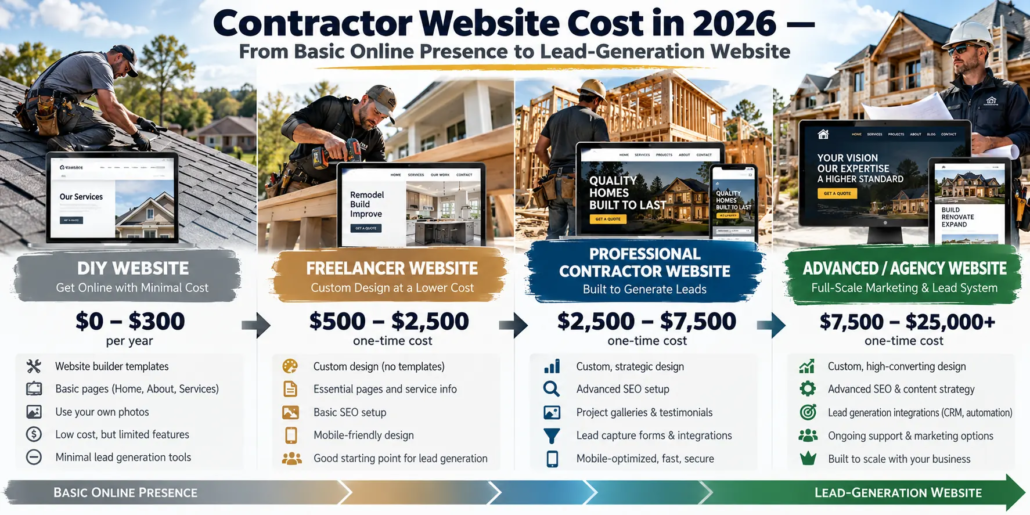
A contractor website in the U.S. can cost anywhere from a few hundred dollars for a basic DIY setup to $15,000 or more for a custom, professionally built website with advanced functionality, content, and search optimization.
But that range isn’t particularly useful until you understand what you’re actually buying.
A $500 website and a $7,500 website may both have a Home, About, Services, Projects, and Contact page. They can still be fundamentally different products.
For a contractor, the better question is:
What does my website need to accomplish for my business—and what should I reasonably pay to accomplish it?
This guide breaks down contractor website costs in 2026, what affects the price, what should be included, which costs are often left out of quotes, and how much different types of construction businesses should consider investing.
How Much Does a Contractor Website Cost in 2026?
For budgeting purposes, U.S. contractors will commonly encounter offers ranging from under $1,000 for basic/template implementations to several thousand dollars for professionally planned websites, with larger custom agency projects reaching $10,000–$15,000 or considerably more.
- Website Approach
- DIY website builder
- Budget/template implementation
- Freelancer/small studio
- Professional contractor website
- Larger custom agency project
- Approximate Market Range
- $0–$1,000+ first year
- $500–$2,000
- $1,500–$6,000
- $3,000–$10,000+
- $10,000–$25,000+
- Usually Best For
- New or very small contractors needing basic presence
- Contractors primarily dependent on referrals
- Small established construction businesses
- Businesses expecting the site to support lead generation
- Multi-location or more complex organizations
Important: These are market observations, not standardized U.S. rates. Website providers package services differently, so two quotes at the same price can include completely different scopes.
One provider may include copywriting, conversion strategy, analytics and basic SEO.
Another may simply design the pages and expect you to provide everything else.
That’s why price should never be compared without scope.
Contractor Website Cost by Build Type
1. DIY Website Builder
DIY platforms can be appropriate when your immediate objective is simply getting your company online.
You choose a template, upload your logo, write the copy, add project photos and configure the contact information yourself.
The monetary cost can be low.
The hidden expense is your time.
For a new solo contractor who gets most work through referrals, that tradeoff may make sense.
For an established remodeling company, roofer, HVAC contractor or general contractor trying to generate qualified online inquiries, DIY becomes a different calculation.
You aren’t only asking:
“Can I build this?”
You’re asking:
“Is building and managing this the best use of my time?”
2. Freelancer or Template-Based Website
Freelancers occupy an enormous part of the market.
One freelancer may customize an existing WordPress template. Another may provide strategy, design, development, copywriting and SEO.
That’s why freelancer pricing varies dramatically.
A freelancer can be an excellent fit when:
- your website is relatively small;
- your services are straightforward;
- you already have your content and photography;
- you don’t need complicated integrations;
- and you know exactly what needs to be built.
The biggest mistake is assuming every freelancer quote includes the same deliverables.
It doesn’t.
3. Professional Contractor Website
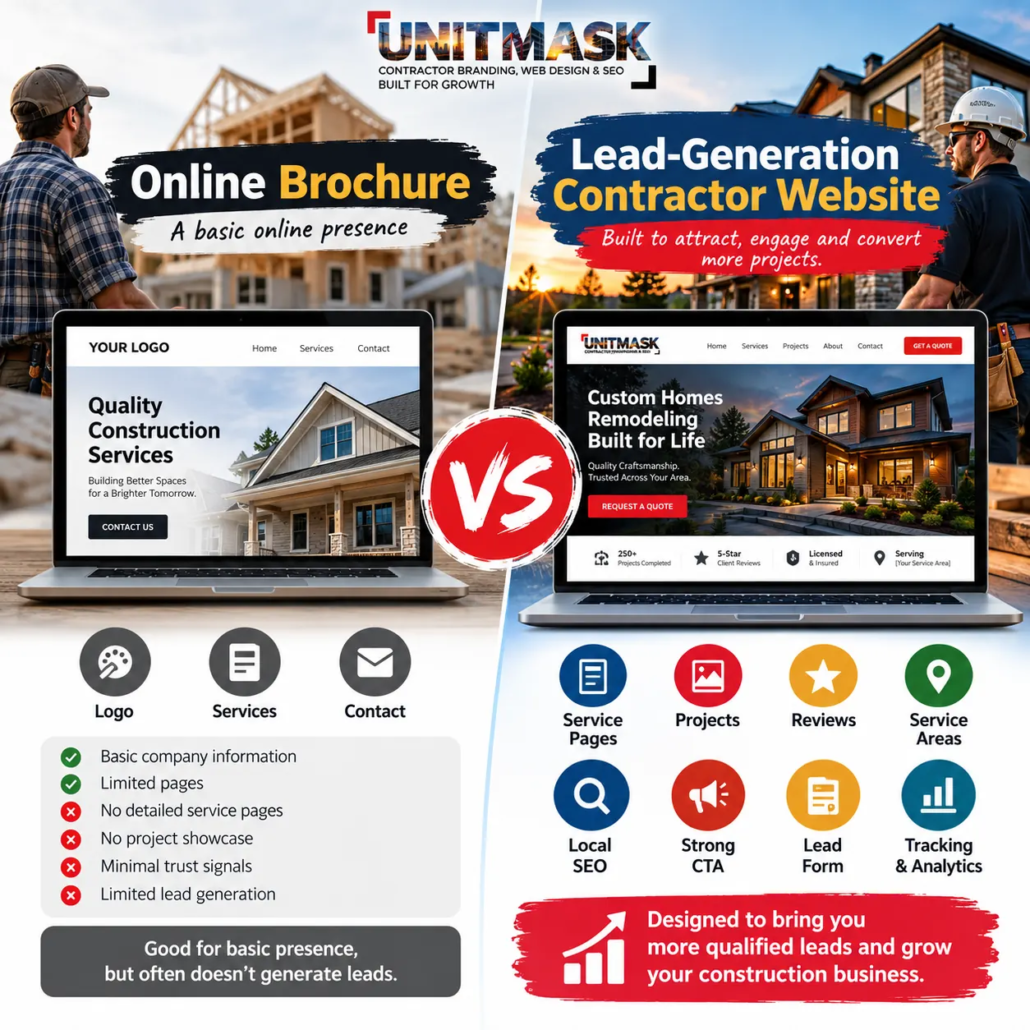
This is where the website starts becoming more than an online brochure.
A lead-focused contractor website might include:
- custom or heavily customized design;
- individual service pages;
- conversion-focused copy;
- service-area strategy;
- project portfolio;
- reviews and testimonials;
- license and insurance information;
- prominent phone and estimate-request CTAs;
- mobile optimization;
- analytics;
- basic technical SEO;
- Search Console setup;
- local-search considerations;
- structured lead forms.
The difference isn’t simply visual polish.
You’re paying for a better system around the visitor’s decision to trust and contact your company.
What Does a $500 vs. $3,000 vs. $10,000 Contractor Website Actually Buy?
Instead of looking at price alone, compare what you’re receiving.
- Area
- Design
- Mobile experience
- Copywriting
- Service pages
- Portfolio
- Conversion strategy
- Local SEO foundation
- Service-area strategy
- Analytics
- Integrations
- Post-launch support
- Budget Website
- Template
- Basic responsive
- Usually DIY
- Limited
- Basic gallery
- Minimal
- Limited
- Rare
- Basic/optional
- Minimal
- Limited
- Professional Website
- Customized/custom
- Intentionally optimized
- Often included/assisted
- Dedicated
- Structured projects
- Strong
- Often included
- Possible
- Usually included
- Moderate
- Varies
- Advanced Website
- Fully Custom
- Advanced UX/testing
- Strategic copywriting
- Extensive architecture
- Detailed case studies
- Advanced
- Advanced
- Extensive
- Advanced tracking
- CRM/automation/custom
- Usually available
This is why comparing website proposals based solely on page count can be misleading.
A five-page site with strategic copy, project proof, conversion planning and proper technical setup can be more valuable than a 15-page website filled with generic content.
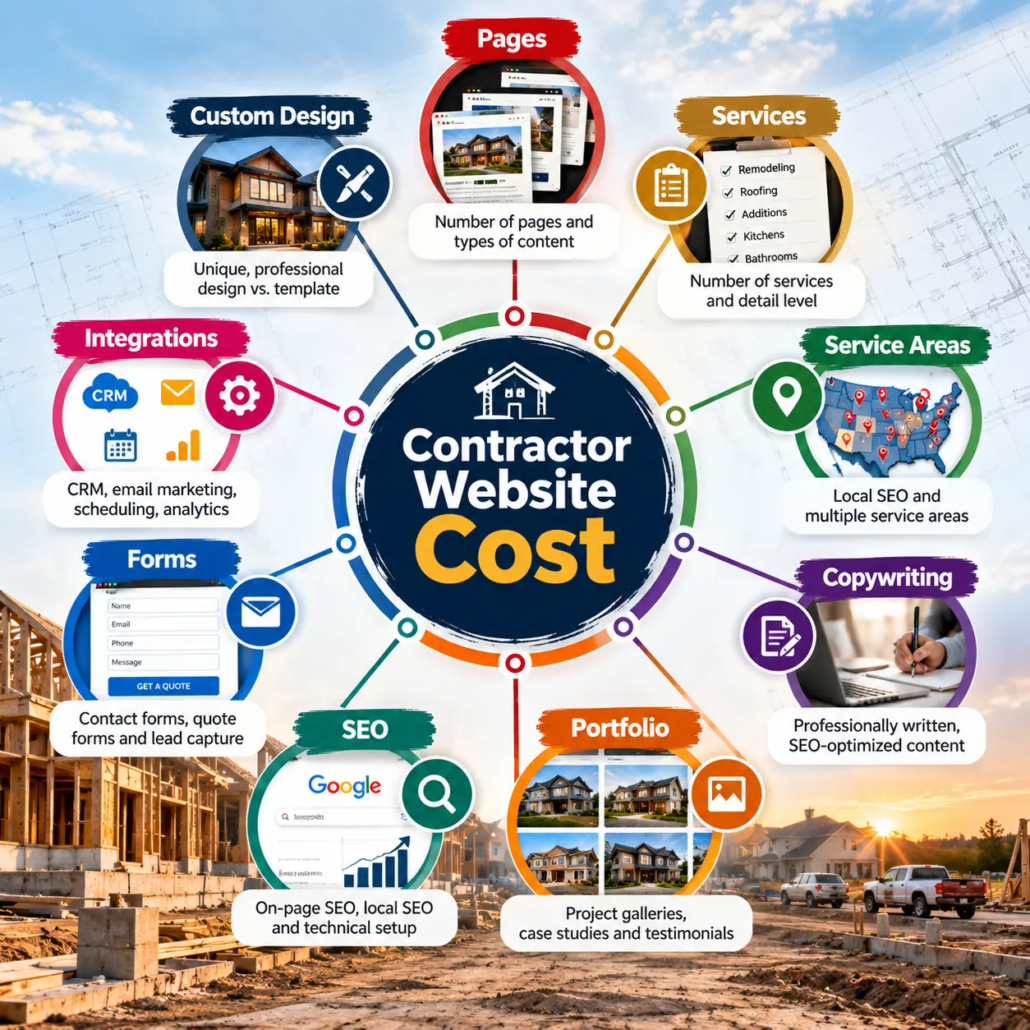
What Determines the Cost of a Contractor Website?
Number of Services
A general contractor offering remodeling, additions, kitchen renovations, bathroom renovations and design-build services may need individual pages for important services.
A roofer may need separate pages for:
- roof replacement;
- roof repair;
- commercial roofing;
- storm damage;
- specific roofing systems.
Each useful page requires strategy, writing, design and implementation.
Service Areas
Contractors often operate across several cities or counties.
That does not mean automatically creating dozens of near-identical city pages.
Useful service-area pages require meaningful local relevance and content.
The more markets your business genuinely needs to represent, the larger the potential website architecture.
Copywriting
One quote may require you to write every word.
Another may include professional copywriting.
Those are not equivalent proposals.
Good contractor copy must answer questions such as:
- What do you build or repair?
- Who do you serve?
- Where do you work?
- Why should someone trust you?
- What proof supports those claims?
- What should the visitor do next?
Project Portfolio
Real completed projects are among the strongest assets a construction company can put on its website.
A structured project page can contain:
- project type;
- location;
- scope;
- challenge;
- solution;
- before/after imagery;
- materials;
- final result.
Building that system takes more work than dropping photographs into a gallery.
Lead Forms and Integrations
A basic contact form is inexpensive.
A form that asks for service type, ZIP code, project timeline, approximate budget and project details—and routes that information into your lead-management workflow—is more involved.
Custom Functionality
Scheduling, financing integrations, CRM connections, calculators, customer portals and custom estimating workflows can all increase development costs.
How Many Pages Does a Contractor Website Actually Need?
A small contractor doesn’t automatically need a 30-page website.
But squeezing everything into five pages can also limit your ability to clearly explain multiple services.
A basic structure might include:
- Home
- About
- Services
- Projects
- Contact
That can work when your company offers one primary service or gets most business through referrals.
An established multi-service contractor may instead need:
- Home
- About
- individual service pages
- Projects
- individual project/case-study pages
- Reviews
- Service Areas
- Financing
- FAQs
- Contact
The right page count depends on how customers search for your services and what they need to know before contacting you.
What a contractor website should include?
How Much Does a 5-Page Contractor Website Cost?
A professional five-page contractor website can still range from roughly $1,000 to several thousand dollars depending on who builds it and what’s included.
The important question isn’t:
“How much for five pages?”
Ask:
“What is being done to those five pages?”
For example, does the quote include:
- discovery and strategy;
- custom design;
- mobile optimization;
- copywriting;
- image optimization;
- contact/estimate forms;
- analytics;
- Search Console;
- on-page SEO;
- technical SEO basics;
- schema where appropriate;
- speed optimization;
- revisions;
- post-launch support?
Two five-page websites may have identical navigation menus while representing completely different amounts of work.
Does Contractor Website Pricing Include SEO?
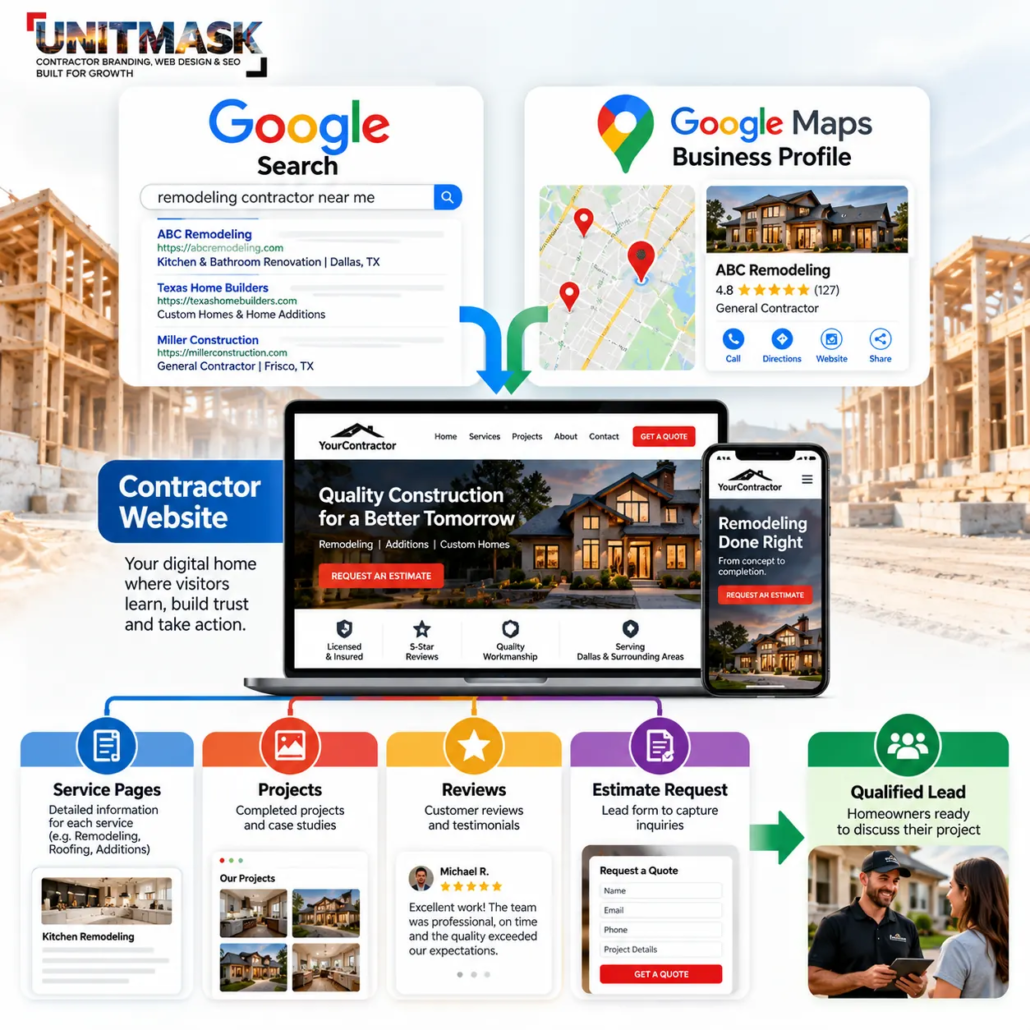
Not necessarily. Website design and ongoing SEO are different services.
A professionally built contractor website should ideally provide a solid technical and on-page foundation.
That can include:
- crawlable site structure;
- logical URLs;
- page titles;
- meta descriptions;
- heading hierarchy;
- internal linking;
- mobile usability;
- image optimization;
- XML sitemap;
- Search Console setup;
- analytics;
- relevant structured data.
But that does not mean the website will automatically rank for every service and city you target.
Ongoing contractor SEO may involve:
- keyword research;
- new service content;
- local content;
- project/case-study publishing;
- internal-link development;
- Google Business Profile optimization;
- reputation/review strategy;
- authority building;
- Search Console analysis;
- ongoing technical improvements.
Google explicitly supports LocalBusiness structured data to help it understand business information, while eligible contractors that travel to customers can operate service-area Business Profiles. That makes coordination between the website and local presence particularly relevant for contractors.
Contractor SEO: The Complete Guide for U.S. Contractors (2026
Local SEO for Contractors: How to Rank Higher on Google Maps in 2026
Google Business Profile guidelines for service-area businesses
Is Your Current Website Ready to Generate Contractor Leads?
A website can look professional and still lose opportunities through unclear services, weak trust signals or poor conversion paths. Get a practical review of what may be holding yours back.
What Should Be Included in a Professional Contractor Website?
Before comparing quotes, check whether the proposed website covers the fundamentals your customers actually need.
Clear Positioning Above the Fold
Within seconds, a visitor should understand:
What you do + where you do it + what they should do next.
“Quality You Can Trust” doesn’t accomplish that.
“Design-Build Remodeling Across North Dallas” does.
Individual Service Information
Don’t make homeowners guess whether you provide their specific service.
Real Project Photography
Your own projects usually communicate more credibility than generic stock photos.
Show the workmanship.
Reviews and Trust Signals
Depending on your business, useful trust elements may include:
- customer reviews;
- years in business;
- contractor license information;
- insurance/bonding information;
- manufacturer certifications;
- industry memberships;
- warranties;
- recognizable completed projects.
Strong Calls to Action
The visitor shouldn’t have to hunt for your phone number or estimate form.
Mobile Experience
Someone discovering your company on a phone should be able to understand the service, inspect your work and contact you without fighting the interface.
Analytics and Lead Tracking
You should eventually be able to answer:
- Where are visitors coming from?
- Which pages attract traffic?
- Which services generate inquiries?
- Which marketing campaigns produce leads?
Without measurement, redesign decisions become guesswork.
Hidden Contractor Website Costs to Ask About
The project price isn’t always the total cost.
Before signing a proposal, ask about:
Domain
Who owns it?
Ideally, your business should retain control of its domain.
Hosting
Is hosting included?
If so, for how long?
Maintenance
Who handles:
- WordPress/core updates;
- backups;
- security;
- plugin updates;
- technical problems?
Premium Software
Are paid themes, plugins or third-party tools required?
What happens when licenses renew?
Copywriting
Are you expected to supply all content?
Photography
Are project photographs supplied by you?
Is editing included?
Additional Pages
How much will another service or location page cost?
Revisions
How many rounds are included?
Post-Launch Changes
What happens when you hire someone, add a service or want a new project uploaded?
SEO
Does “SEO included” mean basic metadata—or actual keyword research, page architecture, local strategy and ongoing optimization?
Those are very different things.
Freelancer vs. Agency vs. DIY: Which Should You Choose?
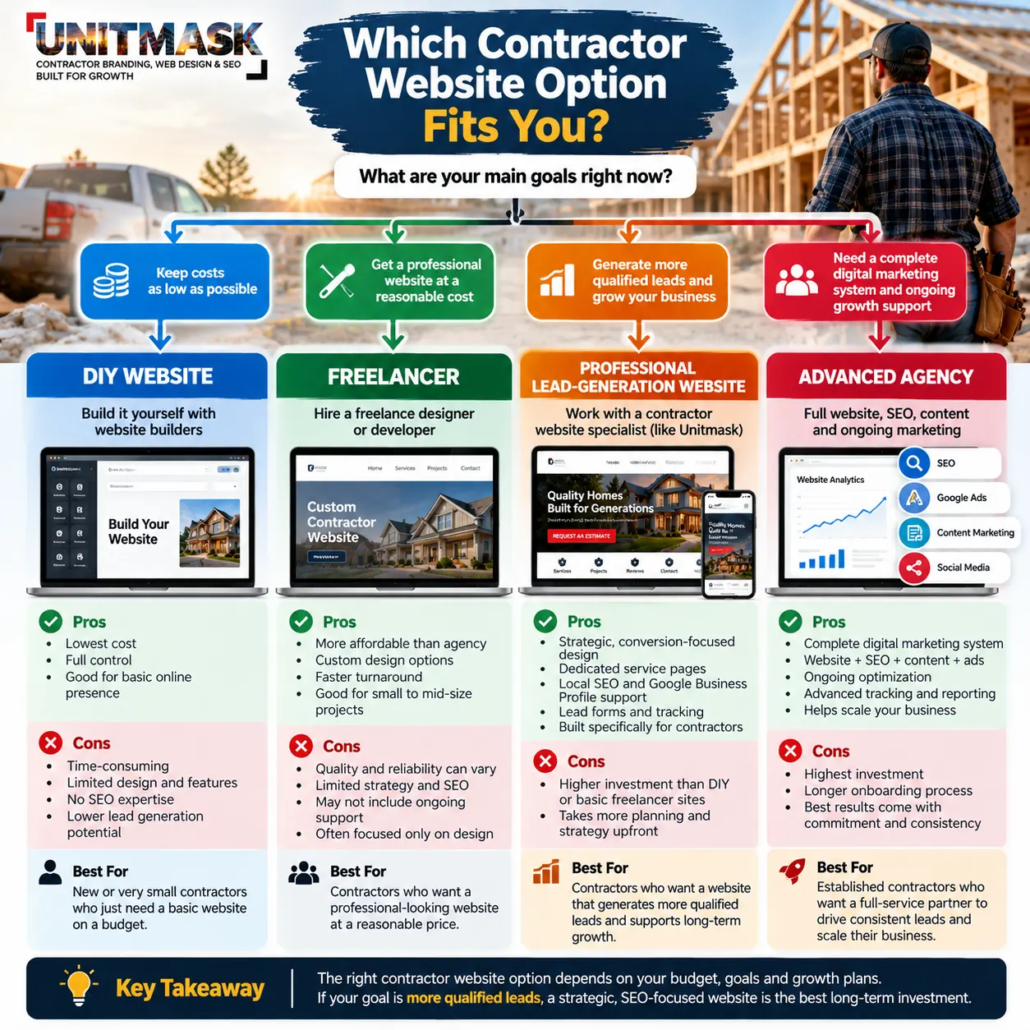
There isn’t one correct answer for every contractor.
Choose DIY when:
- the company is new;
- cash is extremely limited;
- most business comes through personal referrals;
- you have time to build it;
- you mainly need proof that the business exists.
Consider a freelancer when:
- you need professional help;
- the scope is straightforward;
- you have a limited budget;
- you can manage some content internally;
- advanced marketing isn’t yet required.
Consider a contractor-focused professional or agency when:
- the business is established;
- your projects have meaningful contract value;
- you serve multiple services or locations;
- Google visibility matters;
- you run or plan to run advertising;
- you need qualified leads rather than simply “a website”;
- your brand needs to compete against established local contractors.
How Much Should Your Contractor Business Spend?
This is where contractor website pricing becomes more useful.
Instead of asking what the average website costs, start with your business stage.
New Solo Contractor
If you’re establishing the business and virtually all jobs come from referrals, a simple professional presence may be enough initially.
Prioritize:
- credibility;
- mobile usability;
- services;
- contact information;
- project photos;
- Google Business Profile consistency.
Don’t buy an enormous website simply because someone tells you that you need one.
Small Established Contractor
If you have a crew, completed projects, reviews and several services, your website should begin doing more.
Prioritize:
- dedicated services;
- stronger portfolio;
- reviews;
- conversion-focused pages;
- basic search optimization;
- analytics;
- clear service areas.
Growing 11–50 Employee Contractor
At this stage, treating the website as a digital business card can become expensive in a different way.
Your prospects may compare you against other established companies before calling.
Your website may need:
- stronger brand positioning;
- multiple service pages;
- project case studies;
- location/service-area architecture;
- recruiting content;
- stronger trust proof;
- conversion tracking;
- integration with broader SEO and lead-generation efforts.
Multi-Location or High-Growth Contractor
A larger investment becomes more reasonable when the site supports:
- multiple markets;
- substantial paid traffic;
- numerous services;
- recruitment;
- CRM workflows;
- content marketing;
- SEO campaigns;
- sophisticated tracking.
The budget should grow because the business requirement grows—not because an agency has a more expensive package.
Not Sure What Level of Website Your Business Actually Needs?
A website can look professional and still lose opportunities through unclear services, weak trust signals or poor conversion paths. Get a practical review of what may be holding yours back.
Is a Contractor Website Worth the Investment?
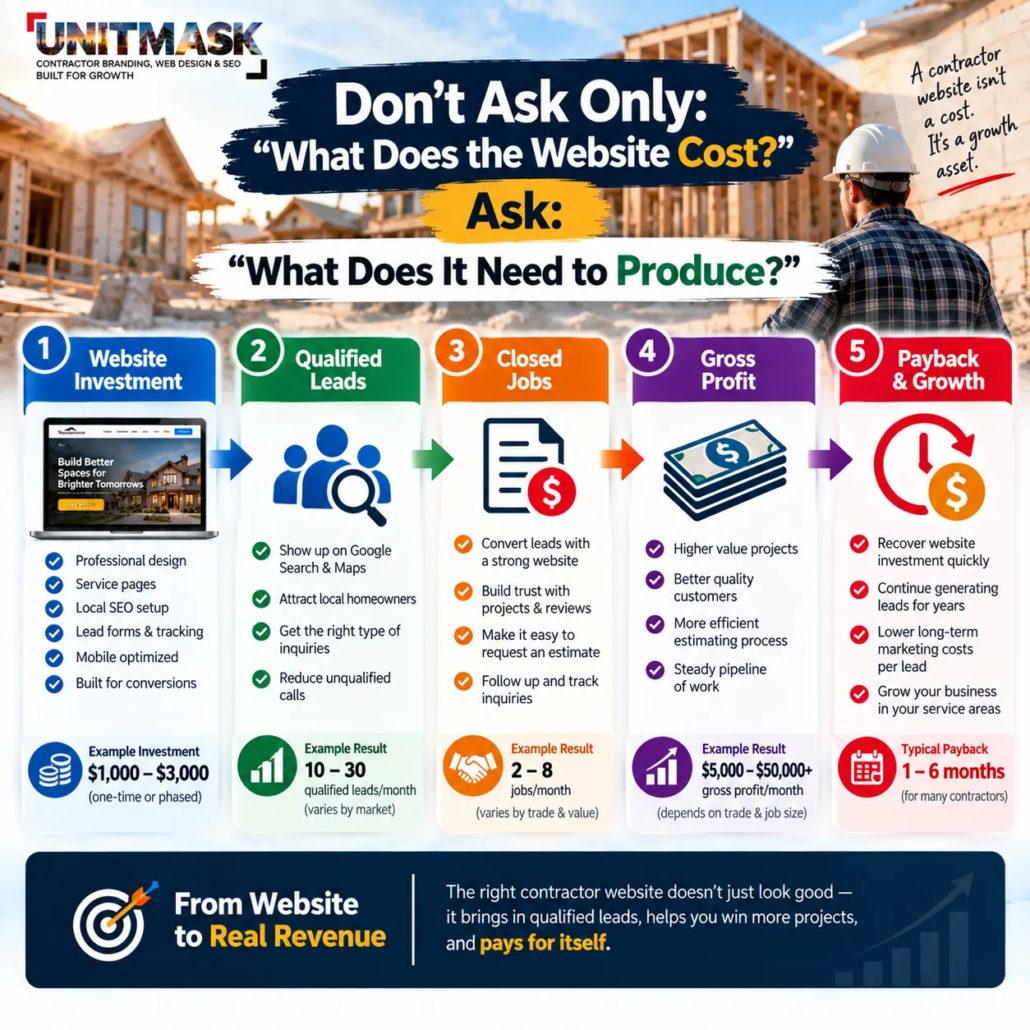
A contractor website shouldn’t be judged like an office expense.
It should be evaluated against the business opportunity it supports.
Use this simple framework:
Website Investment ÷ Gross Profit per Additional Job = Jobs Needed to Recover the Investment
Example:
Suppose your website investment is $4,000.
If an average additional project contributes $4,000 in gross profit, one incremental project could theoretically recover the website investment.
If gross profit is $1,000 per job, the site would need to contribute approximately four incremental jobs.
That doesn’t mean a new website automatically produces those jobs.
It means you now have a rational benchmark for evaluating the investment.
Also consider customer lifetime value, repeat business and referrals.
A website that helps a homeowner discover you today can potentially influence much more than one transaction.
A Cheap Contractor Website Can Become Expensive
A cheap website isn’t automatically bad.
An expensive website isn’t automatically good.
The danger is paying for the wrong thing.
A $700 website that gives a referral-driven contractor a credible online presence may be an excellent investment.
The same website could be a poor choice for a remodeling company spending thousands of dollars each month generating traffic.
Likewise, a $15,000 custom website could be unnecessary for a one-person operation with no intention of actively generating online leads.
Context determines value.
The most expensive contractor website is often not the one with the highest invoice.
It can be the website that sits online for three years while qualified prospects visit it, don’t trust what they see, and call someone else.
10 Questions to Ask Before Accepting a Contractor Website Quote
Before choosing a designer, freelancer or agency, ask:
- Who owns my domain and website after launch?
- Is the design custom or based on an existing template?
- Who writes the website copy?
- Is mobile optimization included?
- What SEO work is actually included?
- Are analytics and Search Console configured?
- How are my services and service areas structured?
- How many revisions are included?
- What ongoing hosting, software or maintenance fees will I pay?
- How will the website turn visitors into calls or estimate requests?
If the provider can’t explain those answers clearly, comparing their price against another quote isn’t particularly useful.
Have a Contractor Website Quote Already?
Before you approve it, compare the scope—not just the price. Unitmask can help identify whether the proposal covers the website, trust, SEO and conversion foundations your business actually needs.
What We See When Reviewing Contractor Websites
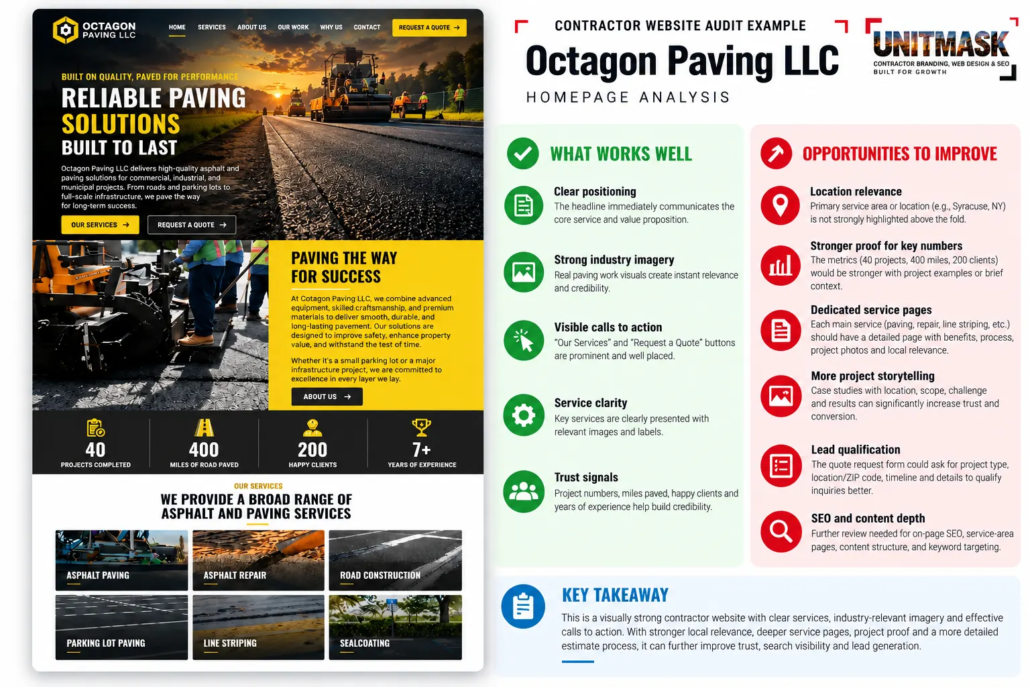
We ask a more important question:
Can a potential customer quickly understand the company, trust it, find the right service, and take the next step?
Take this paving contractor homepage as an example.
At first glance, several fundamentals are strong. The website immediately communicates the service through the headline “Reliable Paving Solutions Built to Last,” uses relevant project imagery instead of generic corporate visuals, and places Request a Quote and Our Services calls to action prominently near the top.
The homepage also creates a logical customer journey:
Service → credibility → capabilities → estimate → reputation → contact.
That is a much stronger foundation than a contractor website that simply lists company information.
But a visual review also reveals opportunities we would investigate further during a Unitmask website audit.
1. Location relevance could be clearer above the fold.
The homepage communicates paving immediately, but the visible hero doesn’t strongly establish the primary market or service area. For a local contractor, adding location context can help visitors confirm within seconds that the company serves them.
2. Strong numbers need supporting proof.
Metrics such as “400 Miles of Road Paved” and “200 Happy Clients” can build trust—but only when they are accurate and defensible. Wherever possible, strong claims should connect to real projects, case studies, or other evidence.
3. Service cards create a good starting point, but dedicated service pages matter.
Asphalt paving, asphalt repair, road construction, parking lot paving, line striping, and sealcoating represent different customer needs and potentially different searches. Each major service should lead to a useful page rather than relying on one general services page.
4. The project work deserves more storytelling.
Construction photography is valuable proof. It becomes substantially stronger when visitors can see the project location, scope, challenge, work completed, and result—not just an image gallery.
5. The estimate path could qualify leads better.
Instead of collecting only basic contact information, a contractor can potentially ask for project type, location or ZIP code, timeline, and project details. That can help the business understand the inquiry before the first conversation.
The Unitmask Audit Principle
A contractor website doesn’t need more design simply for the sake of design.
It needs fewer points of uncertainty between:
“I found this contractor” → “They do what I need” → “They serve my area” → “I trust them” → “I want an estimate.”
That is what we look for when reviewing contractor websites.
Contractor Website Cost FAQs
How much does a contractor website cost in 2026?
Contractor website pricing can range from a few hundred dollars for a DIY or basic template setup to $15,000 or more for larger custom projects. Many professionally built small-business contractor websites fall somewhere in between, depending on page count, design, content, SEO and functionality.
How much does a 5-page contractor website cost?
A professionally built five-page contractor website may cost roughly $1,000 to several thousand dollars. The scope matters more than the page count: custom design, copywriting, SEO setup, project galleries and conversion strategy can significantly change the price.
Is $5,000 too much for a contractor website?
Not necessarily. A $5,000 website may be reasonable if it includes strategy, professional design, content, service pages, project proof, conversion planning and a solid SEO foundation. It may be expensive if you’re receiving little more than a customized template.
Can I build a contractor website myself?
Yes. DIY website builders can work for new or referral-driven contractors that primarily need an online presence. The tradeoff is the time required for design, copy, technical setup, optimization and ongoing maintenance.
Does a contractor website need SEO?
If you want the website to attract search traffic, it needs a sound SEO foundation. However, building an SEO-friendly website and running an ongoing SEO campaign are different services.
Do contractors need separate service pages?
Usually, important services deserve their own useful pages when customers search for them separately. A remodeling company, for example, may benefit from distinct kitchen remodeling, bathroom remodeling and home addition pages rather than putting everything on one generic Services page.
Do contractors need service-area pages?
They can be useful when your business genuinely serves multiple geographic markets and each page provides meaningful local information. Creating dozens of nearly identical city pages simply to target keywords is not a sound content strategy.
Should website hosting be included in the price?
It may or may not be. Ask exactly what the hosting arrangement includes, who controls the account, renewal pricing, backups, security and what happens if you change providers.
How often should a contractor website be redesigned?
There is no universal schedule. Redesign when the current site is creating a measurable business problem—poor mobile usability, outdated positioning, weak conversion paths, technical limitations, changing services or an inability to support your marketing strategy.
What’s more important: website design or SEO?
They solve different parts of the customer journey. SEO helps qualified prospects discover the business; website design, messaging and conversion strategy help those visitors understand, trust and contact it. Contractors pursuing online leads generally need the two to work together.
Final Takeaway: Buy the Website Your Business Needs
The answer to “How much should a contractor website cost?” isn’t one universal dollar amount.
A new solo contractor and a 40-person design-build firm shouldn’t buy the same website.
Start with three questions:
Who needs to find us?
What must they see before they trust us?
What action should the website help them take?
Then determine the pages, content, SEO foundation, trust signals and functionality required to accomplish those goals.
Only then compare prices.
Because for a contractor, the goal isn’t to own a website.
It’s to own a digital asset that makes the business easier to find, easier to trust and easier to contact.
Find Out What’s Holding Your Contractor Website Back
If you already have a website, start by identifying where trust, search visibility or conversion opportunities may be getting lost before investing in another redesign.
Are you a contractor, builder, or home service business owner?
What did you pay for your website—and looking back, was it worth the investment?If you’re currently comparing website quotes, you can also share what you’re being quoted and what’s included. Your experience may help other contractors make a better decision.
Comments are welcome from contractors, builders, construction professionals, and business owners. Please keep the discussion relevant and avoid promotional links or spam.
 unitmask.cloud
 Unitmask.cloud
Leave a Reply
Want to join the discussion?Feel free to contribute!