Digital Marketing for Roofers: Practical Guide (2026)

Digital Marketing for Roofers: A Practical Guide to Growing Your Business

Running a successful roofing company takes more than delivering quality workmanship. Homeowners and commercial property managers also need to discover your business, understand your services, and feel confident enough to contact you.

That is where digital marketing for roofers becomes important.

A practical digital marketing strategy helps roofing contractors improve their online visibility, present their work professionally, and create more opportunities for qualified enquiries.

However, effective roofing marketing does not necessarily require a large advertising budget or a complicated collection of software subscriptions.

For many small and growing roofing companies, the strongest starting point is a combination of professional branding, a useful website, local search visibility, and consistent customer communication.

This guide explains the essential components of roofing digital marketing, how they work together, and where roofing contractors should focus their time and budget.

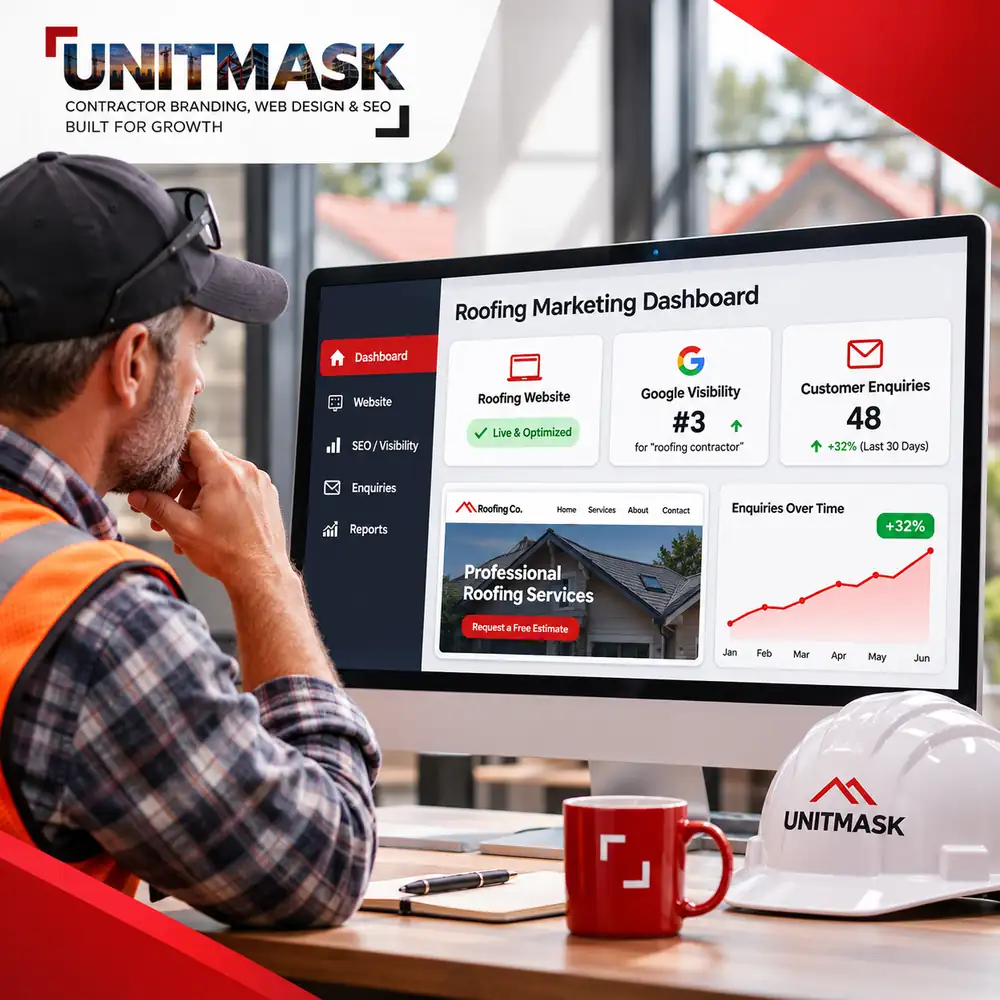
Digital marketing for roofers showing a roofing contractor reviewing website performance, local SEO visibility, and customer leads.

1. What Is Digital Marketing for Roofers?

Digital marketing for roofers refers to the online strategies roofing businesses use to attract potential customers, communicate their services, and generate enquiries.

Unlike traditional advertising methods such as printed flyers, newspaper advertisements, and direct mail, digital marketing helps contractors connect with customers who are actively researching roofing services online.

A complete roofing contractor digital marketing strategy may include:

  • Search engine optimization (SEO)
  • Google Business Profile optimization
  • Professional roofing website design
  • Google Ads and paid search campaigns
  • Social media marketing
  • Online reviews and reputation management
  • Educational roofing content
  • Lead tracking and customer follow-up

Each channel serves a different purpose.

For example, SEO helps a roofing company become discoverable through relevant searches, while a professional website helps visitors evaluate its credibility.

Paid advertising can introduce the business to additional potential customers, while reviews and project photos help establish trust.

The goal is not simply to generate website traffic. It is to turn relevant online attention into genuine business opportunities.

For a broader overview of how branding, website design, and SEO work together, explore Unitmask’s roofing contractor marketing services.

2. Why Roofing Digital Marketing Matters for Small Contractors

A practical roofing digital marketing strategy helps smaller contractors compete for relevant local searches without relying entirely on paid advertising.

Roofing services are often high-consideration purchases.

Whether a homeowner needs a minor roof repair or a complete roof replacement, the decision may involve comparing multiple contractors, checking reviews, and reviewing examples of previous work.

A roofing company with a weak online presence can lose opportunities before a potential customer ever makes contact.

Customers Research Roofing Contractors Online

Potential customers frequently search for services using phrases such as:

  • Roof repair near me
  • Roofing contractor in [City]
  • Residential roof replacement
  • Emergency roofing services
  • Commercial roofing company
  • Storm damage roof inspection

These searches can indicate different customer needs and levels of purchase readiness.

A roofing company that clearly explains its services and locations has a better opportunity to appear relevant to those searches.

Online Presentation Influences Trust

A contractor’s website, logo, photographs, and reviews contribute to the impression customers form about the business.

Inconsistent branding, outdated information, or confusing navigation can make it harder for potential customers to evaluate the company.

Professional presentation does not guarantee enquiries, but it helps remove unnecessary barriers.

Marketing Supports Long-Term Visibility

Paid advertising can generate exposure while campaigns are active.

SEO, useful content, customer reviews, and a well-maintained website can contribute to a longer-term online presence.

The strongest approach usually combines immediate lead-generation activities with improvements that support the business over time.

3. How Website Design Supports Digital Marketing for Roofing Companies

Effective digital marketing for roofing companies starts with a website that clearly explains roofing services, demonstrates real project experience, and makes requesting an estimate simple.

A roofing website should function as more than an online business card.

It should explain what the company does, where it operates, why customers should consider it, and how to request an estimate.

For small roofing companies, website quality often matters more than having a large number of pages.

Essential Roofing Website Features

Clear service information

Create dedicated sections or pages for relevant services, such as residential roofing, commercial roofing, repairs, replacements, and storm damage restoration.

Location-specific information

Explain the cities and service areas covered by the company. Include genuine local project examples where available.

Mobile-friendly design

Homeowners may research roofing services using smartphones, so the website should be easy to navigate on smaller screens.

Visible contact options

Phone numbers, estimate request forms, and contact buttons should be easy to find.

Real project photographs

Show completed roofing projects, workmanship details, and before-and-after comparisons where appropriate.

Trust information

Include accurate licensing information where applicable, insurance details, warranties, customer reviews, and company experience.

Example: A Better Roofing Website Structure

A practical roofing website might contain:

  1. Homepage
  2. Residential Roofing
  3. Commercial Roofing
  4. Roof Repair
  5. Roof Replacement
  6. Storm Damage Services
  7. About the Company
  8. Completed Projects
  9. Service Areas
  10. Contact / Request an Estimate

Not every contractor needs all these pages immediately.

Start with the services customers actually request, then expand as the business grows.

Further reading: Roofing Website Design Ideas: Features That Help Build Trust.

Original roofing project photographs can help homeowners evaluate workmanship and understand the services a contractor provides. Google’s image SEO best practices recommend using descriptive image information and relevant surrounding content to help search engines understand images. Roofing companies should use meaningful filenames, accurate alternative text, and properly optimized images throughout their websites.

Roofing Website & SEO

Is Your Roofing Website Helping You Win More Opportunities?

A professional roofing website should do more than display your services. It should help homeowners understand your work, trust your business, and take the next step.

Unitmask helps U.S. roofing contractors strengthen their online presence through professional branding, website design, and SEO.

4. Improve Local Visibility with Roofing SEO

Search engine optimization is one of the most important components of digital marketing for roofing companies.

Roofing SEO helps search engines understand a company’s services, service areas, and website content.

For contractors serving specific cities or regions, local relevance is particularly important.

Focus on Service-Based Keywords

Instead of trying to rank for every roofing-related keyword, begin with searches that match the company’s actual services.

Examples include:

Roofing service Example keyword
Roof repair roof repair contractor in Dallas
Roof replacement roof replacement company in Tampa
Residential roofing residential roofing contractor in Phoenix
Commercial roofing commercial roofing services in Houston
Emergency services emergency roof repair in Orlando

These are illustrative keyword examples, not verified search-volume recommendations.

Keyword selection should reflect actual services, competition, and local demand.

Optimize Important Website Pages

Each main service page should have:

  • A descriptive page title
  • One clear primary heading
  • Helpful service-specific information
  • Relevant internal links
  • Descriptive image alternative text
  • Accurate business contact information
  • A clear next step for visitors

Avoid creating dozens of nearly identical location pages that simply replace one city name with another.

Instead, develop genuinely useful pages with relevant local information and project experience.

Build Topical Relevance

Publishing helpful content about roof maintenance, repair decisions, replacement costs, and storm damage can support a roofing website’s overall topical coverage.

However, content should be written for real customer questions rather than created solely to repeat keywords.

For a more detailed explanation, read SEO for Roofing Companies: How to Improve Search Visibility.

Google provides an official SEO Starter Guide explaining how search engines discover and understand website content. Roofing contractors can use these recommendations to improve website structure, create helpful service pages, and make important information easier for search engines and potential customers to find.

5. Optimize Your Google Business Profile

For roofing companies serving local customers, Google Business Profile can be an important source of visibility.

An accurate profile helps customers find essential business information through Google Search and Maps.

Google Business Profile Checklist

  • Use the company’s genuine business name.
  • Select the most appropriate primary business category.
  • Add accurate contact details and website information.
  • Configure service areas according to Google’s guidelines.
  • List relevant roofing services.
  • Upload genuine project and business photographs.
  • Keep business hours current.
  • Respond professionally to customer reviews.
  • Update information when services or contact details change.

Roofing companies should also encourage customers to leave honest reviews after completed projects.

Do not purchase reviews, offer prohibited incentives, or publish fabricated customer feedback.

Why Consistency Matters

The business information presented on the website should agree with the information customers find through its Google Business Profile and other relevant business listings.

Consistent information makes it easier for customers to identify and contact the correct business.

Practical tip: Start by improving an existing profile before investing heavily in additional directory listings.

According to Google’s local ranking guidelines, local search visibility is primarily influenced by relevance, distance, and prominence. Roofing contractors should maintain accurate business information, choose appropriate categories, and build a trustworthy online presence rather than relying on keyword stuffing or unnecessary business listings.

6. Use Google Ads for Targeted Roofing Leads

Google Ads can help roofing contractors reach potential customers through paid search placements.

Unlike SEO, which generally requires ongoing effort before meaningful results develop, paid search campaigns can begin receiving traffic after approval and launch.

However, advertising does not automatically produce profitable jobs.

Campaign performance depends on keyword selection, location targeting, landing-page quality, competition, budget, and follow-up.

Choose Keywords with Relevant Intent

For example:

Higher commercial intent

  • Roof repair company near me
  • Roofing contractor estimate
  • Roof replacement contractor
  • Emergency roof repair service

Primarily informational intent

  • How long does a roof last?
  • Types of roofing materials
  • Signs of roof damage

Informational searches can support content marketing, but they may be less appropriate for a campaign focused on immediate estimate requests.

Send Visitors to Relevant Landing Pages

A person searching for emergency roof repair should not be sent to a generic homepage that makes the service difficult to find.

Instead, the landing page should explain the relevant service, service area, contact options, and appropriate trust signals.

Track More Than Clicks

Useful advertising metrics include:

  • Advertising spend
  • Relevant enquiries
  • Cost per qualified lead
  • Estimates scheduled
  • Estimates accepted
  • Jobs won
  • Revenue and gross profit from acquired jobs

A campaign generating many inexpensive clicks may still perform poorly if those visitors do not become customers.

Recommendation: Start with a tightly defined service area and a small group of relevant keywords. Expand only when tracking provides evidence that the campaign is producing worthwhile opportunities.

7. Build Trust Through Roofing Branding

Branding is sometimes overlooked in roofing digital marketing because it does not always produce directly measurable leads.

However, branding influences how a business is recognized and remembered.

A consistent visual identity can make a roofing company appear more established across its website, vehicles, uniforms, estimates, social media, and advertising.

Important Branding Elements

Logo

A clear, recognizable logo that works across digital and printed materials.

Colors and typography

Consistent visual styling that helps customers identify the company.

Business messaging

Straightforward explanations of services, specialties, and customer benefits.

Professional documents

Branded estimates, proposals, invoices, and inspection reports.

Project presentation

Consistent use of genuine photography and completed project information.

Branding should reflect the company’s actual capabilities rather than make exaggerated claims.

A smaller roofing company does not need to imitate a national franchise to look professional.

It needs a recognizable identity that communicates its work clearly.

Explore Roofing Company Logo Ideas and Branding Inspiration for practical design considerations.

8. Online Marketing for Roofers: Social Media and Project Visibility

Online marketing for roofers should focus on showing genuine workmanship, sharing completed projects, and answering common homeowner questions rather than publishing promotional content alone.

Rather than publishing promotional graphics every day, contractors can use social platforms to document completed projects and answer common questions.

Roofing Social Media Content Ideas

Before-and-after projects

Show visible improvements from completed roof repairs or replacements.

Workmanship details

Explain flashing, ventilation, underlayment, and other important roofing components.

Roof maintenance tips

Share practical guidance about identifying common roofing problems.

Project walkthroughs

Document stages of a real roofing installation.

Team introductions

Help customers understand who will be working on their property.

Customer testimonials

Share authentic feedback with appropriate permission.

Which Platforms Should Roofers Prioritize?

Facebook and Instagram can be useful for residential project photography and local brand awareness.

YouTube can support longer educational videos and project explanations.

LinkedIn may be relevant for commercial roofing companies that want to connect with property managers, developers, and other business professionals.

The right platform depends on the company’s customer base.

A residential roof repair company and a commercial roofing contractor should not automatically use identical social media strategies.

Practical approach: Choose one or two relevant platforms and maintain them consistently rather than creating inactive accounts everywhere.

9. Create Helpful Roofing Content That Answers Customer Questions

Content marketing helps roofing companies explain services, address customer concerns, and support search visibility.

Useful content should answer questions customers ask before requesting an estimate.

Roofing Blog Topics Worth Considering

  • How to Know When Your Roof Needs Replacement
  • Roof Repair vs. Roof Replacement: What to Consider
  • What Happens During a Roof Inspection?
  • Common Causes of Residential Roof Leaks
  • How to Prepare for a Roof Replacement
  • Asphalt Shingles vs. Metal Roofing
  • What to Ask Before Hiring a Roofing Contractor
  • How Storm Damage Can Affect a Roof

Each article should provide useful information rather than simply repeat a service description.

For example, an article about roof replacement could explain visible warning signs, the inspection process, factors affecting cost, and questions to discuss with a contractor.

It could then link naturally to the company’s roof replacement service page.

Connect Related Pages with Internal Links

Internal linking helps visitors discover relevant information and helps search engines understand relationships between pages.

A roofing company might connect:

  • A roof maintenance article to its roof repair service page
  • A storm damage guide to its inspection services
  • A roof replacement cost article to its estimate request page
  • A roofing materials comparison to relevant installation services

For a broader set of practical marketing ideas, read Roofing Marketing Strategies for Small Contractors.

10. Improve Roofing Lead Generation and Follow-Up

Getting discovered online is only one part of the marketing process.

Roofing companies also need a reliable way to receive, organize, and respond to enquiries.

A potential customer may contact multiple contractors when requesting a roofing estimate.

If an enquiry is missed or a proposal is delayed, the business may lose an opportunity despite successful marketing.

Create a Simple Lead Management Process

Capture the enquiry

Collect the customer’s name, contact information, location, and requested service.

Qualify the request

Confirm the project type, service area, urgency, and relevant requirements.

Schedule the next action

Arrange an inspection, consultation, or estimate when appropriate.

Prepare the proposal

Provide a clear estimate or proposal explaining the proposed work and relevant terms.

Follow up professionally

Check whether the customer has questions or needs additional information.

Record the outcome

Track whether the enquiry became a scheduled appointment, submitted estimate, or completed job.

Use Practical Tools Instead of Unnecessary Complexity

Small roofing companies may not need a large software platform to manage their earliest enquiries and estimates.

Simple estimating, proposal, inspection, and job-costing tools can help organize important operational information.

Explore Unitmask Roofing Contractor Tools for standalone tools designed around common roofing workflows.

For contractors who need specialized workflows, custom software for construction businesses may be worth considering.

The objective is to reduce missed information and repetitive administrative work, not to add software that the team rarely uses.

11. How Much Should Roofing Companies Spend on Digital Marketing?

There is no universal marketing budget that works for every roofing contractor.

A new residential roofing company may need to prioritize basic online visibility, while an established contractor may already have strong referral traffic and want to expand into additional service areas.

The right budget depends on business goals, margins, competition, service area, and current marketing performance.

Prioritize Marketing Activities by Business Stage

Business stage Recommended focus
New roofing company Branding, basic website, Google Business Profile
Small established contractor Local SEO, reviews, project portfolio, lead tracking
Growing roofing business Service landing pages, content marketing, selective paid ads
Multi-crew roofing company Conversion tracking, lead management, operational efficiency
Multi-location business Location-specific SEO, reporting, consistent branding

Avoid Spending Everywhere at Once

A roofing company with limited resources should not feel pressured to invest simultaneously in Google Ads, Facebook Ads, SEO, multiple social platforms, and expensive software.

Begin by identifying the most important weakness.

If the website is confusing, improve it.

If local search visibility is weak, investigate the Google Business Profile and relevant SEO opportunities.

If enquiries are coming in but few become jobs, review qualification, estimating, and follow-up.

For additional low-cost approaches, see How to Market a Roofing Company Without a Large Budget.

12. Measure What Actually Matters

Digital marketing performance should be evaluated through business outcomes, not simply online activity.

Website impressions, page views, and social media engagement can provide useful information, but they do not automatically represent new customers.

Important Roofing Marketing KPIs

Metric What it tells you
Organic search clicks Visits arriving through unpaid search
Google Business Profile interactions Customer actions recorded on the profile
Website enquiries Leads submitted through the website
Qualified leads Enquiries matching the company’s services and location
Cost per qualified lead Marketing cost relative to qualified enquiries
Estimate-to-job conversion rate Percentage of submitted estimates becoming jobs
Customer acquisition cost Average acquisition cost per new customer
Gross profit per acquired job Profit contribution after direct job costs

Example: Measuring Marketing Results

Suppose a roofing contractor spends $600 on a campaign and receives 20 enquiries.

Of those enquiries:

  • 12 are qualified.
  • 8 receive estimates.
  • 3 become paying jobs.

The cost per qualified lead is:

$600 ÷ 12 = $50

The marketing cost per acquired customer is:

$600 ÷ 3 = $200

These figures are illustrative, not industry benchmarks.

To determine whether the campaign is worthwhile, the contractor must also consider job revenue, gross profit, sales effort, and other acquisition costs.

A campaign should be evaluated based on the quality and profitability of the work it generates.

Example: Why Lead Quality Matters More Than Website Traffic

Consider two hypothetical roofing marketing campaigns.

Campaign A generates 500 website visits but only 5 qualified roofing enquiries.

Campaign B generates 200 website visits and 15 qualified enquiries.

Although Campaign A attracts more visitors, Campaign B produces three times as many qualified opportunities.

This illustrates why roofing contractors should evaluate marketing performance through relevant enquiries, estimates, completed jobs, and profitability rather than website traffic alone.

13. Common Digital Marketing Mistakes Roofing Contractors Should Avoid

Even well-intentioned marketing efforts can waste time and money when the underlying strategy is unclear.

Mistake 1: Paying for Traffic Before Improving the Website

Advertising cannot fully compensate for confusing service information or difficult contact forms.

Better approach: Make the website useful and easy to navigate before scaling paid traffic.

Mistake 2: Targeting Too Many Locations

Trying to compete across a large geographic area can dilute a small company’s resources.

Better approach: Begin with the service areas where the company can reliably deliver work.

Mistake 3: Publishing Generic Content

Articles that repeat broad roofing information without adding practical value may fail to differentiate the business.

Better approach: Include real experience, useful explanations, and original project examples.

Mistake 4: Ignoring Customer Reviews

A roofing company may complete excellent projects but have very little public feedback.

Better approach: Develop a consistent, policy-compliant process for requesting honest reviews.

Mistake 5: Failing to Track Leads

Without basic tracking, contractors cannot reliably determine which marketing activities contribute to business.

Better approach: Record lead sources, estimate outcomes, and completed jobs.

Mistake 6: Choosing Marketing Services Based Only on Price

The cheapest package may not address the company’s actual problems.

Better approach: Evaluate the proposed work, deliverables, reporting, ownership, and relevance to business goals.

For additional guidance, read Roofing Marketing Companies: How to Choose the Right Partner.

14. A 90-Day Roofing Contractor Digital Marketing Plan

This roofing contractor digital marketing plan gives small and growing roofing businesses a structured way to improve their website, local SEO, customer enquiries, and lead tracking.

A structured 90-day plan can help establish the basics and create a foundation for improvement.

Days 1–30: Establish the Foundation

Primary objective: Improve credibility and accessibility.

  • Review the existing website.
  • Correct inaccurate business information.
  • Improve mobile navigation and contact options.
  • Update the Google Business Profile.
  • Add genuine project photographs.
  • Review the company’s visual branding.
  • Set up basic enquiry tracking.

Expected deliverable: A clearer online presence and a more reliable process for receiving customer enquiries.

Days 31–60: Strengthen Search Visibility

Primary objective: Improve relevant local content and discoverability.

  • Review service-page titles and headings.
  • Improve content for priority roofing services.
  • Add useful service-area information.
  • Publish two or three genuinely helpful articles.
  • Connect relevant pages through internal links.
  • Request authentic customer reviews.
  • Review Search Console performance.

Expected deliverable: More complete service information and a stronger foundation for local search visibility.

Days 61–90: Test and Improve Lead Generation

Primary objective: Identify opportunities to generate and convert enquiries.

  • Review organic traffic and enquiries.
  • Test improvements to contact forms and calls to action.
  • Consider a limited paid search campaign if the budget allows.
  • Track qualified enquiries and estimates.
  • Improve follow-up procedures.
  • Review which services produce the strongest opportunities.
  • Plan the next quarter around observed results.

Expected deliverable: A clearer understanding of which marketing activities deserve continued investment.

This plan establishes a process, not a guarantee of rankings, leads, or revenue within 90 days.

From Marketing Leads to Profitable Jobs

Turn Roofing Marketing Leads Into Organized Jobs

Generating roofing enquiries is only the beginning. Contractors also need a reliable process for preparing estimates, presenting proposals, and understanding whether completed jobs are profitable.

Unitmask offers practical roofing business tools designed to help contractors organize these important steps without ongoing software subscriptions.

01

EstimateMaker

Prepare consistent roofing estimates and communicate project pricing clearly.

02

Proposal Builder

Present roofing project scopes and customer proposals professionally.

03

Profit Calculator

Evaluate estimated job profitability and make more informed pricing decisions.

15. Should Roofers Manage Digital Marketing Themselves or Hire an Agency?

Some roofing marketing activities can be managed internally, particularly when the business is small and the owner has time to maintain its online presence.

For example, roofing contractors can often manage project photographs, customer review requests, basic Google Business Profile updates, and social media posts.

Other tasks may require specialized knowledge.

These can include technical website improvements, advanced SEO, conversion tracking, and paid advertising management.

DIY Marketing May Be Suitable When:

  • The company has a limited budget.
  • The owner has time to manage basic marketing tasks.
  • The website is relatively simple.
  • Marketing requirements are straightforward.

Professional Support May Be Useful When:

  • The website needs redesigning.
  • Search visibility is consistently weak.
  • The company is expanding into new service areas.
  • Paid campaigns need specialized management.
  • Branding is inconsistent.
  • The owner needs more time to focus on roofing operations.

Before hiring a provider, ask what services are included, who owns the website and advertising accounts, how results will be measured, and what ongoing costs apply.

The best arrangement is the one that matches the contractor’s actual business needs.

16. Frequently Asked Questions About Digital Marketing for Roofers

What is the best digital marketing strategy for roofers?

There is no single strategy that works for every roofing company. A strong starting point usually includes a professional website, an accurate Google Business Profile, relevant local SEO, authentic reviews, and reliable lead follow-up.

What is roofing digital marketing?

Roofing digital marketing involves using search engines, professional websites, Google Business Profile, online advertising, and customer reviews to help roofing contractors reach potential customers. A practical strategy focuses on improving local visibility, building trust, and generating qualified roofing enquiries.

Does SEO work for roofing companies?

SEO can help roofing companies improve their visibility for relevant search queries. Results depend on competition, website quality, local relevance, and ongoing optimization. Rankings and leads are not guaranteed.

How can roofers get more leads online?

Roofing contractors can improve their opportunities by maintaining accurate business information, optimizing service pages, displaying real project examples, collecting genuine reviews, and making it easy for customers to request estimates.

How does digital marketing for roofing companies generate leads?

Digital marketing for roofing companies helps contractors attract homeowners and property managers searching for roofing services. Local SEO, service-specific landing pages, Google Ads, and clear contact options can turn relevant website visitors into potential customers.

Are Google Ads worth it for roofing contractors?

Google Ads can be useful when campaigns target relevant services and locations, landing pages are effective, and lead outcomes are tracked. Profitability depends on acquisition costs and the value of jobs won.

Do roofing companies need social media marketing?

Social media is not mandatory for every roofing company, but it can help showcase projects, demonstrate workmanship, and build familiarity with potential customers.

What are the most effective online marketing strategies for roofers?

Effective online marketing for roofers includes local SEO, an optimized Google Business Profile, mobile-friendly website design, authentic customer reviews, and helpful roofing content. Contractors can also use targeted paid advertising and social media to support their lead-generation efforts.

How much does digital marketing for roofers cost?

Costs vary depending on the services required, market competition, advertising spend, website condition, and whether work is managed internally or outsourced. Contractors should evaluate specific proposals rather than assume a universal monthly cost.

What should a roofing website include?

A roofing website should clearly explain services, service areas, contact methods, company information, relevant credentials, and genuine project examples. Mobile usability and straightforward navigation are also important.

How long does roofing SEO take to show results?

SEO timelines vary significantly. Technical improvements may be processed relatively quickly, while competitive organic rankings can take months or longer to develop. No provider can guarantee a specific ranking timeline.

Can small roofing companies compete with larger businesses online?

Yes, smaller contractors can focus on specific services, local relevance, customer experience, and genuine project expertise. However, competition and available resources will influence results.

What is the difference between roofing SEO and roofing PPC?

SEO focuses on improving visibility through unpaid search results, while PPC involves paying for advertising placements. Both can support roofing marketing, but they have different cost structures, timelines, and measurement requirements.

Should roofers hire a digital marketing agency?

Hiring an agency may be appropriate when the company needs specialized skills or lacks time to manage marketing internally. Contractors should compare deliverables, costs, experience, reporting, and account ownership before deciding.

What is the most important roofing marketing metric?

Qualified enquiries and profitable customer acquisition are generally more meaningful than traffic alone. Contractors should connect marketing activity with estimates, completed jobs, and financial results.

What should a roofing contractor digital marketing plan include?

A roofing contractor digital marketing plan should include clear business goals, priority roofing services, target locations, website optimization, local SEO, lead tracking, and customer follow-up. Contractors should measure qualified enquiries, estimates, and completed jobs to evaluate marketing performance.
Build a Roofing Marketing System That Supports Your Business

Successful digital marketing for roofers is not about being present on every advertising platform or publishing content every day.

It is about making the roofing company easier to discover, easier to understand, and easier to contact.

A professional website, consistent branding, relevant local SEO, authentic customer reviews, and organized lead follow-up can create a practical foundation for growth.

Start with the areas that need the most improvement. Measure meaningful outcomes. Expand marketing activities when there is a clear reason to do so.

Your roofing work deserves an online presence that communicates its quality.

At Unitmask, we help roofing contractors improve their professional presentation through branding, website design, and SEO-focused services.

Explore Unitmask Roofing Contractor Marketing Services and discover practical ways to strengthen your company’s online presence.